

Reef Snorkelling: Fit Your Kit and Go

Quick summary
A well-fitted mask and correct snorkel type solve 90 per cent of beginner problems before you hit the water.
Two clearing techniques - one for the mask, one for the snorkel - are all you need to stay comfortable for an hour on the reef.
The how-to
After reading this, you can fit, test, and clear your own gear, and read reef conditions before entering the water.
Most bad snorkel experiences come from gear that doesn't fit, not from the ocean.
A leaking mask floods every few minutes and ends the session early.
A poorly positioned snorkel lets water in on every small wave.
Fix those two things on land and the reef takes care of the rest.
The mask: fit is everything
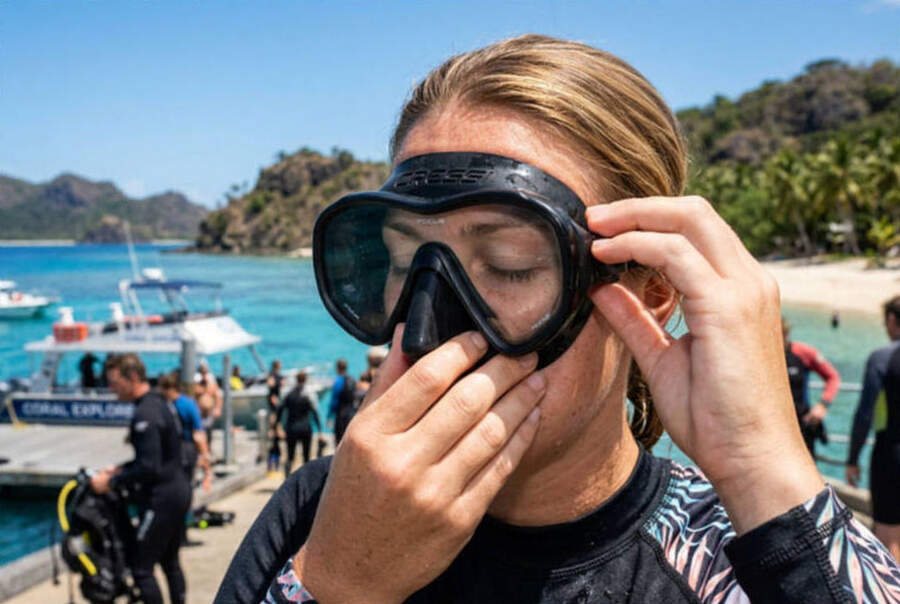
The no-strap test separates a fitting mask from one that will flood you all day.
Press the mask against your face without touching the strap, inhale gently through your nose, and let go.
If it stays in place under gentle suction, the silicone skirt is sealing against your face.
If it drops, try a different size or shape before putting money down.
The strap is not a clamp.
Overtightening pushes the skirt frame into your face and breaks the seal it was trying to create.
Once the mask passes the no-strap test, adjust the strap so the mask sits snug without pulling.
If you tighten it and the mask leaks more, you're moving in the wrong direction.
One more thing: a single hair crossing the silicone skirt will funnel water in regardless of fit.
Pull hair back, run a finger around the skirt before you enter, and re-check if the mask floods unexpectedly.
"The tighter the strap, the more likely the mask will leak."
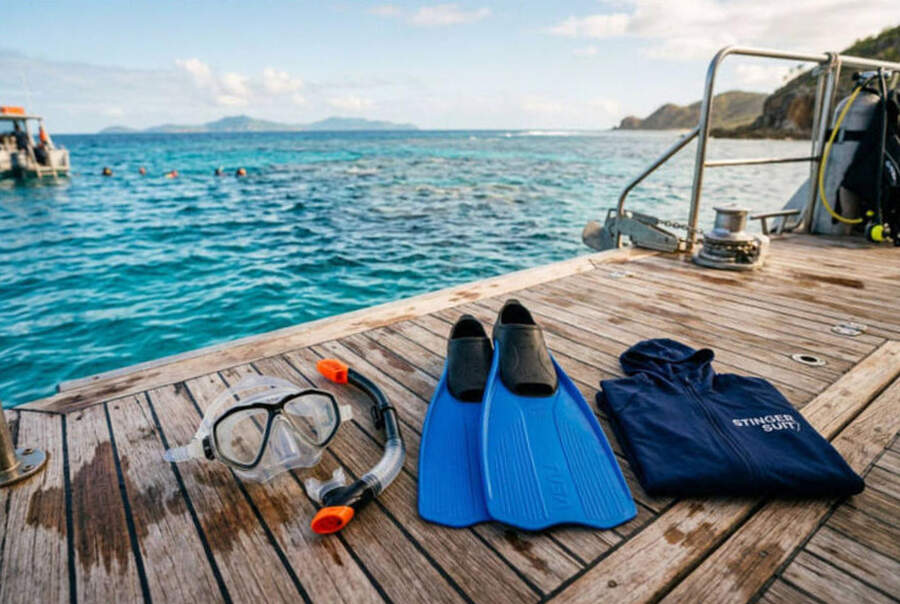 Choosing your snorkel
Three snorkel types cover the range from flat-calm tropical days to choppy conditions:
Wet snorkels are J-shaped tubes, nothing more.
They flood when submerged, drain when you surface and blow clear, and are the lightest option in the water.
Experienced snorkellers often prefer them for duck-diving because there is no valve to bypass.
Semi-dry snorkels carry a splash guard at the top and a purge valve at the mouthpiece.
The splash guard deflects surface chop and slows water entry in small waves.
The purge valve at the bottom lets you clear the tube with a small exhale rather than a full blast - easier when you're tired.
This is the best general choice for reef snorkelling in variable conditions.
Dry snorkels have a float valve that seals the tube when submerged.
They are excellent for surface-only snorkelling - the tube stays clear even in choppy water.
The float mechanism adds drag when you duck-dive and can be slow to clear on ascent, so they don't suit snorkellers who want to go under.
For a first trip to the Great Barrier Reef, a semi-dry is the practical choice.
For minke whale or manta encounters where you'll duck-dive repeatedly, consider a wet snorkel.
Fins: heel vs open-foot
Open-heel fins worn with booties are common in diving but awkward for reef snorkelling - they're heavier and the booties add bulk.
Full-foot fins in a medium blade length are the standard reef option.
Sizing runs snug: the foot pocket should grip without pinching on land - in water, neoprene expands slightly so a loose fit becomes sloppy.
Blade length matters for conditions.
Short blades (under 60 centimetres) are manoeuvrable in tight reef channels but require faster kicks.
Mid-length blades are the most efficient in open reef water with low current.
Long blades (freediving style, 70 centimetres-plus) are efficient for covering distance but impractical around coral.
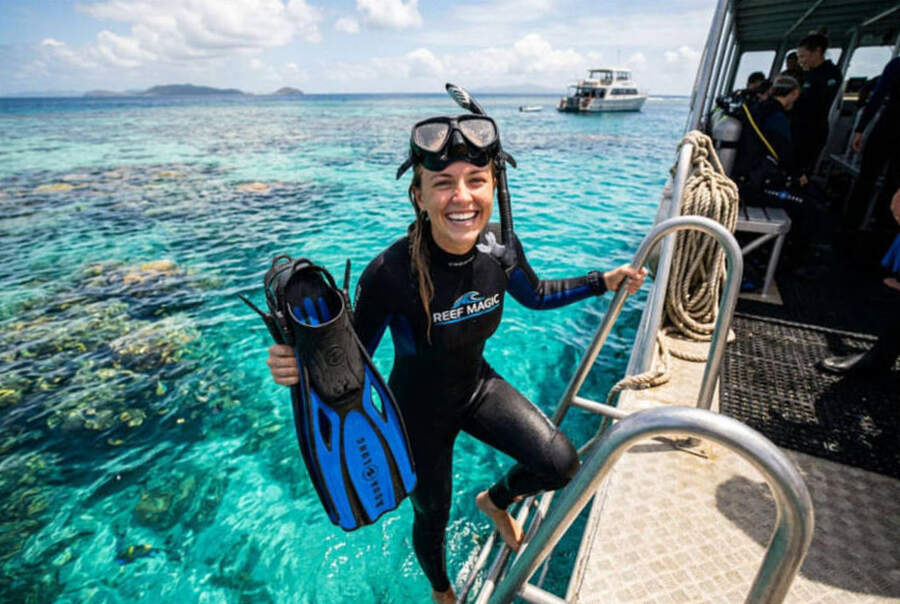 Positioning in the water
How you hold your body underwater determines how much energy you spend and how much coral you disturb.
Snorkel position: when you look straight down, the snorkel tube should sit vertical.
If it angles backward, the tip dips toward the water and every small wave sends water down the tube.
Adjust the snorkel angle at the mouthpiece clip so vertical is your default position.
Kick height: keep fins below the waterline at all times.
A fin breaking the surface on each stroke creates drag, slows you down, and - at the reef - risks kicking sand or rubble onto coral.
Slow, deep kicks from the hip generate more thrust and keep the fin submerged.
Current and entry direction: assess the drift before you enter by watching debris or foam on the surface.
Swim into the current at the start, when you're fresh, and return with it when tired.
Don't fight current back to the boat - signal for a pickup and let the crew come to you.
Two clearing techniques
Every snorkeller should own two clearing moves before they reach the reef.
Clearing the snorkel: exhale sharply through the tube - a short blast rather than a slow puff.
The air column pushes water out through the top opening or through the purge valve.
One firm exhale is usually enough; two means the tube re-flooded immediately, which points to positioning rather than technique.
Clearing the mask: tilt your head back slightly, place two fingers on the top of the frame, and exhale steadily through your nose.
The air bubble forms at the top and pushes water down and out the bottom seal.
Keep exhaling until the mask clears.
Don't press the bottom of the mask - it breaks the seal and floods everything again.
Practice both in knee-deep water before swimming away from the boat.
Two minutes of practice means you can fix problems calmly at the reef instead of panicking 200 metres from the ladder.
Reading reef conditions before entry
Reef snorkelling in Australia spans a huge range of conditions, from flat tropical days on the GBR to persistent surge on Sydney's ocean pools and east-facing Victorian beaches.
Visibility: check what's stirring the water.
Swell hitting shallow reef kicks sand into the water column and cuts visibility to a few metres.
At the outer reef, this clears quickly - at inshore sites with a sandy bottom, it can take hours.
Surge: in and out surge on shallow reef systems is manageable but demands energy.
Work with it - swim during the outward pull on the reef, pause during the inward push, and you'll cover ground without fighting.
Surge that's strong enough to move you off your feet in waist-deep water is a signal to wait for smaller swell or move to a sheltered site.
Current: tidal current at reef passages and channels can run fast without being visible from the surface.
Floating debris and watching other snorkellers from the boat is the easiest way to read it before entry.
GBR reef rules for snorkellers
The Great Barrier Reef Marine Park Authority sets responsible practice guidelines that apply to all reef visitors.
No touching coral - even contact that seems harmless transfers oils and disrupts the mucus layer that protects coral from disease.
No standing on reef - even sandy-looking patches near coral structures often contain fragile growth.
No chasing or crowding marine life - fish, rays, turtles, and sharks are easily stressed and will leave the area.
Anchoring in sand or rubble, not on coral - applies to boats, not snorkellers, but worth knowing if you're on a private vessel.
A shorty wetsuit or lycra stinger suit is practical on the GBR from October through May, and on some sites year-round.
In winter (June-August), a 3mm wetsuit keeps you comfortable in the Coral Sea's 22-24 degree water for sessions over an hour.
Snorkel with a buddy.
In Australia, there is no legal requirement to snorkel with a partner, but operator safety briefs always recommend it, and the logic is sound: a mask flood or cramp is manageable with someone close by and a serious problem without anyone nearby.
Before your next session
Four things to check before you hit the water:
Does your mask pass the no-strap test on your face today - humidity, sunscreen, and weight changes all affect seal.
Is your snorkel positioned vertical when you're looking down.
Have you practised a mask clear and snorkel blast in the shallows.
Have you watched the water for two minutes to read current direction and surge height.
Check current reef conditions and tides for your area at Seabreeze tides before heading out.
Frequently asked questions
Should I buy gear or rent it?
Rental masks are sized for average faces and often don't seal well on narrower or wider face shapes.
A fitted mask from a dive shop costs $60-150 AUD and solves most leaking problems permanently.
Rental fins and snorkels are usually fine for occasional trips.
Can I snorkel if I wear glasses?
Yes - prescription lenses can be bonded to the inside of a two-window mask, or you can wear daily-wear contact lenses.
Some divers use full-face masks with prescription inserts, though full-face masks are not recommended for duck-diving.
What about full-face snorkel masks?
Full-face masks provide a wide field of view and are comfortable for slow surface swimming.
They are not suitable for duck-diving, and several incidents have raised questions about CO2 buildup in extended sessions - if you're doing anything beyond slow surface snorkelling, use a traditional mask and snorkel.
How long can I snorkel before getting cold?
In Queensland GBR water (22-26 degrees Celsius), most people are comfortable for 60-90 minutes in a wetsuit or lycra suit.
In south-east Australian waters (14-18 degrees Celsius in winter), a 3mm or 5mm wetsuit is needed and cold becomes a factor after 45-60 minutes for most people.



 Cape Naturaliste, WA
