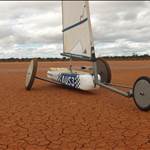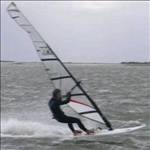


Is it just a coincidence that the kite, windsurf and sailing speed records are all so close ?
I understand physics says a non planing hull has a maximum speed through water equal to something like 1/ square root 2 x hull length in feet = knots (easy approximation)
Is there something in either the wind, the water, the venues or the sailors that will keep kite / windsurf / sail speeds all similar ? or is it just coincidence at the moment.
Is there some formula that limits teh ability to generate speed through sailing in air / some point at which drag exceeds lift ??
do you wonder what speed you could do with a bigger rig on Lake Titicaca, rather than down at sea level
If you took your kite out at Lennox Head the other week you may have set a new record
Its to do with the viscosity of water.
I will use an analogy:
If you try to cook some noodles at the top of Mt Everest you'll find you'll have to cook them longer as the water will boil at a temperature lower than 100*C lets say 80. If you try to cook them at the bottom of a deep mine they'll boil at above 100*C, say 110. Pressure and temperature are directly proportional. Raise one, so will the other.
As you approach the mythical 50kn the fin is splitting the water at such a rate that the low pressure side of the foil is low enough to boil the water at its ambient temp. The formation of air bubbles results in cavitation. Which is not good for speed records. Foils are getting very efficient, but they still require a high and low pressure side which will ultimately result in the same outcome given a high enough velocity.
Obviously water temperature, composition and other factors play a role. But I am led to believe that this limit, enforced by the physical properties of water itself is somewhere around 50kn.
I think kiters have the outright record at the moment. The fact that they can skim across the water rather than sail through it may help their cause. Which is also why they have been classed differently and do not hold the 'sailing' related speed records. ha.ha.
But surely a boat hull, a windsurf board and a kiteboard have very different sizes, weights and different fin size ratios, hull lengths etc. but they still have very similar speed records.
Perhaps there is a golden formula for these ratios and the absolute size doesn't matter as much as the ratio, and everybody has found that ratio ?
The land speed record is very different at 110 knots. I guess this could imply what you said and that what stopping water records is not sail design but hull design.
So would it be possible (and valid) to put a hull in a channel of water, accelerate the water flow and measure the force required to hold the hull in the same place ? Would this replicate sailing and would a graph of the force vs water flow therefore be exponential tending toward somewhere around 50 knots ?
But - would this imply it is impossible to accelerate a finned planning hull over the maximum graph speed, 'cause I would have thought that a great big engine could push a finned windsurf hull greater than 50 knots, or is that just a ignoramouses assumption ?
What about a foil like Lairds towboards, would the foil blade create to much drag?
Laird's foil boards probably use a typical wing section which is the most efficient lifting surface for speeds below cavitation inception. Check out the sailing Moths that use hydrofoils, its exactly the same concept. They minimise drag by getting the hull out of the water. So the only drag is from the foil and the struts/rudder/centreboard.
They are good up till cavitation, then a different type of section is required. Supercavitating foils look like a thin isosceles triangle, very sharp at the nose with a thick square cut tail.
I've read a little on supercavitating torpedos its pretty interesting.
whatthe how does the French boat L'Hydroptere get to 61kn does it have those cavitating fins?
So I think that answers my question
The reason why the kitesurf, sail and windsurf speed records are simialr at present is because it takes a non-linear amount of power to exceed some speed around 50 knots due to cavitation drag of the fin which is required to produce forward movement.
Thus, whilst not impossible to go faster, it becomes signifcantly harder to exceed this speed.
Don't know if it is right, but it makes sense to me as it is a similar idea to non-planing hulls, where a speed over 1/root2 x hull length is disproportionally harder due to having to overcome the bow wave. Possible (need a planing hull) but comparatively much harder.
So - what are the options other than supercavitating fins ?
Just going straight downwind ? Whatever your sailing I guess you would need some balls for this and technically I suppose it wouldn't be classed as sailing, more like horizontal parachuting.
A two stage system, one to get to 50 knot and one to get over 50 knot ?