

Both The Age and SMH were running this story and now it's been censored... why?
Can anyone find a cache?
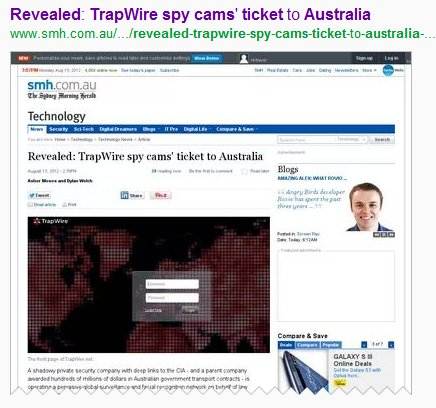
Original links:www.theage.com.au/technology/technology-news/revealed-trapwire-spy-cams-ticket-to-australia-20120813-2448z.htmlhttp://www.smh.com.au/technology/technology-news/revealed-trapwire-spy-cams-ticket-to-australia-20120813-2448z.html
maybe it wasn't censored - maybe the newspapers pulled there own story when they realised it was bullshxt. They get fooled all the time by taking something of the internet as fact and publishing it. Gets very embarrasing
It sounds like an awesome system (if it's real, because it also looks like a 14 year old's fantasy based on everything they've learned from Hollywood).
Am I correct in thinking that it collates and analyses data, ie data mines huge swathes of data looking for (configured) patterns. The data is faces and number plates etcetera? How is this any different from normal security and surveillance work, except for the huge processing power?

A jet-skier who became stranded in Jamaica Bay easily breached JFK's security system by walking undetected through two runways and into a terminal.
Daniel Castillo of Queens swam to shore and then walked past motion sensors and closed-circuit cameras of the airport's state-of--the art Perimeter Intrusion Detection System.
The $100 million system is meant to safeguard against terrorists.
Sheesh it's so ironic, we have a real conspiracy theory happening and PM's off with the fairies.
btw if you go to wikileaks you can read all the emails that describe trapwire.
However - since the story broke on wikileaks a week or so ago, they have been under sustained attack to try to keep their site offline.
Pity the attackers (trapwire/abraxis/stratfor?) forgot about twitter etc, ie you can't stop a sieve by plugging one hole.
wallstreetwindow.com/julian-assange-wikileaks-media
Just in case,
Revealed: TrapWire spy cams' ticket to Australia
ASHER MOSES AND DYLAN WELCH
13 Aug, 2012 02:39 PM
A shadowy private security company with deep links to the CIA - and a parent company awarded hundreds of millions of dollars in Australian government transport contracts - is operating a pervasive global surveillance and facial recognition network on behalf of law enforcement.
Over the past few days the internet has been abuzz with revelations regarding TrapWire, an analytical system that integrates with surveillance cameras to capture photographs or video evidence of "suspicious activity".
TrapWire is owned by the multinational conglomerate, Cubic Corporation, which in 2010 signed a $370 million contract with the NSW Government to provide Sydney's electronic ticketing system for public transport, based on the London Oyster card system.
In April this year it was awarded a $65 million contract to provide services to CityRail and also runs the Brisbane "go card" system.
Fairfax is seeking comment from the government about whether there has been any consideration of bringing the TrapWire system here.
The TrapWire story began late last week, when emails from a private intelligence company, Stratfor - originally released as part of WikiLeaks's Global Intelligence Files in February - appeared online.
The emails and other documentation revealed TrapWire is installed in some of the western world's most sensitive locations - including the White House, 10 Downing Street, New Scotland Yard, the London Stock Exchange and five hundred locations in the New York subway system. Trapwire is also installed in many Las Vegas casinos.
An Australian single mother who online is an anti-surveillance state activist known as Asher Wolf is leading a campaign to expose the clandestine operation, which was created in the wake of the September 11 terrorist attacks and has been operating without public scrutiny for years.
Australia is leading the way in development of facial recognition technology and Australian government agencies have reacted enthusiastically to it.
The founder of TrapWire is 30-year Central Intelligence Agency veteran Richard Hollis Helms. Several of TrapWire's top managers are also former CIA officers. It is part of security company Abraxas Corporation, which reportedly holds sensitive and lucrative contracts involving activities such as creating fake identities for CIA officers.
In December 2010 Cubic Corporation bought Abraxas for $US124 million.
The aim of TrapWire is to prevent terrorist attacks by recognising suspicious patterns in activity. It forwards its reports to police departments across the US and law enforcement organisations such as FBI and US Department of Homeland Security.
Helms said in a 2005 interview that TrapWire "can collect information about people and vehicles that is more accurate than facial recognition, draw patterns, and do threat assessments of areas that may be under observation from terrorists."
In 2007 the company said that it analyses each aspect of a security incident and "compares it to all previously-collected reporting across the entire TrapWire network. Any patterns detected - links among individuals, vehicles, or activities - will be reported back to each affected facility."
In addition to analysing surveillance footage TrapWire also operates "see something say something" citizen reporting campaigns in Las Vegas, New York, Washington DC and Los Angeles and all reports received are collated in the TrapWire database, analysed by the company and forwarded to law enforcement.
While it appears that TrapWire does not operate in Australia, its parent company Cubic holds several large Commonwealth, NSW and Queensland government contracts. It operates in Australia as Cubic Transportation with offices in Sydney, Brisbane and Perth. In 2008 it also opened a defence subsidiary based in Queensland, Cubic Defence Australia, run by Mark Horn.
Cubic Defence Australia has won about $32 million in contracts with the Australian defence force, mainly providing combat simulation and training systems.
Comment is being sought from Cubic about the links between their work in Australia and TrapWire.
Ms Wolf, 32, whose father survived a Siberian gulag during World War II and grandmother at 15 had her thumb cut off by Soviet Union secret police, said she had personal motivations behind her campaigning for civil liberties.
"All Australians should be concerned about the outsourcing of Australian government (or military operations) to foreign-owned, private contractors with links to spy agencies," she said.
She said there were inherent conflicts of interest with profit-driven private contractors working in national security. Ms Wolf is also concerned about Australian law enforcement demands for telco data retention and a lack of adequate time for public consultations during the inquiry into national security legislation reforms.
"They're drowning in data and I don't believe it's helping national security, I believe it's making us more insecure because we don't know where to look at real threats," she said.
Ms Wolf, who has a three-year-old son, said "it was definitely more interesting to be scrolling through tweets on info-warfare than watching 3am infomercials while breastfeeding".
The online hacking collective Anonymous has also bought into the issue. They are trying to organise an event called "smash a cam Saturday", where they provide the internet addresses of US security cameras attached to the TrapWire network, and then provide instructions to supporters about how to hack them.
According to Cubic's 2011 annual report, its revenues in Australia have ballooned to $115 million in 2011, up from $39.9 million in 2009.
"The primary reasons for the increase in gross margins from services in 2011 were the improvement in margin and increase in service revenue related to our transportation business in the U.K and Australia as well as the gross margin from 2011 Abraxas sales since the acquisition in December 2010," the annual report reads.
A search on Cubic's websites reveals no information about Abraxas or TrapWire. The page on TrapWire's website outlining its executives and their links to the CIA has recently been removed.
On its website TrapWire says it was founded in 2004 to build and deploy counter-terrorism technologies "in the wake of the September 11th terrorist attacks". It seeks to prevent such attacks from occurring in the future and boasts on its website that its technology can "detect patterns of behavior indicative of pre-operational planning".
US authorities were criticised after the al Qaeda attacks of 2001 over failings in information sharing, and part of TrapWire's appeals appears to be that it is designed to make it easier to share information across a global surveillance network. Despite the pervasiveness of its monitoring, it states one of its advantages is that it does not share "sensitive of personally identifiable information".
The internal TrapWire emails were obtained by hackers when they broke into Stratfor Global Intelligence, which had a partnership deal with TrapWire which saw Stratfor earning an eight per cent finder's fee for any clients it referred to the Cubic company.
Separately, a Microsoft-powered police surveillance system is being installed in New York City that connects thousands of New York Police Department and private security cameras in the city, recording and archiving up to 30 days worth of footage at a time. Police can backtrack through the footage when investigating crimes. Microsoft plans to offer it up to other cities around the world.
Page:1234single page
© SMH
Share on
Facebook Tweet on
Twitter Email to
a friend
Just in case yr wondering, apparently the authors of the story found that it's not run by Cubic corporation as claimed - having trouble tracking back thru shell companies etc. So they pulled the story for that inaccuracy. Be interesting to see if an updated version appears.