

I understand how and why seabreees work, but a few questions i cant seem to find the answer is.
1. why does a seabreeze blow from the north east on the east coast, and the south west from the west coast?
2. Why doesnt it come from the south east in eastern australia, and why doesnt it com from the north west in western australia?
3. Which direction does a seabreeze come from in northern territory and south australia, and why?
I hope someone could share some light.
i was alwas under the idea that a seabreeze was called so as the breeze was blowing from the sea, the wind just blows more in cetain directions at different times of the year in different locations
Jarryd
has a lot to do with the coleus effect and which side of the continent you are on 
Hey hamburglar,
Being in the ACT, which direction does your seabreeze kick in.
I goooooogled your suggestion, came up with this.
www.erowid.org/experiences/exp.php?ID=23200
Thanks for educating me.
Lol
Kr
ummmmm sorry my mistake to much " tequila" i ment Coriolis effect ....didn't know the other existed
bloody google " hicup "
try Coriolis effect
and Eotvo effect you can't see breeze in the ACT you can only feel it
not only spirals horizontally but also vertically down the coast
coming home from work (nsw)have seen blowingWNW,then got to the beach
and a 25kn NEer is pumping
I'll have a stab..
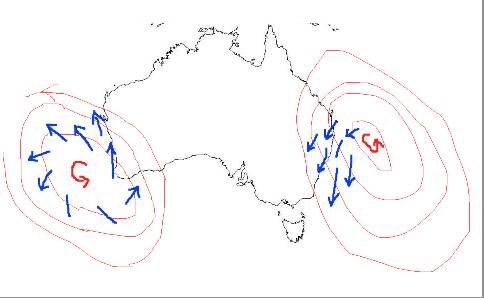
This is a seabreeze system for both Geraldton and Gerroa... Gerroa works off the back of the high, while Geraldton works off the front of a high.. The wind at ground level does not travel along the isobars (in Red), but outwards at an angle (blue).. Then the land heating up in summer does some funky updrafts, and you get cold air coming in from the sea to fill the void.. This is a seabreeze.. It's not just wind from the sea, it's a specific system..
It's the same basic system australia wide, but the eventual direction changes because the land is at a different angle..
-------------------
I heard on Totally Wild that bluebottles travel with their inflated sails, and after a few days of strong NE winds, all the bluebottles on a particular tack will get washed onto the coast.. Other Bluebottles on a different tack sail off in a different direction..
Whats with those crazy blue snail shells you see washed up with the blue bottles...?
Those things are crazy blue
interestingly (just my own observaions), here in SEQ, this following kind of synoptic seems to give us the greatest chance of a seabreeze - an inland trough heading towards the coast + a large distance between isobars over us + 30degrees-ish air temp or more. It doesn't seem to matter if there are low or high pressure systems influencing it

if we don't have a trough present, it doesn't seem to matter how hot it is, it never seems to blow hard
if we're lucky enough to get a tightly wrapped isobar pressure system that aids it, maybe it's just a bonus?
Straight from Seabreeze help section
Seabreezes...
Cold sinks, heat rises. It's the concept that makes hot air balloons work, and why your vegies are at the bottom of the fridge. During a summer day, the land is heated by the sun, and this heat is absorbed by the surrounding air. Once this air meets a particular temperature, it begins to rise quite rapidly. As a result, a low pressure area is created at ground level. The sea doesn't heat up as quickly as the land, so the air temperature over the water is much less. As a result, this air is free to move sideways to occupy our new low pressure area. The result is a light to gale force wind which rushes in from the sea to fill the lower pressure area left by the hot air rising from the land. Seabreezes usually happen in spring and summer, when the difference in temperature between land and sea is greatest.
Seabreezes are the most amazing phenonenom. For many years I never really paid much attention to the wind. One day, we arrived (late) at the local river to do some water skiing. It was around 1pm, the water was glassy - perfect conditions. Then, me mate Mick says "Here comes the seabreeze...". Looking across the river we could see an approaching line of rough water. And then it hit us full on - the full glory of a 25 knot seabreeze.
What's even more amazing is that the wind can be travelling faster than the front of the seabreeze. It can be progressing inland at 25 km/h, but the actual wind can be blowing at 35 km/h! Sometimes the seabreeze can reach many kilometers inland, and other days it teases you by staying just offshore, coming in, and then going out again.
So to get a seabreeze, it needs to be hot inland. But too hot and you won't get one at all. To explain why this is the case, we need to understand high's and low's and the squiqqly charts they show on the telly called 'Synoptic Charts'.