

Was out taday with a mate who was flying an '09 switch. He's a beginner, just at the point where his waterstarts are just about sorted, and on his first run of the day he drops the kite and accidentally manages to activate both the push away safety and the flagging line, which his leash was hooked into.
Unfortunately his chicken dick wasn't in which caused his chicken loop to fall off into the water never to be seen again. I don't own any Cabs but the few times I've flown them I've never had any problems and have found them as good as anything else I've ridden. Luckily he was just behind the break and was able to swim in with no problems.
There's an article in the current Kitesurf mag about the 2012 cab bar but it doesn't say whether the chicken loop still comes away from the bar and can be lost. Based on what happened today unless they have redesigned their IMO totally Fu*#ed safety system I wouldn't consider riding one let alone spending my hard earned cash on one.
Are you sure its 09?
I have a 6m switch and with the IDS system the chicken loop doesnt fall off.

Flexifoil had the same design in 08.
I kept a spare chicken loop behind the seat of the car incase i threw the safety 
Bad design
It's better to have a safety system that can completely release, even though there is a slight chance that you might lose your chicken loop.
The alternative systems release the end of the loop and it then has to slide through the hook. There is a slight chance of your fingers getting caught on the end of the release or the loop getting caught on the hook. This has happened in the past.
The example of the Cabrinha failure was not a design flaw, it was user error. The user had the system attached incorrectly, twice. He had the leash attached to the wrong point and he didn't have the chicken dick in place.
So he accidentally released BOTH safeties? Didn't have his dick in place and lost his chicken loop because he had his leash connected to the wrong place? Sounds like your mate needs some more lessons, definitely not product failure just a series of bad mistakes.
Title should be...
" Not mate bashing....."
And sign off with..." I bought him a lesson for Xmas/ suggested he read the manual/ took him aside and quietly explained how to use the safety"
Instead of Cab bashing.

The Cabrinha system has three releases if you ride hooked in or two for unhooked.
You have to release all of them to lose your chicken loop. How many attachments and quick releases do you want?
I feel the need to clarify a few things since my post seems to have been misunderstood.
Firstly my post was only partly about the loss of the chicken loop. The fact that you Can activate your final release IS a design flaw. Your final release should only be able to be activated by a deliberate act not by mistake as in this case.
As for the "he made a bunch of mistakes so it's his fault" attitude, that skips over the fact that if multiple things go wrong that still shouldn't result in the loss of the kite.
I'd hazard a guess that if I'd said that he was an advanced kiter that was going for an unhooked trick, droped the kite and then while in the process of hooking back in, activated both safeties, nobody would be screaming user error.
In case anybody still doesn't think this is a design flaw had he been hooked in "properly" it would have resulted in a loose kite close to shore. This wasnt much of a problem yesterday as it was a quite weekday but if it happened later in the day or on a weekend when we have
hundreds of cars parked on the beach or on any metro beach at anytime, think of what the worst case might have been and the tell me it isn't a Fu#*ed up design.
Lost chicken loop?
Easy solved!
Try this with other manufacturers :) And yes, I've got short hands:)
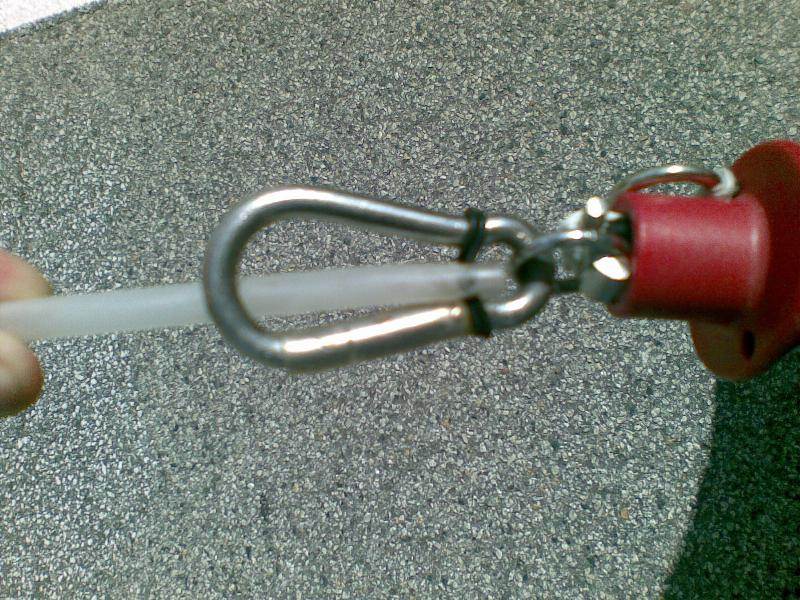
Cab provides the best bar on the market. Safest and user friendly as well as functional as a function. Little bit idiot proof too. Kiters bashing cabs are like car fanatics bashing porsche 911's. You know their awesome, You know you want one but you just cant afford it. Theyre a bit more expensive for a reason you know...
just a few small points:
1/ I dont Cab bash and as I said I've enjoyed the few sessions I've had on mates cabs.
2/ After what happened I don't think their awesome and dont want one, even though l could afford to replace my entire quiver tomorrow if I wanted to.
and 3/ my point still seems too have have been missed which is, for the third time is, you should only be able to activate your final safety BY A DELIBERATE ACT not by accident as happened.
It would be nice if people could get past the "stick the chicken dick in and you wont have a problem" bulls#*t and would address the real problem, which also happens to be the subject of this post, which is the accidental activation of the final safety! NOBODY so far has.
So you are saying the design flaw is in it's simplicity then? I'd say that is one of the greatest strengths on (almost) all kites, KISS. If I've just stuffed something up or pinged a pulley or line I want the quick releases as dumb as possible to give me the greatest chance of flagging the kite as quickly as possible, or worst case scenario dumping it completely, as quickly as possible. I'm more than happy with grabbing the bright red thing and pushing it away, I don't see any value in a QR being a two or three step process to avoid the odd accidental release.
One of my kites is an '09 Cab with IDS, I rig it with the leash onto the ring contrary to the instructions that came with the kite but I remember to put the donkey dick in. If/when I start riding unhooked on this particular kite I'll take my chances on losing the chicken loop if things go pear shaped and be grateful kite design and safety improved so much before I took up the sport.
IMO if you want to discuss bad design on QR systems question the Rotor System on the Core Sensor bar. Putting a recent recall aside it may well be a simple and reliable system but it's flaw is that it is different from every other kite. In a moment of sheer panic you will revert to your subconscious and not be thinking about how to release your QR, in simplistic terms it will just happen due to muscle memory once you make the decision to punch out and reach for the QR. But not if you have been flying kites for years with a push/pull QR and that is what your muscle memory reverts back to.
Ok I get your point now.
I have an 09 Cabrinha IDS.
The 09 Cab velcro on the chickenloop does have to be wrapped carefully to make sure that it will not release accidentally. Cabrinha do explain how to do that.
If you wrap it too loosely, there is a risk that it could release accidentally. With it being velcro, there is also the problem with wear and deterioration of the grip, or fine seaweed or such getting onto the velcro.
While its in good condition and wrapped right, it should work.
If mine deteriorates, I would just use a normal leash and leash directly to the IDS ring after tying a knot just above it to make sure the black ABS sheath on the IDS line will not catch on the Primary Q/R.
They improved the velcro a bit in 2010 or 2011 and then replaced it with a mechanical system for 2012. I never did like the velcro system but i couldn't win an argument that it wasn't functional if it was in good condition and used correctly.
As steve said. But this time with pictures
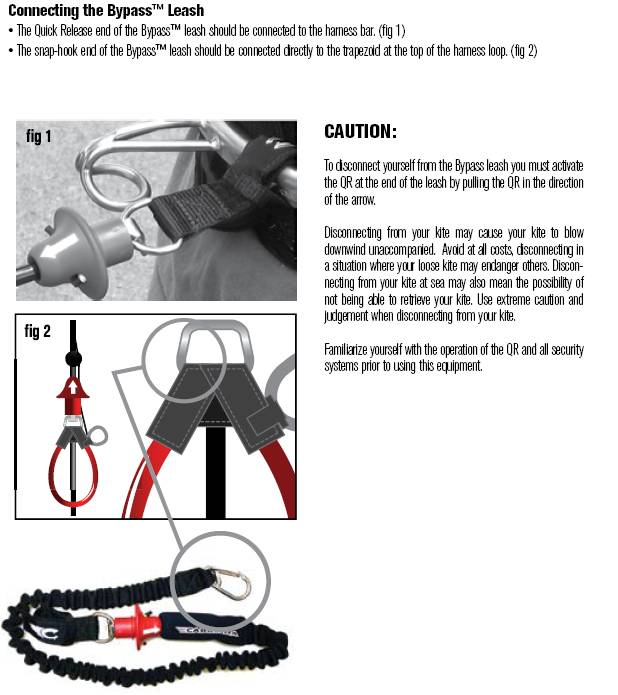
Rest of manual online.
I own the 09 switchblade and have never accidently triggered the kites in the 3 years i have owned it. when i have released the kite it was at my discretion, and not of the kites discretion.
KR
Shodan, what part of ' the leash was connected to the wrong place' are you struggling with? You are getting annoyed because your question is not being answered, when it clearly has been answered several times already.
Just to clarify Steve, I know I having my leash connected to the ring on the landing line is incorrect (but I then don't try and force the velcro around it). I know that's not how Cab intended it be set up but atleast I'm doing it differently and knowing it, rather than doing it wrong and not having a clue.
But that could start a whole new thread on people that think they know better... 
On that model bar, if strong tension comes on the IDS line suddenly the velcro securing system can release by itself, fully releasing the kite. You can grasp the IDS velcro strap system with one hand if the main safety release is deployed to prevent this happening.
Also note that clipping onto the ring on the IDS line (landing line) means you have a three stage release rather than a two stage one.
Further details: kitesurfing-handbook.peterskiteboarding.com/gear/safety-leash
The sequence to fully release the kite when you clip direct to the IDS ring is:
1. Deploy the main release - kite is then secured by IDS line (landing line)
2. Deploy the IDS velcro strap system - kite is then secured by safety leash connected to IDS line
3. Deploy the safety release on the safety leash - kite is completely released.
So doing this effectively turns the 2 stage release system (when safety is clipped to recommended Trapezoid leash attachment point) into a 3 stage system.
^^^Not really, I (and others) that clip onto the ring on the IDS line completely ignore the velcro, turns it back into a two stage release. Why bypass a safety release by clipping onto the ring only to re-engage it by then wrapping it in the velcro?
I'm personally not a big fan of the velcro release on my 2009 IDS, not because it releases prematurely (subject of the thread) but because if I've dumped the QR above the chicken loop and the kite is still loaded up how the heck am I going to reach the velcro on the IDS at the far end of a leash under tension? If I have to dump the kite completely I'm going to go for the QR on the leash and ignore the velco release anyway.
Obviously safety is a big thing, but (unless I'm missing something) why introduce safety releases that can't be reached?
I flew a mate's kite on the beach the other day, the wasn't much wind and we were killing time, it had little release tabs on the steering lines just above the bar and another release tab above the trim lines for the front lines, this is along with the chicken loop QR and the QR on the leash. Does anyone know what the value/intent of this is? Surely if you start releasing individual lines you risk throwing the kite into something uncontrollable and dangerous?