


Can someone please confirm that 200 amphr battery's will have the same lifespan as a 100 amphr battery?
I'm looking at some Cat 200 amphr battery's that have partial filled gel in them they are $980 each as to the 100amphr which are $220 each?
I hate electrics and am no good at sorting electric string, but even so I can't see why the life of a battery would vary with its capacity.
So I should buy two 100 amphr battery's and parallel them to make 200amphr and will cost me $440 rather than the $980 for the 200 and same lifespan? It's hard to get my head around that!
Select to expand quoteMorningBird said..
I hate electrics and am no good at sorting electric string, but even so I can't see why the life of a battery would vary with its capacity.
The life of a battery can be influenced by the demands placed on it, therefore it could be argued that a lower capacity battery is working harder than one of a higher capacity.
Maybe think along a different line. How good are the warranties on the respective batteries??
Most warranties are no more than one to two years I believe CISCO unless you can find better!
I bought two 105 amp hour AGM batteries in Feb 2010. They are still going strong. A 40 watt panel keeps them charged up. They don't get a hard life but have been run down below 50% on occasion.
Select to expand quotesouthace said..
Most warranties are no more than one to two years I believe CISCO unless you can find better!
Yes, that is what I am saying. Most times a more expensive so called marine battery will only have a one year warranty just the same as a cheaper truck and tractor battery.
I had Marshall (made by Exide) standard truck and tractor batteries with one year warranties in my charter yacht that were still quite healthy after five years because I looked after them well.
I have 3 x 120Ah batteries which run Fridge, Freezer, Auto helm, Navigation equipment etc. This is not enough to get me through a night with all running so I think I will be adding at least one more 120Ah.
If the 200Ah and the 100Ah are exactly the same spec other than capacity and if space and weight is not an issue then it is a no brainer that the 100Ah are the way to go.
I have just been through the same exersize and bought two 110 ah batteries for $370.00. Standard lead acid designed as a dual purpose cranking and deep cycle battery. Couldn't get 6 volt replacements of the same size as the old ones so went for 12 volt that are exactly the same size to fit the box.
my two cents
let me make up unprofessional guess
price is no related to quality, capacity, nothing electrical just the quantity of sales
Only problem with two smaller batteries is that for optimum life you should charge and discharge them separately. If they are in parallel then one is always trying to charge the other. This is nature, one leg is always shorter, one breast....
not true
very good to charge them parallel
even better discharged parallel
when there is No charge or discharge ....disconnect parallel
Parallel charging is advisable only when the batteries are all the same type, since charging characteristics varies by battery type and mixing battery types can result in undercharging or overcharging. In my case, I went with identical dual-purpose batteries for house and starter batteries so all can be charged simultaneously. Dual-purpose batteries also have the advantage of tolerating deep discharges that would wreck most pure starter batteries, and (I'm told) typically last longer as a result.
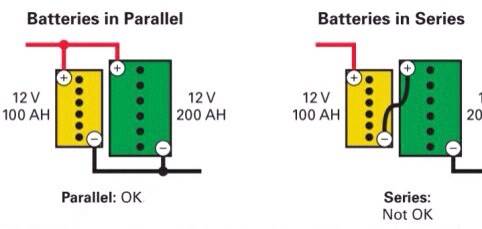
Yes there is no limitation charging batteries parallel, as long as they all have the same chemistry.
unequal capacity or the same capacity with unequal discharge ...does not matter at all
they all have the same voltage but different rate of charging,
smaller or less discharge batterys are top up faster and all available current goes larger bat.
They nicely equalise, because they both on equal voltage...there is no flow between them.
On discharge ....the same process.
Problem with losing the capacity starts, when all is switched off, but bat. are still interconnected.
..it is quite simple....isn't it.....