

Hi Guys,
Here a brief description of yesterday
I was returning from a single handed trip to Second Valley yesterday, after overnighting at Wirrina. The forecast I got in the morning showed a front mid afternoon with the winds changing from a light northerly to a strong southwesterly with winds rising to 30 knots in the evening.
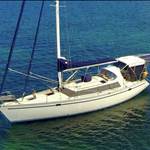
The first few hours, I had a 1-2 metre swell from the W-NW a northerly wind of 7-10 knots. I was motorsailing along, with my smallish gaff rigged main and club footed, non-furling jib pulled tight and stabilising the roll nicely. Life was rosy.
I was thinking that I might reef the main at the first sign of any change…... I got a sign. I could see increased swell ahead. Within a few seconds, WHAM! -We got hit by a big westerly gust on the beam which threatened to flatten the boat. I was at the pilothouse helm, and the wheel was closer then the mainsheet, so I used that to bring her around pointed into the wind. The wind was increasing, looking like over 40 knots with plenty of spray coming of the swell. I was sh**ting myself, as I tried to set the AP to hold into the gusting wind, allowing me to take a few steps to the cockpit to let out tension off the main and jib sheets. The old trusty Autohelm 4000 did the job, and I loosened the sheets a bit, so Otto didn't have to work as hard. A small sigh of relief. I then prepared to climb out on the foredeck as all running lines are controlled from the base of the mast.
Again - my butt was at a high pucker factor as I made my way around the pilothouse trusting my safety line to hold on to me should a large swell come over the bow. Luckily - no green water but plenty of spray. I was drenched almost immediately.
Looking at bedlam on the deck, with the sails flapping out of control and the club-footed boom swinging wildly, I began to have second thoughts. I released the jib halyard but it wasn't coming down without me hanging off it, and I wasn't game to go near the raging club foot. Then I looked at the main. Rather than trying to reef (or drop) the mainsail I decided to just scandalise the gaff, and get back to the helm before Otto decided this is too much to handle.
Back in the pilothouse, catching my breath, I could see the wind was dropping slightly. I tightened up the sheets a bit to reduce the flogging and wait things out, When down to about 25 knots I was confident enough to drop the sails without putting myself at too much risk
30 minutes after it all started, the wind was down to 10 knots again. It took another hour before I was game to raise them up, (yes - reefed this time). I made it safely home with no damage done, but plenty of lessons learned.
1. REEF EARLY!
2. Double check the weather (not sure if it was a late weather warning or if my phone didn't update, but a Stong Wind Warning was issued at some stage during the day).
3. Practice reefing procedures.
4. Investigate replacing club footed jib with roller reefed jib.
5. Investigate running gaff halyard to pilothouse to allow fast scandalising.
6. A dependable Autopilot is a wonderful thing when singlehanded
OK - Have at me. I am sure there are plenty of other things I should have done.
My new boAt has all the lines controlled from base of Mast also.not sure I like it. Makes single handled trickier. My old yacht had everything coming to cockpit
Easy as pie to do everything. Reefing alone was a sinch as all I had to do was release halyard from cockpit. Go to mast . Hook the reef, then back to cockpit. Love the winches on mast but in not sure if they're practical.
Select to expand quoteAusCan said...
OK - Have at me. I am sure there are plenty of other things I should have done.
There's no need for that. The whole time I was reading your story I was thinking one thing..
You know where you went wrong and you've thought about how to do it better next time. That's a bigger lesson then you'll learn here..
Happy sailing...
If possible turn and run with the weather much better to drop the jib and much better ride take your boat speed off the wind speed.
Maybe look into a furling headsail Operated from the wheelhouse.
Select to expand quoteChopesBro said...
Great story. ...I can only say two words for my biggest mistakes
Coral reefs
Been there, done that 
McN, Toph, - You guys are too nice.
Steve- All lines running the the cockpit are great to have, but not so easy to set up with a pilot house and a gaff rig. I need to think that through some more.
Southace - Very good point. Running with the wind was one of the options that ran ran through my head in a nano-second. But I looked starboard and saw land a few km off, so went port. Once I decided to go into the wind, I wasn't game to reverse my decision til things died down. Next time if I know there is a chance for a weather change, I'll chart a path which leaves room to deal with it.
You left your berth, you experienced strong winds, you re-entered your berth.
SUCCESS!!
I wish all my sailing days were like that.
Great topic - let's have more stories. There must be thousands of them out there.
regards,
allan
Select to expand quoteAusCan said..
1. REEF EARLY!
2. Double check the weather (not sure if it was a late weather warning or if my phone didn't update, but a Stong Wind Warning was issued at some stage during the day).
3. Practice reefing procedures.
4. Investigate replacing club footed jib with roller reefed jib.
5. Investigate running gaff halyard to pilothouse to allow fast scandalising.
6. A dependable Autopilot is a wonderful thing when singlehanded
Quick solution for the headsail would be to run a thin line up through each hank to the head of the sail. Turning block at the tack and have the line run back to where ever the halyard is. To drop the sail in these conditions let the halyard go and haul the jib down with the thinner line.
Scandalising the main will be OK but with a gaff it might be better to lower the lot and let the boat sit lying a hull with that large wheelhouse letting it weathercock or just slowly motor into it. Running before it will just keep you in the strong wind longer.
Always reef when you first think of it.
Ramona- I like your suggestion for the jib pull down line. That would have been handy.
My main concern with dropping the main during the chaos with everything flailing around was the fact that I don't have a boom topping lift, (so when I drop the main halyard, the boom drops (usually into a cradle in a controlled manner). In these conditions I was worried about the boom hammering the crap out of the pilothouse roof (or me). There was enough flailing already going on.
I could have tightened up the mainsheet and then dropped the main, but I was fairly sure the AP wouldn't be able to hold its line if I did that.
Gday AusCan,
Do you have adjustable Lazy Jacks?
I would of thought they were essential rigging on a gaff rig.
On my junk rig they are connected to the mast above the highest point the jaws of the gaff can go, to raise sail, you lift the boom out of the gallows with these adjustable Lazy Jacks, then haul away. You can then slacken the LJ's but still keeping them fast, making sure boom can swing above the gallows, & absolutely required on my rig, as the LJ's hold the sail bundle up when reefed(no reefing outhaul).
I did a bit of experimenting with a jib downhaul, & ended up with a simple system exactly as Ramona explained, except I don't go through the sail hanks as it created too much friction and was impossible to bring it down, I simply connected the line straight from the turning block to the second highest hank, works a treat.
cheers
Good story AusCan. I don't have topping lift, my boom sits on a removable pedestal I made that is on
top of the cabin. I'll need a rigger to install the lazy jacks I'm making, so he can install a topping lift too.
Fortunately I have a spare exit box on the mast. Your story illustrates the need for a boats set up to be
adequate and easy to use. I haven't quite got there yet.
Blue Moon - I've got lazy jacks, but they're fairly lightweight line. They wouldn't have lasted long if I would have cinched them up.
Well, I will put something out there about classic mistakes. I am still trying to get over this incident during a race a few weeks ago on Pittwater.
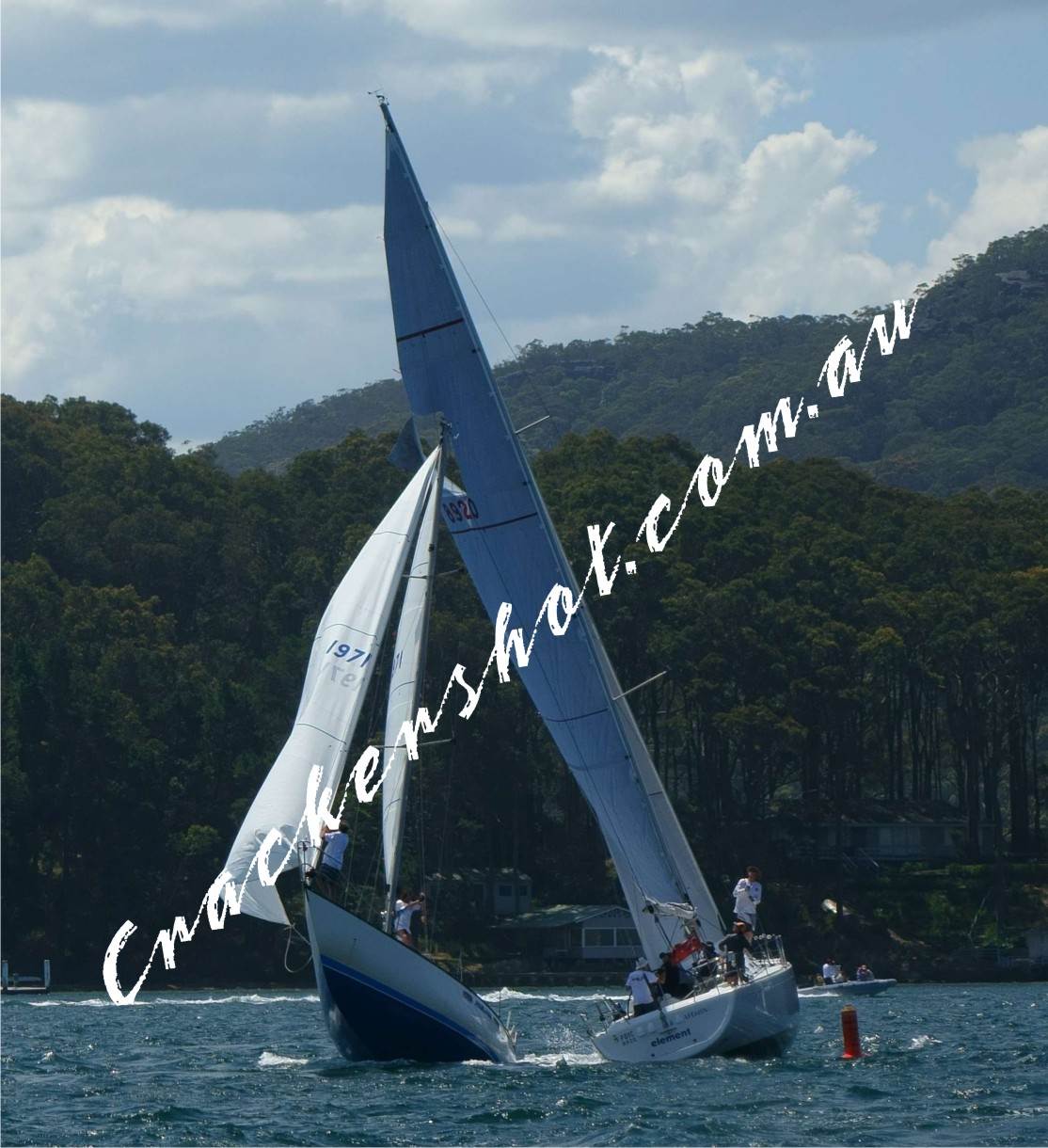
From the picture it looks like a classic Port/Starboard incident during a race, but it was a little more involved than that. That is the start mark to the right of the Beneteau 44.7, and I expected him to leave that mark to port, as we were starting the race. I was just sitting waiting for him to go, then take his stern.
At the time of the photo (taken from the start boat), the stern of the East Coast is underwater and the cockpit is full. She was then rolled onto starboard and towed about 200 metres before the Benny stopped.
Thankfully, no major damage to either boat and amazingly, no one was injured.
Eventually, I may blow the photo up and put it on a wall somewhere......
Noel
Select to expand quoteEC31 said..
Well, I will put something out there about classic mistakes. I am still trying to get over this incident during a race a few weeks ago on Pittwater.
From the picture it looks like a classic Port/Starboard incident during a race, but it was a little more involved than that. That is the start mark to the right of the Beneteau 44.7, and I expected him to leave that mark to port, as we were starting the race. I was just sitting waiting for him to go, then take his stern.
At the time of the photo (taken from the start boat), the stern of the East Coast is underwater and the cockpit is full. She was then rolled onto starboard and towed about 200 metres before the Benny stopped.
Thankfully, no major damage to either boat and amazingly, no one was injured.
Eventually, I may blow the photo up and put it on a wall somewhere......
Noel
A good summary of my experience of racing sailors!
Hi EC31, i,m sure you are sick of these questions , but they must be asked .
wind change after they set the line ??
no major damage ......... ?? weird stress on rig right down to the chain plates !!
why didn't he tack across the line ??? did you ask that question ?
did you or he try to avoid the collision ??
was there any protest lodged ?
has your heart rate gone back to normal ?
...................
i know , so many questions , .........................
Its always handy to have a story to tell in the bar at the sailing club, and because we go out adventuring instead of staying home watching tv we create the stories. So Auscan, you did a good job, I enjoyed your story and learned from it! My favourite disaster story is how our boat got wedged under a bridge with tide at full tilt, but its so embarrassing I dont like to mention it. Entertained the locals though. Caused by the forehand calling out "she'll fit, she'll fit, its ok .... then "we wont fit we wont fit go back goooo back!!!.. " but too late  Hard astern couldn't beat the tide and we got carried right into a nice jam. We could of course have checked clearance earlier with a chart.
Theres a good saying though, from a girl sailor "The art of the sailor is to leave nothing to chance." -Annie Van De Wiele and thats got truth in it.
SandS,
The line was poorly set from 5 minutes, so not a late change. We missed the pin because of a head sail sheet that snagged a boom winch, so went out and around to start.
I asked why he didn't tack, he said there was a boat behind him. I can't see any in the photo, and I was on port to take his stern.
He thought he was going to hit the mark, so beared off to go around. Except he didn't know I was there. He hasn't let off his main (as the photo shows, the boom is still on the centre line), so the boat heeled over and punched the main sail down onto my mast. Which explains why we didn't take out his headsail or rigging. Just snagged his boom bag halyard. He didn't admit to not seeing me, but look where he is standing, and looking.....
He didn't protest, and neither did I. Being Port/Starboard, I was in no position to do so. I guess he didn't because he knew he hadn't given me room and opportunity to avoid him. His damage is under 5K. Still waiting on a rigging report for mine, but appears to be only a bent furler track and a couple of bits at the top of the mast. I would think the forestay will require replacing. May cost me a bit more, but the boat is still floating and the crew are still talking to me.
Excellent explanation EC31. A bit of bad luck, and some good. His lookout probably needs some extra training.
EC31 well, good that there were no injuries. As he took your wind your mast may have sat up more vertical as well .
i recon he should have tacked around the mark , 1 ... to start the race 2.. to avoid collision
to alter course and come off the breeze and create a collision scenario does not give him starboard rights .
There still should have been a protest. Even if it's the starting boat crew protesting about the competitors involved not protesting!
Select to expand quoteSo, I'm entering Port Phillip Heads with a gusty following wind and steep waves (maybe 3m) against a strong ebb (had a senior moment & misread slack water time).
<div>
<div>I'm my fin keel, wheel steered, Catalina 34, under engine with no sails up.
<div>
<div>Each following wave throws my stern to port trying to force me into a broach down the face of the wave, which I have to rapidly correct by turning the wheel to port.
<div>As the wave passes under me, I now have to rapidly correct the other way so I don't broach to starboard at the bottom of the wave.
<div>The rudder transmits significant forces through to the wheel.
<div>Handling the situation requires absolute concentration correcting and re-correcting to maintain control of the boat.
<div>After about 15 mins I reached less turbulent water and the drama was over.
<div>So, let's have suggestions how I could have handled it better.
<div>regards,
<div>Alllan
An auto pilot that acts directly to the steering quadrant is the easy answer. When I had to cross my local bar in unpleasant conditions in my fishing vessel I always used the pilot. Reaction time is faster than a helmsman.
Select to expand quoteDatawiz said..
So, I'm entering Port Phillip Heads with a gusty following wind and steep waves (maybe 3m) against a strong ebb (had a senior moment & misread slack water time).
<div>
<div>I'm my fin keel, wheel steered, Catalina 34, under engine with no sails up.
a bit of head-sail out to give you some drive from the bow ... works a treat
and as you know , cant afford to miss read slack-water time there.....
Select to expand quoteRamona said..
An auto pilot that acts directly to the steering quadrant is the easy answer. When I had to cross my local bar in unpleasant conditions in my fishing vessel I always used the pilot. Reaction time is faster than a helmsman.
Thanks Ramona,
The Raymarine ST4000+ Autopilot (drives the wheel via a stepper motor & gearbox) wouldn't have been able to handle the load on the wheel imposed by the rudder. The actual load on the wheel was significant - I certainly couldnt have steered with one hand (a Police boat stood off a couple of hundred metres watching, but I was so busy on the wheel I couldn't take a hand off it to signal l was OK)
Either the stepper motor would have stalled or the plastic gears in the planetary gearbox would have stripped - I've since had stripped gears as a result of less trying conditions. Even if it could have handled the situation, I doubt it would have applied enough correction to keep the stern under control. I had to haul the rudder (via the wheel) through about 40 degrees to keep the boat under control.
Overall, this Autopilot design is too lightweight for heavy conditions.
I take your point about the autopilot on the fishing boat and suspect that the mass of the fishing boat would contribute to a slower and more stable "yawing" (for want of a better word) condition.
The Catalina is around 5 tonne, so quite light really. As a result, the stern was being thrown about quite quickly.
I welcome any more thoughts on this.
regards,
Allan
Select to expand quoteDatawiz said..
So, I'm entering Port Phillip Heads with a gusty following wind and steep waves (maybe 3m) against a strong ebb (had a senior moment & misread slack water time).
<div>
<div>I'm my fin keel, wheel steered, Catalina 34, under engine with no sails up.
Catalina 34 should track very well and if it was tiller steered rather than wheel I don't think you would have had as much drama. My personal belief is that wheel steering has no place on yachts less than 40 ft in length. A Peterson 42 I previously owned had tiller steering which was perfect. The machismo fool that bought it from me HAD to put wheel steer on her.
Directly downwind and following seas can be a hairy situation, particularly in restricted waters like the Pinchgut.
If you run in at 90 degrees to the swell, you run the risk of a pitch pole if the seas are big and steep. If you can hold her under power alone at a slight angle off 90 degrees to one side or the other she should surf in well.
If the wind is say slightly on the stbd quarter and you have a moderate amount of jib poled out to port, you should be able to ride in heaving the rudder to port just to keep her out of the broach which will be assisted by the head sail tending to drag the bow to port.
You got it right anyway as you are here to tell the tale.
Glad to see in your avatar that you are wearing your life jacket!!!! 
What Ramona says about auto pilot rings true as long as it is directly to steering quadrant or tiller. Raymarine auto pilots that are belted to wheel steering get wet and will slip. That confuses the auto pilot no end.
It has to be a real auto pilot that acts directly on the quadrant. Check out the autopilots the Figaro racers use. I have the same situation here crossing the bar against the outgoing tide and I nearly always sail though but I'm not adverse to running the engine at the same time. With a tiller I have to brace my feet and use two hands to steer. The idea is to anticipate the movement and react with plenty of force to keep the vessel from broaching. Breaking waves at a bar travel at 17 knots which is faster than we travel in our lead mines. You need to keep the stern into the waves so they pass under you. With wheel steering I would think you would need a marker on the wheel mark the centre position. Procedure is the same though, just anticipate.