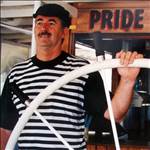


I just happened to be standing in my tender touching up the topsides when maritime turned up to do the mooring inspection and you guessed it I was politely informed that I need to wear a pfd when in the tender alone.
I thort that one was sorted out ? But apparently the exemption for safety equipment other than a tied on bailer doesn't extend to life jackets. Even if your tied alongside. Anyway I know better than to argue the point with a man in uniform ! So jackets are us.
Like they say.....A life jacket never spoiled a day on the water!.
But it's been a revelation for me Sailing in Qld coming from NSW, in Qld there is no requirement to carry Pfds even when sailing alone or in the tender alone, just a torch in the tender after dark from what I could make out.
Qld puts the responsibility back on the person, unlike the nanny state, I'm not saying Pfds aren't good, but sitting in your dinghy tied alongside....surely there needs to be some commonsense from the authorities.
I'm currently in qld trying to get back to Sydney when I get some northerlies and I also noticed I seem to be the only one wearing a PDF when I'm in the tender. For me it's just that's what I do coming from nsw. Each to their own I suppose.
Select to expand quoteBlueMoon said..
Like they say.....A life jacket never spoiled a day on the water!.
But it's been a revelation for me Sailing in Qld coming from NSW, in Qld there is no requirement to carry Pfds even when sailing alone or in the tender alone, just a torch in the tender after dark from what I could make out.
Qld puts the responsibility back on the person, unlike the nanny state, I'm not saying Pfds aren't good, but sitting in your dinghy tied alongside....surely there needs to be some commonsense from the authorities.
Common sense and bureaucrats just don't go hand in hand, surely you know that by now! 
Got me beat. The government is worried about being able to finance the ageing population, yet they are going out of their way to ensure we live longer. Maybe when we turn 50, we should get an exemption from all these laws that's protect us from mother nature culling out the idiots. And if we then survive till we're 100, then Mother Nature has given our gene line the thumbs up. 
Nice theory there Crusoe.
where abouts are you oldboyracer?
im currently in Bums Bay, looking like Tuesday for me to go south
Ask them why a rower in a single scull in the dark doesn't have to wear one, yet rowing a 10ft fiberglass dinghy you do!!!
Yep, if I'm sitting down in my tender rowing I need to wear a PFD but if I stand up and say it's a paddle board I don't need to wear one...?
Select to expand quoteBlueMoon said..
Like they say.....A life jacket never spoiled a day on the water!.
But it's been a revelation for me Sailing in Qld coming from NSW, in Qld there is no requirement to carry Pfds even when sailing alone or in the tender alone, just a torch in the tender after dark from what I could make out.
Qld puts the responsibility back on the person, unlike the nanny state, I'm not saying Pfds aren't good, but sitting in your dinghy tied alongside....surely there needs to be some commonsense from the authorities.
Commonsense was applied by the very polite BSO, it was just a reminder and as I said Pfds are me, a week before I was swinging 10m above the water no hard hat,no pfd,no high vize, no ground person with an angle grinder in hand, and no law being broken. But I'm sure I would of got their attention !
P?S did I mention just how close to shore I swing. Anyway just a heads up NSW is a PFD state ( unless your swimming of course )
Select to expand quoteBlueMoon said..
Like they say.....A life jacket never spoiled a day on the water!.
Actually they can.
Like when my wife got caught in the break zone off her kayak. She knows to go under breaking waves but the lifejacket kept her in the foam.
Or the time a really good Laser sailor couldn't swim fast enough to retrieve his capsized Laser (they go fast on their side in a blow) and had to be rescued by the rescue boat.
Or 40 years ago when I pulled my Flying Ant up from a capsize and the centreboard went between me and the jacket. Thankfully my crew wondered where I had gone as I was under the boat when it came up and couldn't get away from the board.
So for me I like an inflatable jacket that I would choose to inflate. I have never needed a jacket yet and they have caused me more hindrance than help. A long legged steamer wetsuit is far safer in my book - it gives flotation and you can swim fast and pull yourself up the sides of the boat without anything getting in the way.
And rowing with a lifejacket is a pain, that would be dangerous if you really needed to make it back to the boat in bad weather.
Yes lifejackets have made some of my days on the water worse, but I carry them, happily wear them racing dinghies and wear my inflatable offshore all the time. I hate the idea that I can swim ashore but rowing my tender I need a jacket - stupid rule.
Select to expand quoteBlueMoon said..
Nice theory there Crusoe.
where abouts are you oldboyracer?
im currently in Bums Bay, looking like Tuesday for me to go south
At Tin Can Bay , I'm single handed so I'm waiting for a few days of "right weather" to get to Scarborough . Looks good for Wednesday for me
Select to expand quoteoldboyracer said..BlueMoon said..
Nice theory there Crusoe.
where abouts are you oldboyracer?
im currently in Bums Bay, looking like Tuesday for me to go south
At Tin Can Bay , I'm single handed so I'm waiting for a few days of "right weather" to get to Scarborough . Looks good for Wednesday for me
I got held up for 10 days near TCB including being anchored there (Smooger point)during the tornado scare and 60 to 70 kts at the anchorage. Also single handed but Sailing in company with a couple of other single handlers since Shaw Is has been good fun. For a change of scenery you could head over to Carlo Creek and anchor in the 2 to 3m hole there, enter on high tide is best, lovely onshore atmosphere.....sunset over the water, $15 taxi fare to Rainbow Beach.
cheers
I don't think that those in Health & Safety legislation sit around trying to make up the most ridiculous and/or annoying rules. They have access to stats from Australia & overseas and try to balance an improvement in safety against practical considerations.
I'm afraid that just because one individual uses a chain saw wearing shorts, singlet & thongs doesn't mean it's a good idea.
I see quite a number of individuals who would struggle if in the water without a pfd. Maybe the boating officer should just tip em out of the tender and see how they do!
Splash out on a nice comfy pfd I say.
Imho of course.
Cheers to all
Bristol
I don't think that those in Health & Safety legislation sit around trying to make up the most ridiculous and/or annoying rules. They have access to stats from Australia & overseas and try to balance an improvement in safety against practical considerations.
I'm afraid that just because one individual uses a chain saw wearing shorts, singlet & thongs doesn't mean it's a good idea.
I see quite a number of individuals who would struggle if in the water without a pfd. Maybe the boating officer should just tip em out of the tender and see how they do!
Splash out on a nice comfy pfd I say.
Imho of course.
Cheers to all
Bristol
Hi all
Down here in Tassie I wear my Stormy inflatable vest/jacket all the time
Here is some interesting information from MAST on cold water immersion (it is worth watching the video)
Regards Don
"For nothing is pleasant that comes from compulsion!"
Despite the mantra quoted by Blue Moon above, which is being flogged to death recently by the authorities, it is exceedingly sad that some people just don't get the idea or resist it at their peril.
The recent tragedy at Cronulla comes to mind where if the septuagenarian, who lost his life there, was wearing a pfd, he would - probably - be still amongst us sipping his beer at the table.
Select to expand quotesirgallivant said..
"
The recent tragedy at Cronulla comes to mind where if the septuagenarian, who lost his life there, was wearing a pfd, he would - probably - be still amongst us sipping his beer at the table.
In Terry's case his wife had just purchased two new pdfs for the trip. They were aiming to enter Botany Bay when they ran into the reef. The young lady apparently jumped over one side and landed in waist deep water. Terry jumped over the other side and disappeared. They were not wearing the new pdfs.
Hindsight is wonderful but I think if I was closing the coast in the dark after 24 hours of crappy weather I would be wearing a jacket and tether.
Select to expand quoteRamona said..sirgallivant said..
"
The recent tragedy at Cronulla comes to mind where if the septuagenarian, who lost his life there, was wearing a pfd, he would - probably - be still amongst us sipping his beer at the table.
In Terry's case his wife had just purchased two new pdfs for the trip. They were aiming to enter Botany Bay when they ran into the reef. The young lady apparently jumped over one side and landed in waist deep water. Terry jumped over the other side and disappeared. They were not wearing the new pdfs.
Hindsight is wonderful but I think if I was closing the coast in the dark after 24 hours of crappy weather I would be wearing a jacket and tether.
I have said this on this forum before but i think it is worth repeating
MAST in Tasmania say that most deaths down here occur in good weather close to home where people have not bothered putting their PFD's whereas in bad weather people will normally have one on
A couple of years ago i slipped getting off the boat i crew on, on to the jetty and ended up in the water and dressed in my wet weather sailing gear it was hard work getting out of the water without any assistance
Regards Don
I manually inflate my pfd's annually to test them, but recently thought I really should properly testmyself as well asthe pfd. So I jumped in fully clothed in foul weather gear (boots and all) and set off my pfd. The pfd supported me very well, but what amazed me was the extreme difficulty in swimming more than a metre or two. Taking off the boots to allow a frog-kick helped a lot, but I realised that even in a 1 knot tide, I would probably be way out of reach of the dinghy and boat before I had time to react after falling in, let alone in significant waves. Boarding via the stern ladder took much more than the normal effort due to the many litres of water trapped in my clothing. Staying afloat without the pfd would have been very difficult.
I did my trial in flat 18C water, with no panic, no fatigue and no injuries: I love my pfd's even more now. I recommend this exercise to every boater or sailor.
Cheers, Graeme
Select to expand quotewongaga said..
I manually inflate my pfd's annually to test them, but recently thought I really should properly testmyself as well asthe pfd. So I jumped in fully clothed in foul weather gear (boots and all) and set off my pfd. The pfd supported me very well, but what amazed me was the extreme difficulty in swimming more than a metre or two. Taking off the boots to allow a frog-kick helped a lot, but I realised that even in a 1 knot tide, I would probably be way out of reach of the dinghy and boat before I had time to react after falling in, let alone in significant waves. Boarding via the stern ladder took much more than the normal effort due to the many litres of water trapped in my clothing. Staying afloat without the pfd would have been very difficult.
I did my trial in flat 18C water, with no panic, no fatigue and no injuries: I love my pfd's even more now. I recommend this exercise to every boater or sailor.
Cheers, Graeme
Real life drills are always useful, when I did my coxswains ticket we had to abandon ship off a trawler, fully clothed with a solas pfd and try to get into a liferaft. Before you go over the teacher tells you to swim to the liferaft entry and pull yourself as far under water as possible so you bounce up into the the liferaft. It was a bit of eye opener. Not one of us got in the first time and some took 3 tries. Of course in an emergency once the first one is in he can help the others which is good because I'm not sure I would bounce in quite so easily now as I did 20 years ago .
When I did my masters ticket we had to do the same except the inflatable was upside down and had to
be righted first.....now that takes a bit of effort.
Select to expand quoteWander66 said..wongaga said..
I manually inflate my pfd's annually to test them, but recently thought I really should properly testmyself as well asthe pfd. So I jumped in fully clothed in foul weather gear (boots and all) and set off my pfd. The pfd supported me very well, but what amazed me was the extreme difficulty in swimming more than a metre or two. Taking off the boots to allow a frog-kick helped a lot, but I realised that even in a 1 knot tide, I would probably be way out of reach of the dinghy and boat before I had time to react after falling in, let alone in significant waves. Boarding via the stern ladder took much more than the normal effort due to the many litres of water trapped in my clothing. Staying afloat without the pfd would have been very difficult.
I did my trial in flat 18C water, with no panic, no fatigue and no injuries: I love my pfd's even more now. I recommend this exercise to every boater or sailor.
Cheers, Graeme
Real life drills are always useful, when I did my coxswains ticket we had to abandon ship off a trawler, fully clothed with a solas pfd and try to get into a liferaft. Before you go over the teacher tells you to swim to the liferaft entry and pull yourself as far under water as possible so you bounce up into the the liferaft. It was a bit of eye opener. Not one of us got in the first time and some took 3 tries. Of course in an emergency once the first one is in he can help the others which is good because I'm not sure I would bounce in quite so easily now as I did 20 years ago .
When I did a Sea Safety & Survival course, we had to inflate our pfd's, jump into the heated swimming pool, swim to the life raft and get in.
Fisrt thing that became apparent was swimming was pretty well impossible let alone getting into the life raft when you're wearing an inflated pfd.
So if the s**t hits the fan, I'll not be inflating my pfd unless absolutely necessary.
regards,
allan
Select to expand quotesamsturdy said..
When I did my masters ticket we had to do the same except the inflatable was upside down and had to
be righted first.....now that takes a bit of effort.
yes that is hard work , we did that in our safety survival @ sea course . In a pool no wind . Imagine in a gale in a confused sea state
good chance the raft will end up upside down as well .
Well, Ramona, l don't have to be in bad weather or in a dangerous situation or crossing bars, when l sail on my own, l put the pfd on as a last move before l release the mooring line. All the time, every time. Period.
My tender is a kayak so l have to wear a pfd by law but l think it is just common sense.
Good seamanship is a dying art, less and less people l meet have a clue of basic requirements of prudent behaviour on water.
It is sad, but those people who declare their sea-knowledge the loudest and contemptuously list the different courses they have completed are the most blatant offenders of braking basic rules of seamanship and they act like superior beings just because of the stamp on a piece of paper they don't deserve in the first place. ( the members commenting on this subject are not the ones l mentioned above!)
It is just gravely disappointing
how ignorant some of our brethrens are.
Also, l must express my disappointment about the fact that not one of the contributors mentioned the undeniable importance of a crotch strap on a pfd without which even the most sophisticated pfd becomes useless. Cotch straps are not accessories.
NO PFD SHOULD BE SOLD WITHOUT A PERMANENTLY ATTACHED CROTCH STRAP!
Select to expand quoteWander66 said..
Real life drills are always useful, when I did my coxswains ticket we had to abandon ship off a trawler, fully clothed with a solas pfd and try to get into a liferaft.
When I did my exercise with Bundy Marine TAFE it was at Sandy Hook in June, ie, cold, wearing overalls and foam pfds.
First off they said we should bunch together arms around shoulders to preserve body heat.
Then they said if we peed it would warm the water up and we would feel better. We did.
Then they pulled the inverted liferaft to us which we all got into pretty quick smart.
Select to expand quoteBristolfashion said..
I don't think that those in Health & Safety legislation sit around trying to make up the most ridiculous and/or annoying rules. They have access to stats from Australia & overseas and try to balance an improvement in safety against practical considerations.
I'm afraid that just because one individual uses a chain saw wearing shorts, singlet & thongs doesn't mean it's a good idea.
I see quite a number of individuals who would struggle if in the water without a pfd. Maybe the boating officer should just tip em out of the tender and see how they do!
Splash out on a nice comfy pfd I say.
Imho of course.
Cheers to all
Bristol
That may be true, but nowdays if one incident happens, we're crying wolf. And where exactly are those statistics and if any how good they are?
The best preventative mesure would be not to do it at all. Stuff happens and we just have to accept that none of us is excempt from accidents.
But even if you wear an inflatable PFD, especially the one what most of us use - the manual type, you can fall into the water, hit your head on the way, gett knocked out and still drown, because you couldn't to deploy the vest.
And PFDs of the other type are buljy as hell. I've pulled out a 150N jacket the other day, the obne with the collar, good luck moving in it nd even better luck trying to wear it while sailing a smaller boat.
Lear how to swim properly, learn how to recover when your kayak capsizes and so on. Most people use the tender to ferry goods onboard from shore. And if you decide to take it, even in QLD into the blue, you must wear a life jacket crossing the bar.
The auto or manual debate is a never ending one as different circumstances require different solutions.
Both of my pfds with crotch straps and harnesses - a Baltic Race Edition for inshore use and a Secumar Pro 220 with a plb for offshore use - are auto and manual. The better quality auto wests come with a blanking plug, which renders the wests to manual by blocking the water's approach to the "firing pin" of the auto system.
Of course, despite all of those safety measures tragic accidents can happen - like having the west in manual mode and falling overboard, hitting one's head on the way - but as long as one is donning the west it is much more likely one is going to survive a mishap and there is no doubt about that.
Select to expand quoteSeebreasy73 said..Bristolfashion said..
I don't think that those in Health & Safety legislation sit around trying to make up the most ridiculous and/or annoying rules. They have access to stats from Australia & overseas and try to balance an improvement in safety against practical considerations.
I'm afraid that just because one individual uses a chain saw wearing shorts, singlet & thongs doesn't mean it's a good idea.
I see quite a number of individuals who would struggle if in the water without a pfd. Maybe the boating officer should just tip em out of the tender and see how they do!
Splash out on a nice comfy pfd I say.
Imho of course.
Cheers to all
Bristol
That may be true, but nowdays if one incident happens, we're crying wolf. And where exactly are those statistics and if any how good they are?
The best preventative mesure would be not to do it at all. Stuff happens and we just have to accept that none of us is excempt from accidents.
But even if you wear an inflatable PFD, especially the one what most of us use - the manual type, you can fall into the water, hit your head on the way, gett knocked out and still drown, because you couldn't to deploy the vest.
And PFDs of the other type are buljy as hell. I've pulled out a 150N jacket the other day, the obne with the collar, good luck moving in it nd even better luck trying to wear it while sailing a smaller boat.
Lear how to swim properly, learn how to recover when your kayak capsizes and so on. Most people use the tender to ferry goods onboard from shore. And if you decide to take it, even in QLD into the blue, you must wear a life jacket crossing the bar.
I really think it's a matter of horses for courses.
For example your comments above.
I wear a 150 auto every time I go out . It really is not that cumbersome especially up here where rarely do you require wet weather gear or even a jumper.
I sail solo a Sonata 20 footer (Small) nearly every week . A harness would be useless as the strop would have to be 6 inches long to prevent me falling overboard and if I did so it would be difficult pulling myself back up whilst being dragged along. I have no issue jumping around the boat ,setting a kite and dousing it or changing hanked headsails with it on and if I fell overboard would prefer for the jacket to self inflate and for me to set off the plb or phone home (VMR )if conscious. Stuff the boat I could buy another. I was a good swimmer and surfed every other day as a young bloke before leg straps were invented. I go the the gym twice a week ,have a 14 handicap golf and walk the course so am pretty fit but being 75 next month am also a realist.
It is hard to get a rule that suits all. I am still pretty strong and can clamber around and up my boat. I can still pull myself up the anchor chain and over the pretty high forebeam of my cat. As long as I am in boardies only.
The idea that a lifejacket always makes you safer doesn't work for me. As has been ample stated above, the wearing of boots and long trousers is very debilitating in the water. Personally I don't even own seaboots or long trousers and we have cruised to Tassie and lots up north. I like the idea of being mobile, of being able to pull myself back up my harness tether (I can hang on to the tether at about 10 knots boatspeed but I do lose my pants - undies too!). I like the idea of being able to pull myself up the stern of most boats with no assistance, I like being able to do a pretty quick 50 metres swim to get back to the dinghy if the anchor lets go when snorkelling. I always sail in bare feet.
There have been multiple cases of people being next to a boat and being unable to assist with getting themselves back on board - sometimes tragically. Lifejackets are very restrictive in allowing you to pull yourself back on board. Boots, trousers and jackets are pretty deadly too. Personally I like the idea of wearing shorts for as long as possible with bare feet, merino Tee shirt and loose jacket. (For many cruisers who don't sit on the rail staying dry is often easy). Then if I fall in I can get rid of the spray jacket. If I was in the dinghy I will swim, like I do at the beach, the reef, or the pool. If I am offshore I will be wearing my inflatable PFD but when I inflate it that means I can't swim anywhere near as effectively and I have gone from self rescuing to basically stationary. If colder I can wear my sharkskin kayak top.
I would prefer than decision to be mine. Only I can tell if I can pull myself back aboard, how fast I can swim and how strong I am feeling. Sometimes that initial spurt, together with low drag and a bit of fitness could get you back aboard and safe. An inflated ifejacket, spray jacket, boots and pants make you more passive and much less mobile. All the safety stuff we sometimes wear can stop us safely getting back onto the boat. I have done multiple kayak rescues and it is the fat guys with all the bells and whistles around them that have the most trouble keeping themselves safe after a capsize. The clutter catches on the boat, the deck lines and stops them getting back on. Then they often have a low power to weight ratio and sometimes can't physically pull themselves from the water onto the low deck of a kayak. Others take 2 seconds and do it in a flash. The person's fitness and ability in the water is a huge factor in being safe.
So for me, and this is personal because I am still fit and almost as strong as when I was 20, I don't like a self inflating jacket. I don't like rowing with a lifejacket. I don't want anything around my crotch when I wear the jacket. When I get less mobile I may change my mind but I am safer if I don't go full geriatric. The blanket rule makes me less safe in my tender.
Oh and as to the idea the bureaucrats knowing best, my brother was part author (with 40 years experience) of a submission that was backed up with data from surf lifesaving Australia that showed that lifejackets should not be mandatory when sailboarding in the surf. RMS agreed and so sailboarders were free to be able to dive deep away from immersed rigs. Then at a meeting of all Australian maritime authorities NSW caved in and went along with a blanket rule, including sailboarders in surf zones, because they wanted to have a uniform approach. So the experts were overruled in the interests of bureaucratic ease. We got a bad rule from people who don't sailboard. I think the dinghy rule is a bad rule from people who have never tried rowing in a big breeze with a life jacket on. I would be happy to go and get my Bronze medallion updated and show this instead - it would help me stay fit too.
cheers
Phil
Great post Phil.
I have one golden rule and that's when offshore at night, my crew MUST be in pfd's and tethered on. If I'm solo offshore, I always have a pfd on, and tethered at night. So whilst I'm a PFD/harness guy, I can't refute your logic and what you write makes perfect rational sense.
Fitness levels is a huge part of making that decision. If you're overweight and not match fit, you should wear a PFD all the time as you're not swimming or climbing anything anywhere anytime soon. But if you're fit, and you feel it could lessen your capability?
I saw Stacy Jackson, one of our legend Aussie sailors down the club the other day. Man that girl looks fit. So much so she wouldn't need to swim anywhere, she can probably sprint over water to the boat, stomp on the starboard toe rail with her right boot forcing a tack roll/gybe, whilst pulling the spinnaker round by the lazy sheet with her right hand, left hand is skull dragging the boom over by the vang, easing outhaul and cunningham with her left foot (you've more than one toe you pussy) respectively whilst letting the traveller run through her teeth biting down to jam it.
Before you ask, the tiller's fine unattended. By now it's too terrified of her to do anything but behave itself perfectly.
Ooops, am thread drifting again, sorry.
I just realised I write like I helm....ooops, not paying attention, correction, back on course, sorry......ooo look at the butterfly, drift again, oops, correction, back on course, sorry.....mmm is that girl on the beach actually nude??, drift again, bump bump, oops, tack, correction, back on course, sorry......
Select to expand quotesirgallivant said..
"For nothing is pleasant that comes from compulsion!"
Despite the mantra quoted by Blue Moon above, which is being flogged to death recently by the authorities, it is exceedingly sad that some people just don't get the idea or resist it at their peril.
The recent tragedy at Cronulla comes to mind where if the septuagenarian, who lost his life there, was wearing a pfd, he would - probably - be still amongst us sipping his beer at the table.
Some of us get the idea very well - I've done a fair amount of research on PFD use, including talking to the top guys at Surf Life Saving Australia and US Sailing, and checking out the enormous amount of information about the human capacity to assess risks.
The poor guy who died off Cronulla may well have died if he had a PFD on. Everyone knows (and SLSA agree) that being able to dive under breaking waves is critical, especially if there are rocks inshore. Arguably what would have saved a life in that situation is being fit and active enough to have spent lots of time bodysurfing and therefore have been able to get into the beach safety in large waves, as bodysurfers do all the time.
The issue is that dying due to not having a PFD on in a tender is extremely uncommon, and it is arguably illogical to worry about the issue much when there are far, far, far more common dangers that are normally ignored. Our chances of dying through lack of physical activity, for example, are vastly higher than our chances of dying through not wearing a PFD in our dinghy, especially when becoming fitter will not just reduce your chances of heart disease etc, but will mean that if you do fall out of your dinghy you can hop back in or swim ashore happily.
The problem that adding safety gear may turn people off a healthy activity is not one that can just be ignored, although RMS say they do ignore it. There is a lot of evidence that overall health in the Australian population may have been harmed by mandatory bicycle helmets, for example. Note that I'm not saying that the case is clear, but there is certainly a lot of evidence.
Similarly, the rate of death in ocean racing (to use one example) has skyrocketed since extra safety gear was put on the boats. That, along with much of the research into risk calculation, indicates that it's not a case of "not getting it", but of having done a hell of a lot of research that indicates that the issue is problematic.
The bizarre silliness of the issue is indicated by the fact that it's illegal for me to use my very stable RIB to get out to my boat, which I can board from the water, unless I'm wearing a PFD but it's perfectly legal for me to use a lilo or just swim out to a boat that I can't board from the water.
With respect to Bristol, yes many rules are brought in as a logical outcome of research - but not the PFD ones in NSW as far as I know. As Kankama noted I wrote a submission about windsurfing and PFD rules in NSW and it is apparent that RMS do NOT do research on this sort of stuff. Many of their factual claims were ridiculously wrong, ludicrous to make, and the thrust of their proposals would, as SLSC said, have killed people.
As just one example, RMS claimed that the number of people windsurfing in Australia has been increasing and therefore there were more people at risk. In fact, as a committee member of Windsurfing Australia and former president of the biggest windsurfer racing class I know (and confirmed through what remains of the industry) that numbers are down to about 5% of what they were.
That little example indicates that the people dreaming up these rules have not done the most basic of research. To make claims in an official proposal without doing reasonable research is basically nothing more than lying. It is ridiculous behaviour and such people deserve no respect as professionals. In that situation, nothing the RMS say about PFD use should be believed.