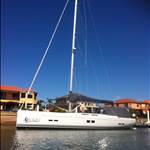


Hi all
Looking at replacing the spinnaker halyard on my Sailmaster (28 foot) and tossing up between 8 mm and 10 mm double braid
My mainsail and head sail halyards are 8 mm with dyneema core but i don't think this is needed for the spinnaker
Leaning towards the 8 mm but thought the 10 mm might be a bit easier on the hands
Any thoughts would be appreciated
Any
Hi Don,
I'd go the 10mm db. For the reason you've stated, easier on hands, if blocks and winches are all ok with it.
i would go the 10 mm double braid just for ease of handling I also like like something with a little stretch as it saves shredding the kite when you flog it a bit as the lower stretch ropes give greater impact loads
The kite halyard typically holds a lot more weight than a jib or main halyard. It's not just holding the set, unchanging tension between two points, it's holding a fair share of the extra weight generated by the wind filling the sail (typically the largest area sail you set on most yachts too). Not to mention shock loads when the kite flogs.
Check the SWL before you pick a size and make.
On my 28 l use 10mm db.
On an Adams 10.6 we broke the mast with a huuge assy and 10mm db sheets.

kites run nowhere near the loads that headsails or mains run on their halyards code zeros and assos generate much higher loads due to bringing the apparent so far forward and needing to be cut with less round necessitating much higher halyard tensions which is why if your running a zero you need dynema on a 2 to 1 halyard so as to halve the compression loads as that is what causes masts to fail . Kites when running or reaching don't generate any where near the load of the headsails remember the apparent wind is with you there by halving the force of the wind on the sail this is why you can carry so much more sail area off the breeze our zero which is 2/3 the area of our standard kite cant be carried in over 12 well forward where as our standard kite can carry through to 35 running
Select to expand quoteboty said...
kites run nowhere near the loads that headsails or mains run on their halyards code zeros and assos generate much higher loads due to bringing the apparent so far forward and needing to be cut with less round necessitating much higher halyard tensions which is why if your running a zero you need dynema on a 2 to 1 halyard so as to halve the compression loads as that is what causes masts to fail . Kites when running or reaching don't generate any where near the load of the headsails remember the apparent wind is with you there by halving the force of the wind on the sail this is why you can carry so much more sail area off the breeze our zero which is 2/3 the area of our standard kite cant be carried in over 12 well forward where as our standard kite can carry through to 35 running
We're talking about halyards here.
You're saying in one statement that kite halyards carry nowhere near the load a jib halyard carries, and then in the next statement you're talking about how much more load your assymetric kite carries?
We're more than likely talking about a cruiser here, not a TP52 or Wild Oats.
You seem a little confused about apparent wind. The more apparent wind generated, the less the load on the kite (and everything else for that matter). Chances are the yacht in question generates very little apparent wind, which means more load, on everything.
If you want to talk specifically about halyard loads, the foresail halyard and main halyard are carrying not much more load as is placed on them by the Cunningham/downhaul and vang. The weight the wind generates on the sail is being shared for the much larger part by the forestay, sheets and in the case of the main, the mast. The kite halyard, at it's attachment point to the kite on the other hand, must cope with a much larger percentage of the load placed on the sail by the wind. Don't underestimate how much load the wind places on everything it's far more than you would think, especially on what is generally the largest sail on the boat, the kite.
OP, sorry for the carry on. Most braided (and rated) ropes are fairly capable of carrying the high loads these days. All I'm saying is take the SWL and breaking strains into account as well before your purchase. Rope in the length and diameter you'll require isn't cheap. You want to make sure it's up to the task before you buy it.
On Arriba (38' cat) I use an 8mm spectra spinnaker halyard with no issues. The spinnaker sail area is a whopping 106 sq mtr, almost as big as the mail sail.
By comparison, my main halyard is 12 mm double braid poly.
YMMV!
Select to expand quotescruzin said..
On Arriba (38' cat) I use an 8mm spectra spinnaker halyard with no issues. The spinnaker sail area is a whopping 106 sq mtr, almost as big as the mail sail.
By comparison, my main halyard is 12 mm double braid poly.
YMMV!Select to expand quoteSubsonic said..boty said...
kites run nowhere near the loads that headsails or mains run on their halyards code zeros and assos generate much higher loads due to bringing the apparent so far forward and needing to be cut with less round necessitating much higher halyard tensions which is why if your running a zero you need dynema on a 2 to 1 halyard so as to halve the compression loads as that is what causes masts to fail . Kites when running or reaching don't generate any where near the load of the headsails remember the apparent wind is with you there by halving the force of the wind on the sail this is why you can carry so much more sail area off the breeze our zero which is 2/3 the area of our standard kite cant be carried in over 12 well forward where as our standard kite can carry through to 35 running
We're talking about halyards here.
You're saying in one statement that kite halyards carry nowhere near the load a jib halyard carries, and then in the next statement you're talking about how much more load your assymetric kite carries?
We're more than likely talking about a cruiser here, not a TP52 or Wild Oats.
You seem a little confused about apparent wind. The more apparent wind generated, the less the load on the kite (and everything else for that matter). Chances are the yacht in question generates very little apparent wind, which means more load, on everything.
If you want to talk specifically about halyard loads, the foresail halyard and main halyard are carrying not much more load as is placed on them by the Cunningham/downhaul and vang. The weight the wind generates on the sail is being shared for the much larger part by the forestay, sheets and in the case of the main, the mast. The kite halyard, at it's attachment point to the kite on the other hand, must cope with a much larger percentage of the load placed on the sail by the wind. Don't underestimate how much load the wind places on everything it's far more than you would think, especially on what is generally the largest sail on the boat, the kite.
OP, sorry for the carry on. Most braided (and rated) ropes are fairly capable of carrying the high loads these days. All I'm saying is take the SWL and breaking strains into account as well before your purchase. Rope in the length and diameter you'll require isn't cheap. You want to make sure it's up to the task before you buy it.
I'm with you Boty, you are spot on with your statement. My boat has twice the size clutches to hold the main and jib halyards compared to the spinnaker halyard. In fact we have had to fit Harken ceramic jaws at a cost of $1,200.00 a set to stop the main and jib slipping. I have had to winch the last 2m of plenty of spinnaker halyards under full load and I can tell you there is a lot less strain on the spinnaker halyard than on the jib or main halyards. I must say there are plenty of cruising boats running round with far too little tensions.
In lay mans terms apparent wind is the true wind force and angle on your sails and rigging. Hence when going to windward the apparent wind will be higher than true wind and running down wind the apparent wind will be less than true wind. If your apparent wind is going up it is still increasing pressure on the sails. The difference between True wind and apparent wind will very from boat to boat depending on the boats performance, but it is all still relative. I alway sail with my wind instruments set to apparent.