

im getting through the list of things to do on the boat that need doing.
recently got all new sheets, halyards and a 130AH battery.
Ive got enough money now to get a tiller pilot and a new 160W panel, but the rigging still has a big ? over it.
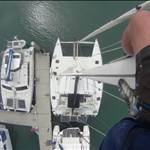
Part of me wants to get up the mast and see if i can do it myself, and possibly save quite a bit of $, but the other part is saying , "dont stuff around" and get a rigger up there to check it.
I know for sure theres an issue with at least 1 spreader that needs addressing and 1 swage on the backstay needs replacing.
Some say i should drop the mast , as i dont know the age of the rigging and when it was last done. To me it mostly looks fine.
I am worried that the costs will get blown right out if i pay riggers.
What do you people think?
Go up SS. A Bosuns chair and a mate grinding you up, and you need to be able to do it in emergencies anyway. Might as well try it now in controlled conditions.
Do one stay at a time your self remove it and have a new one made and refit it
When you can afford it do the next one and so on
Worse first
As long as you're mast head is ok and the sheaths fit
your halyards should be ok
I think my main halyard sheave has gone square. I'll get the boys from Rigtech to
fix it. They put my Lazyjack saddles and blocks on and rigged the lines much cheaper
than I thought.
Use some back up systems when going up the mast, 1 halyard hauling you up and a second halyard as back up. A short tether tieing you off when you stop to work etc. And test them at deck level first. A failure of one component that is hauling you up should not cause you to die.
I'd say that unless you get vertigo from heights, you' d be better off doing yourself in the long run, as you will then know you can do it if an emergency occurred, and you had to go up and fix something away from the comforts of having dockside services available, good luck. 
I think you guys are forgetting he is talking about ocean passages.
Boats cost money .
when you are 2 days from land in 50knts I would feel much safer knowing my rig is in good condition and serviced by someone who knows what they are doing.
Steve can you afford to replace the whole rigging mast and sails when it comes down? Because you will have troubles with insurance.
I have been on 3 boats when the mast has come down.
Good points all around. The youtube vids of the home made board with foot slots ( easy mast?) Is great. Id try this. At least ill go go up with easy mast system and in the bosuns chair with someone taking the dlavk on a winch. I can have a look and make a decision then. Replacing a norseman swage looks pretty simple which is one thing needs doing.
Norsman are no longer made if you didn't know
There are some terminal wedges / cones still available over seas
Europe top litch for metric
USA and UK for imperial getting harder
I gave up last year trying to find a full set
Cheapest way if you can't find the right size norsman cones is get a quote off a rigger every time you take a wire off the mast
A eye and lturnbuckle roughly depending on wire size
Work on $100 plus wire
Just so you've some idea
There's sta lok but it gets to expensive as you probably sell your boat before your next rigging
I do mine two wires at a time, I take off one of the lowers for example, compare it to the other side to see how much difference there is then take it to a rigging company to get them made. I support the mast with rope while it's missing one stay. Grab a mate to help while your up the mast to supply the bits you forgot. It helps if you can both hear well or it turns into a Benny Hill sketch. Lots of laughs but not a lot of work, come watch me next time lol
You brought new sheets and halyards before doing the standing rigging.
really.
you deserve to have to pay the rigger twice to pull the rig and do it properly.
Sorry
Get a quote from your local mooring contractor (one with a barge mounted crane), to help you drop the mast. Once down you can inspect and replace at your leisure. However it is still going to cost you $1000 to $2000 dollars. If you are sailing offshore, it is a must.
Dont understand?
Did you see the state of my main/jib halyards?
Riggings in way better nick and i did this on advice from a rigger so dont be quick to judgeSelect to expand quotelydia said...
You brought new sheets and halyards before doing the standing rigging.
really.
you deserve to have to pay the rigger twice to pull the rig and do it properly.
Sorry


I would drop the mast and do it thoroughly. Do it well, Do it once!
If you want the rig insured, you will likely need a riggers report, speak with your insurance company. On my last boat, Club Marine accepted the riggers invoice (which was pretty scant in detail) for new standing rigging as proof enough. Will a rigger sign off on your handy work? Contact a rigger and discuss what you can do to save some dosh (like lowering the rig, removing old shrouds/stays etc and taking them to the rigger to get new ones made up). Replace sheaves etc yourself.
I haven't done it myself, but did once watch 4 guys lower the mast on about a 27' yacht using an A frame. They used a professional looking aluminium A frame set up. It was all done in no time. Here's the method using a few 2x4's.
What I think,
make the board with the footholds to climb the mast, only make the board thicker under where your feet go, as all your weight is pressing on a 12mm wide (or so) timber - wider is easier on the feet, unless you have strong soles to the boots. You can add a bosun's chair and a person to help, but the foot board will give your feet something to hold on to up there.
On the rigging, yes, replace the running rigging first, as that will haul you up there and hold you there, and be the back-up safety lines, etc.
The main way to save money depends on the rigging size. For 5mm wire or less, you can bend it around an eye if it is 7x7 or 7x19 wire. 1x19 is too stiff for bending around an eye. After that you can put in turnbuckles.
For my lower stays I did it in 5mm galvanised wire, at about $3 per metre, plus a dollar or 3 for the eyes and the same for the swages. The turnbuckles (stainless M8 or M10) cost me about $30 each. You could use stainless 7x7 wire if you prefer, up to $5 per metre at these sizes.
A friend put me on to galvanised wire, saying how cheap it was and that it was commercially commonplace for cranes and lifts/hoists, so will suit yachts. It did so in the older days, before shininess was paramount. But it still works today. Maybe you replace it after 7 years instead of the ten or so for stainless rigging.
I've swaged 6mm wire and it was far, far harder than anything up to 5mm. I use a hand swage tool, Bunnings sell the ones that do 1,2,3,4 and 5mm for about $90. You don't need a hydraulic press or to hire one or to have a shop do it.
OTOH Miami Stainless sell 6mm swageless terminals for $34 www.miamistainless.com.au/general-hardware/swage-terminals/swageless-terminals/12x120mm-s7810r-0612120 as well as wire www.miamistainless.com.au/wire-rope/per-metre and every other fitting.
Last year my 5 outer stays for a 28' boat, cost about $1550 for the shop to do the lot, including replacing 5 sheaves and pins.
So it all depends on the wire size and the terminals you have on the mast if you want to DIY with eyes and swages, or DIY swageless fittings, or just budget the figures quoted if you delegate it all to a shop.
Steve Rigging is always a worry it might look fine but at the swag points is might have a hidden problem.
Old boy racer has the right idea to do it on a budget if you can afford it remove one stay and it it exact;y the same length on the opposite side. get a quote on two and one.
Down here in Vic there places that all they do is swag your new wires on and can supply turn buckles and eys or bring your own. Will be places up there the same .
I did not know you were Clark Kent!
There are several ways to approach this.
lets try the economic model first.
One broken halyard is worth $250 and the time to replace it while a dropped rig might be $20k And you don't have insurance cover about now.
now the engineering model
you don't know the age of the standing rigging but have not dye tested it yet it looks OK to you In the absence of x ray vision .
So in the absence of all data you tick it good Ignoring the life of the product.
now the seamanship model
a broken halyard means you can generally rig up a jury halyard even if it is the main halyard so the boat can still sail forward.
broken rig not so much.
you have already identified a spreader problem and a back stay defect.
Besides most rigs have a problem at the mast step these days that you will not fully see until it is lifted out.
Just bite the bullet and get it pulled out and then you know.
I am in the exact same position with most recent rebuild and as much as I want to avoid the cost and delay there is really one one answer.
If you are in Sydney, I can recommend Joe Walsh Rigging.
Joe and Sam did a lift out and replacement of standing and running rigging on my other boat two years ago and did superb work and right on the quote.
Thanks All for the tips and tricks!
ill only be bothering with 3rd party insurance if i can get it.
ive seen a video of a guy lowering a mast using his boom going from the base of mast to the forestay and connected to the forestay. uses the main sheet block to lower the mast aft - by himself. I may do this after ive been up the mast. Thankfully i can do this now with my new sheets and halyards.
Broken halyard worth 250? dont see how. Lydia you need to talk to me on simple terms mate cause ive no clue what youre talking about.
Im not spending 20k on a 5 k boat, but if all goes well and history repeats itself , ill graft away and turn her into a 12 k boat.
I paid about 150 for control lines and sheets. Theyre all good and waaaay better than what ive had for a year, so as far as im concerned im sweet for ropes. Theyre nice colours :)
The condition of the stays which are all 6.5mm are great actually. Theres only one thing ive noticed and that is a crack in a swage on 1 of the 2 backstays thats been repaired.
Im only going coastal cruising in a year however theres a great feeling of knowing your boat/bike/ car rather than taking it to someone to do and putting all trust in someone who probably couldnt give a **** about you.
Ive actually heard alot of stories about people having surveys/rig inspections and the riggers missing things. I guess some may not care as much. I care, so i think ill do what i can, look, learn, and then pay someone experienced to have a look - most likely in the yard when doing the antifoul
It certainly seems like its important to lower the mast and i think in the yard would be the place.
Ss, it the boat is a top hat the mast is deck stepped so there are any number of ways to drop the rig.
Even used a light pole at the end of a jetty one night to drop a rig and replace a main halyard.
i agree don,t just rely on a riig inspection.
But I would not expect any change out of $12k for a new top hat rig installed If you broke a mast.
Select to expand quotelydia said..
Ss, it the boat is a top hat the mast is deck stepped so there are any number of ways to drop the rig.
Even used a light pole at the end of a jetty one night to drop a rig and replace a main halyard.
i agree don,t just rely on a riig inspection.
But I would not expect any change out of $12k for a new top hat rig installed If you broke a mast.
Im not really understanding why youd need to drop the mast to replace halyards? i did all of them in 20 minutes with the rig up.
that easy climb system is greeeat. i love that, thanks to you. i will watch these videos but up here in bundanoon its a tad chilly. time to light the fire! bet its a bit chilly in greenwell point????
Steve,
Using the method shown in FreeRadical's video is straightforward with a Top Hat. It can be done singlehanded. Personally I think it safer to lower the mast on the mooring before going up the slip, rather than when you are already on the slip.
With a Top Hat you have to lift the mast out of its socket so the methods which involve using the boom and rotating the mast around a hinge at its base will not work.
It is much easier to free corroded components, replace sheaves and similar when the mast is down so it is well worth the effort of lowering it.
There is a lot to be said for doing things yourself to know that it is done right. I bought a cat with the mast part way rebuilt and stored at a rigging shop. New stays had been made already. I had the mast work finished and a rigger put the mast back up. While it was still looosely supported by a hiab I was tightening the stays, 1 failed completly as someone had only just caught the end of the wire when swaging it. If it had beeh a little stronger it would have failed while sailing and the mast would have gone over. We had to discard and replace all the new rigging as we could not trust it. Insurance generally requires new wires every 7 to 10 years , but I met a guy in Fiji 2 months ago on his second circumnavigation in his 46ft Wharram Ariki cat called Piggy. He built it himself in the 70s and it still has the original wire and 30 year old sails, the boat looked immaculate, and he had recently sailed Canada to NZ to Fiji. I will play safe and replace my 15 year old wire before going offshore, but keep some onboard as back up, It might be better than the new ones. Need to put up some new fittings to take extra halyards for a gennaker etc so mast will need to come down anyway.
Ss, your halyards where still in the mast, this one had broken.
so fencing wire was used to push a mouse the length of the spar
no twists with other halyards or electrical cables.
timber down works best
Select to expand quotetomooh said..
There is a lot to be said for doing things yourself to know that it is done right. I bought a cat with the mast part way rebuilt and stored at a rigging shop. New stays had been made already. I had the mast work finished and a rigger put the mast back up. While it was still looosely supported by a hiab I was tightening the stays, 1 failed completly as someone had only just caught the end of the wire when swaging it. If it had beeh a little stronger it would have failed while sailing and the mast would have gone over. We had to discard and replace all the new rigging as we could not trust it. Insurance generally requires new wires every 7 to 10 years , but I met a guy in Fiji 2 months ago on his second circumnavigation in his 46ft Wharram Ariki cat called Piggy. He built it himself in the 70s and it still has the original wire and 30 year old sails, the boat looked immaculate, and he had recently sailed Canada to NZ to Fiji. I will play safe and replace my 15 year old wire before going offshore, but keep some onboard as back up, It might be better than the new ones.
Unfortunately its too true. recently i had an engine rebuild on a motorbike that i was going to do myself but the company offered to supply the parts should i take it to one of their dealers. Bike came back with alot of oil leaks, parts that were replaced in the engine were stuffed again as a result of the mechanic leaving gaskets that didnt fit loose inside..So i payed for the labour, then had to pull the thing apart anyway and fix it properly. Now its done right.
My problem is i just dont trust anyone and its all based on these experiences.
All comes down to what you feel comfortable doing yourself and the level of risk involved. I like tinkering on my boat and will tackle all sorts of jobs that are outside my comfort zone. But items that involve the safety of me and the people on the boat will tend to passed on to the professionals.
Like SamSturdy, my rigger of choice is RigTech at RPAYC. Relatively expensive, but a job well done and something that I can trust for the offshore and coastal stuff next year. I have dealt with a couple of the other local riggers and they left a lot to be desired.
hey SS my advice for what is worth, is , ...... get a quote from your local rigger to do the entire standing rigging . including the screw fittings at the deck level [ they are about $100 each ]
with stainless wire stranded rigging a visual inspection is not good enough, as you carnt see inside the fittings or the inside wire strands .
find a way to pay for it ! you will love you sailing for the next ten years !!! then do it again !!
Select to expand quotelydia said...
Ss, your halyards where still in the mast, this one had broken.
so fencing wire was used to push a mouse the length of the spar
no twists with other halyards or electrical cables.
timber down works best
Youve lost me yet again...