

Hi,
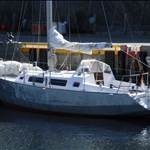
I`m new here. I live in Germany, Hamburg and own a self builded van de Stadt 34 in Aluminium. I love my boat, but one thing I don`t love at all. Especially by an halfway wind, and more than about 16 kn Wind my boat becomes strong weather helm. My boat is top rigged, the draft is 1.6 m. It´s not yet a fin keel but a medium long keel. The rudder is a balanced spade rudder.
Do other owners of a van de Stadt 34 experiences the same problems and what have you done to minimaze weather helm?
I think over to make the rudder a bit larger to get more area or to change the rudder and build a skeg hung rudder. Would it be worthwile thinking about it?
Excuse my really bad english, please. School is long time ago.
Welcome, nice to see International posts.
In my opinion, Mr van de Stadt knew what he was doing when he designed boats, so I would rather look to sail trim to balance the boat. Maybe it is telling you to let out your traveller or main sheet when the wind gets over 15 knots? Or perhaps a reef in the main? Have you tried these things?
I agree with Yara. VDS 34s are well designed yachts and should balance very well. Modifying the design could ruin the yacht.
Look more at the way you are sailing the yacht.
As above, I owned a Van de Stadt 34 in aluminium until a couple of months ago, lee and weather helm were only ever a sail trim issue, they like an early reef in the mainsail, and being aluminium(lighter) you can reduce sail area quite early and still maintain design hull speed, have fun.
Hi, thank´s for your answers.
I know I have to reef very early. And I know I have to trim the sails correctly. But that´s not the thing I complain about. Changing the rudder wouldn´t ruin the design because van de Stadt itself made in it´s boat building plans a drawing with a skeg hung rudder as a possible opinion to build.
I remember a guy who want to buy a van de Stadt 34 and he also wondered about the remarkable weather helm of this boat.
I know many van de Stadt 34 are built in Australia and I´m interested how the different modification van de Stadt offers behaves.
I made longer voyages across the North sea and I noticed that my self steering advice - a Pacific Windpilot- couldn´t hold the course escpecially by wind coming 90 degrees inrespect from my course. Little changings in course in example by the waves to a course more higher to the wind creates such a strong weather helm the Pacific couldn´t steer back to my desired course. That´s wy I think over to build a skeg hung rudder, to make the boat more sturdy.
Because your Van de Stadt has the longer keel version it should have less weather helm than a fin keel I would have thought. I would be more inclined to try and tune out the weather helm by keeping the mast vertical and maybe moving the fore stay further forward or at least get more sail forward of the mast.
Setting the Windpilot to steer while reaching should not be a problem if you can hold the boat on course in the same conditions by hand. I presume you have a tiller. The Windpilot has to be connected to the tiller with the weather helm allowed for, this is usually about 3 to 10 degrees of tiller off line. For my windvane steering I have separate cleats for each control line so that as the wind strength varies I can make allowance easily for weather helm.
I would suggest downloading the Selden mast tuning PDF.
www.riggingandsails.com/pdf/selden-tuning.pdf
I note that you built this boat yourself. DId you make it exactly to the design drawings? Whilst no doubt if you built it yourself originally, you could do hull modifications, but if they are not done to the original design you will reduce the value of your boat.
Some other possibilities: Is the boat floating at the design waterline, or is she down at the bow? What is the cut of the jib like? Baggy, or nice and firm?
My 2 bobs worth. I used to race with these guys on an Adams10 and it seems the the decision before a race as to which sail size combination usually (99% of the time) resulted in too much sail for the wind conditions. My job was to work the main because I'm pretty well deaf and when the said owner/helmsman (who contracted white line fever every time we crossed the start line) started abusing everyone, it had no apparent effect on me. Anyway, what I figured is that a main sail that may perform nicely up to 16knts with just the required amount of weather helm is an absolute no go in anything above 16knts. You don't normally reef when sailing around the cans. Now this Adams10 had so much roach the back had to be released to tack. Exciting times. And on these windy days with too much main sail exposed, I could virtually steer the boat with the main sheet while the helmsman held the rudder near on full lock giving me his words of advice at about 130dB. I'm not sure what the cut of your main is Yara, but as the wind come up, the weather helm increases and it's usually a good sign you need to reef or reduce the main sail somehow. On my fancy 40 footer I'm taking in the first reef in on the main (next to no roach) at 18knts and the second follows in at about 25knts.
Cheers
Hi Farvel
say hello to Hamburg for me. Used to work in Vedel Saalehafen and Moldauhafen
and visit St. Pauli market often.
Don't look at the other boats. Same boats just don't like too much main.
Learn yours, you probably find much confortable to have second reef on main and
adjust headsail accordingly.
Personally, on 20 knots plus, I drop main, use Genoa only and still flying 6 - 7 knots.
And weather helm, there is none.
Hello Farvel, I apologise for the late reply as I have just returned from a little “messing about in boats”. I hope that you have cured your problem by now but, if not, please consider the following:
Poor balance (Weather Helm) increases as the Centre of Effort (CE) moves aft of the Centre of Lateral Resistance (CLR), and can also be caused by warped rudders, skegs, and keels/centreboards, or even by baggy sails. When your CE lines up vertically with your CLR, your helm is neutral. If the CE gets forward of the CLR the boat falls off, Lee helm. If the CE is aft of the CLR then there is weather helm, as the power in the rig is now putting more effort aft.It pushes that part of the boat away from the wind which causes the bow to turn into the wind as she pivots on the CLR. This must then be corrected by the rudder which, when used excessively acts like a brake to the vessel.
To use sail trim to move the CE forward, and reduce weather helm:
Remove mast rake (or even rake slightly forward).
Reduce wind pressure on the main, or increase the pressure on the head sail. This can be done by shaping (trimming) the sails, and dropping the main to leeward. As the wind increases, shape/position become more critical (should be flatter). If you can, tighten the backstay. This helps to pull the fullness out of the main and will flatten the head sail. The idea is to flatten the sails and keep the draft forward.
Tighten the outhaul to flatten the bottom part of the main. At the same time tighten the Main and Genoa halyard to keep the draft(s) forward. Bottom batten should line up with boom, top batten with masthead. Twist at the top of the mainsail will allow wind to spill.
Move the Genoa lead aft to flatten the lower section and twist off the leech.
Dropping the boom to leeward after shaping will reduce weather helm.
Add a boom vang which helps maintain shape when easing out.
More weight aft and windward, less weight in the bow.
Reef (the main more than the jib).
Boats with blown-out or baggy sails suffer from weather helm because the CE moves aft. You can cure a bit of that, especially in rising winds, by tightening the halyards and flattening the sail any way you can, which will move the CE forward. The deepest bulge in a sail, the camber, always moves toward the edge under most strain. Sometimes overlooked is that a large headsail can contribute to weather helm so try changing down to a smaller genoa or working jib and you CE will move forward. Hope this helps and good sailing to you.
Gute Winde, Sie Favel