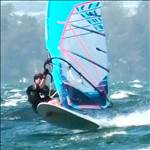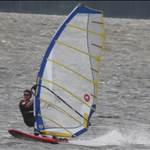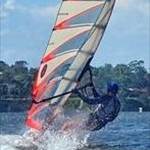


So, the local windsurfing shop has a great deal on jp funride boards - 40% discount
I currently have a Fanatic Viper, 6.6 Natural North Sails, Gold mast. Although am not quiet in the footstraps, I know I will soon be, already planning, and having a lot of fun. The day will soon come that I want my first short board. Now the question is .. being a light weight at 70kg. Should I go for the 130 or 145 L board ? and is this board suitable for me ?
Thanks in advance,
Paul
Depending on how old or athletic you are, I would have thought that 110L would be all you need.
So, either larger board will do fine. I don't like huge boards. Once you are floating, more litres don't really get you planing earlier. Certainly the 130L board is more than adequate.
I'm 82kg, and I find an 83L board will keep me floating in the holes and 93 is more than enough, so 130L will be enough for you to fit it out with a nice armchair and a telly.
When you are learning to get into straps, things like rail shape and footstrap position are more influential than volume.
Cool, thanks for input! A little more about myself - 28 male, average fitness, but getting fitter all the time with windsurfing twice a week :) I do much of my surfing in the Oslo fjord, Norway, so when it blows it can get choppy - hence why I was thinking that the 145L might be more stable when uphauling, got to start working on those water starts :) was recommended the 145L in the shop, but leaning more towards the 130 myself. Just want it to be as much fun as possible !
Thanks again, of course any other input is welcomed
Paul
Sounds like there is no reason not to go to a smaller board.
I originally learnt on a Wally in 1981, then did not sail for over 10 years. When I came back, I went to a 110L Bombora X-it, which was a total POS, btu I still learnt to uphaul, water start and plane in straps on it.
You will easily be able to uphaul a 130L board, and likely do well on anything down to 110L easily.
If it blows, you don't want too much board under you.
Learn to waterstart as a priority. It is not easier to learn later than sooner, so the sooner you get started on it, the better.
If your going to go the smaller board its best if where you sail get nice consistent wind and stronger 15 kts +..if you only get gusty 15kts a small board will be harder to handle & uphaul in the slop.
If you need to choose between 130 and 145, at your weight, go for 130.
I'm 100kg, and purchased 160. After 10 months I feel I should have gone 145.
So the advice above to go for 115 is probably spot-on.
As Sboardcrazy says, it depends on how consistent the wind is. If the wind is very gusty then the bigger board will be more fun as it will be a bit easier to get onto the plane in the gusts and remain on the plane in the lulls.
If the wind is consistent, ie when it blows it constantly blows then a smaller board will be better.


I was thinking that you could more about tell who sails what and how skilled they are.
I'm east coast, and can't imagine how a 130L board could ever be considered "small" for a 70kg sailor. Both 130 and 145 are massive in my world.
Mind you, Maui is so like Bundaberg/Elliott Hds, I felt like I had flown half-way around teh world , just to wind up back there, 30 yr ago, when the pace was slower, so east/west is not the only thing that determines wind and board preference.
I think you would be better off with the 130. I am about your weight (72kg) and my biggest board is a 114 JP Slalom. It's easy to uphaul with my biggest sail (7.5m NP V8). Good in chop and slop, up to about 20-25 knots. Then I change down to a 105 or even a 90 if it really starts to blow (not much of that last season  Think the 140 may be too big in the choppy conditions and may be a handful when gybing. Less crashes means more energy for enjoyment.
I guess, but 145L won't get planing sooner than 130L, all other things being equal.
Board type, rocker line, sail type, expertise level etc are going to have more effect than the last few litres. Since he was comparing 2 simlar boards, those factors are less relevant.
When responding, I also took into account his info about where he sails.
It did not sound like he was going to be short of wind.
And you might not think it, but I was actually being conservative.
Normally I say that anything over 100L is a waste, esp for a 70kg sailor.
I have great faith in people's ability to progress, once the basics are mastered.
I don't really think that many people need huge volume boards or that they need to reduce board size slowly or incrementally.
This guy is an athletic surfer, so he will be fine on a smaller board.
Learning to waterstart is much more useful than lumbering yourself with a huge baord and not that difficult for someone who has basic sail control.
Evil Panda said
But isn't gybing on a smaller board easier? I think so.
Talking from the point of view of a very average gyber..no..easier to turn but less forgiving of average technique on the exit which is where most gybes fall apart..

Without hijacking, (OK totally hijacking) falling apart on the exit of a gybe is caused by poor technique, ie leaning back on the entry to the gybe, and has nothing to do with board size.
Choppy water state challenges gybing technique too, and a bigger board is no help there.
Litres are your friend if you are heavy, but once you get 20-30 litres over your body weight, adding more does not add any futher benefit.
No, but without being argumentative, how big a board do you really need to stand up on ? Sailboards are not hard to balance on at all, esp compared to a skateboard, or a surfboard. Even small boards are large by comparison to everythign except SUP's and cruise ships. I bet that withing a short time, I can teach most poeple to stay on anyti9ng that will float them ,as I shake and wobble it about. In fact, taht's teh first thing I do on teh odd occcasion I teach anyone.
Keeping in mind that we are talking about an athletic 70kg 28year old surfer, 110L is plenty for him, 130L is big, 145L is massive.
Stability and early planing both come from board width, but extra litres are often added with thickness and length, as well as width.
If you look at a bunch of boards from the same line, in different volumes, they don't really look much different. Measure them, and the biggest difference is thickness, and that won't help stability at all.
i'll throw in, why not...
matching a board to your skills and conditions will reduce your frustration and hopefully keep you in the sport for years to come. the world needs more windsurfers.
obviously the 40% discount is enticing, so you need to factor your budget in.
smaller boards are more sensitive to weight change which makes them very manouverable...if you are sufficiently skilled to be delicate and precise with them.
larger boards plane in and through lighter winds, but become a real hand (foot?) full in over-powered/choppy conditions.
the formula I was taught is to take your body weight in kilos, and add 20 litres to it for a wet rig and you've got around the size you need to float. as you're learning to get in the straps/waterstart/gybe, I'd add some more litres to that.
so for you (in my opinion) your conditons and your sail size, a modern board around the 100-110 litre is probably ideal. its got plenty of float in saltwater for you and your rig, and will be a good balance between stability and performance through transtions and heavier conditions.
for gybing (big board/small board debate), i'd say in the learning days a small board turns better, but a bigger board is more forgiving with the rig flip - which is where most people fall off! so much technique is required in a gybe, its overwhelming, even after years of sailing, most still struggle to exit well. your first ever gybe is a 'survival' gybe, ugly as sin. a big board helps beginners at least make first base more often. i think i would have taken longer to get there with a smaller board.
^^
So really, we are down to what the definition of a big or small board is.
Given that 130L is 58 more than the rider in this case, I think it qualifies as big.
110L is 38 more than the rider.
I agree that the fist gybe is always a "survival gybe".
Good gybing is always a result of steady rail pressure producing a smooth carve, avoiding the "3 county gybe".
I'm about 70 kgs like you and after about 4-5 months learning and sometimes planing on a longboard without footstraps fitted, i bought a 120l X-cite ride and not long after even thought i could have bought the 110l instead and still managed ok.
If your local dealler has the X-cite ride at a good price too, it could be worth considering, because you will probably never need to sell it, as like me you will keep it for lighter wind days for years to come (maybe forever) even when you get a smaller board.
Dont underestimate yourself and your ability, the 120 X-cite is a fairly easy board to sail and up-haul, even in fairly choppy bay conditions, and will see plenty of use as you get much better still, whereas the fun ride you MAY want to sell later.
So long as you can get out regularly..Sorry I'm biting because I'd love to live where you get enough regular wind to sail a small board every week & get those gybes going.. [}:)]..Back to topic..
Wow,
So I went to bed, came back, and wow, what alot of helpful responses :)
I went out and got the 130L, but now am thinking that maybe I should of gotten the 120L now .. darn, wondering if I could exchange it in the shop for a 120... If not, I can keep the 130L for this season, and sell it next season, and get myself a 120 xcite ride.
In addition, I'm out in the water at least once a week, sometimes twice a week, since April - It was still possible to go skiing! - So I got myself a nice toasty warm ION 5/4, alot it can be too warm now, have had to just drop the sail and jump in to cool off :)
The wind here is very variable, sometimes its 3ms/5 knots up to 7ms/15 knots, and it can just suddenly disappear - that was a long trip to get back home !
Also in the Winter I snowboard weekly, so naturally am really looking forward to carving in the footstraps !
So the question is .. keep the 130, or try and exchange it for 120 ?
Thanks guys, Ill keep with the 130L, and slap my 6.6 Natural North Sails on it, next season if I want an 120 excite ride, ill sale the funride, and use the cash for the xcite :) ... Looking forward to using it !
Thanks again guys .. I wish I lived somewhere where there was golden beaches, and steady winds, you lucky boys !
Paul
ahhh .. been here scuba diving, but this also make me cry with frustration that am not doing this:
That's cool.
It's good to have robust discussion. I didn't detect any element of argument, which is a different beast.
Not knowing you, or anything about you makes it harder though.
I'm still confused about what you might define as a small board for a 70kg sailor.
On gybing, I often talk to people who are clearly still learning or struggling with gybes, and I nearly always discover that they just have no idea what they are trying to do in a gybe.
They are trying to mimic what they see others doing, but only in the larger sense of "turn the board and flip the rig" as opposed to having identified the individual elements which actually makes that happen.
THe lack of a school system in OZ is a bigger impediment than board size of frequency of sailing, I think.
I used the Peter Hart "Carve Clinic" video, which my wife watched with me, and then she coached me. That saved me years of wasted effort and a lot of angst.
Most of the people I have seen struggling have not had any lessons or have not seen or not using any video tutorial etc.
I'm a big fan of lessons, and certainly took advantage of the opportunity to have some in Maui, despite people surprisingly trying to talk me out of them.
[}:)]..Back to topic..
Ive just got a video & I learnt more about why things were going wrong with that than ever.Frustrated that it all semmed to be coming together & then last sail in different conditions I was absolutley hopeless.. Want to get out to practise on the little board but the winds been pretty useless..looks like more dry land practise..