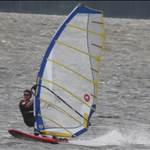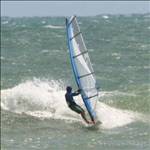


Hello all. I am new to the site and just want to have a brief intro and question. I sail with monster in Georges Bay in the North-east of Tassie and have been on the water for about 5 years having learnt to sail at Wellington Point in QLD. Hope some of you guys up there remember me. My question is this, which type of gybe is best to keep planing right through the turn, conventional carve gybe or the duck gybe? It seems to me the carve gybe would be slower, at some point your sail will be at 90 degrees to the wind and if you are going faster than the apparent wind this would have to slow you down, also the sail will have to travel further around the mast to the new take-up position which would also be slower. I am just starting to learn the duck gybe and am wondering if the time spent falling off is worthwhile.
I know my gybes would improve considerably without the face plant in the middle of them.
Can't give you a personal experience, but how many guys do duck gybes when racing?????
I've only just learnt how to duck gybe (about a month or so ago) and usually get about 80% of my normal gybes, and 50% of my ducks. If you can plane out of a normal gybe then you can learn to duck gybe no worries -- it's easier than you think! And it's a very worthwhile move to learn, it breaks up the monotony of your typical burn and turn routine.
Peter Hart says about the duck gybe "...the sail is depowered for less time, hence it supplies many learning gybers with their first planing exit". I've noticed that they're about the same in terms of planing out, with a duck you exit switch stance so you don't unsettle the board when stepping.
The main points are:
1) Reach right back down the boom with your back hand before the gybe
2) Throw the rig forward before you turn dead downwind
3) Your old front hand grabs the boom near the clew and immediately throws it HARD back over your shoulder. This is where most of my ducks failed -- the mast should be down and back up in less than a second.
4) Grab the new side of the boom (as far forwards as you can) and go!
When you get it, you'll be planing out and suddenly realise that your feet are all twisted up on the wrong side of the board, it can be fun figuring out how to get them to where they're supposed to be without losing control 
A decade ago the duck gybe was the thing to do on our lake. But with only so much time on the water, for me, trying to master it was to the detriment of the conventional gybe. The duck gybe is great coming out of a gust on flat water - as is the case in Canberra because the gusts are pretty narrow. But I found if the wind picked up and the chop was tricky - I couldn't gybe at all.
The trouble with the duck is you lose the balancing assistance of the rig during the transition ( the tight rope walker effect)
The boardspeed of even the best alpha tracks drop below 20 knots in the flat waters of Sandy Point , so if the wind is anywhere near 20 knots the apparent-wind-over-the-nose advantage is gone.
But they look good.
Select to expand quoteI am just starting to learn the duck gybe and am wondering if the time spent falling off is worthwhile.
yes it is it ceeps me amused

Iceman, the short answer is no its not the best gybe for planing exits. That would be the step gybe, but its not bad, and YES most emphatically, it is worth it. Duck gybes are fun. Variety is the spice of life. It's really satisfying to learn something new and DGs are a nice blend of - not too difficult, flashy, safe, and fun to learn. A well executed duck gybe imho is a beautiful thing to behold.
As for planing exits and DGs - its true that the rig flip is very quick and you have your sail back in your hands on the new side while you are still deep off the wind. However you can't take advantage of it (except to apply mast foot pressure) because you can't sheet in until you get close to a beam reach. That's why they invented Monkey Gybes. It gives you something to do instead of just standing there waiting for the carve to come round (vis. a rig and sailor 360).
To all, thanks for the advice, reading into your comments it looks like the duck is worthwhile to learn but is not the cure all for gybing and not one you would normally use in general sailing. I will persevere with it as a good way to learn a new skill but will concentrate on getting my step gybe more consistant and faster.
Harty claimed that alot of people had their first planing gybes when attempting ducks rather than carve gybes. The reason I think is that with a duck you have to focus on carving the board at its best if you are to stand a chance at not falling off at the end.
Carve/step gybes you can play safe, which is the beauty of the carve gybe- you can alter the gybe at any point and still come out dry, this is the downfall of the move as you can persist with gybing poorly for years (I know  ). They compliment eachother in that you want to put that same carve from the duck gybe into the carve gybe to nail pulling them on the plane.
I agree with MK, its not the rig flip that is important. Enter on a broad reach at full speed and keep the weight forward so the tail doesn't sink. The board keeps planing with no power in the rig and you step and flick the rig just after the board goes through downwind.
You know Fitz, you raised and interesting point. When learning to carve, I did a lot of reading on the why's and wherefore's and a lot of what I read had to do with how to position the sail and when and how to spin it etc. I found I was getting all tied up trying to get the sail to perform when the real problem was my positioning and balance on the board. I firmly believe that the first step in mastering a gybe is to not loose sight of the fact it is the board that is the important bit. You must get it round with good speed and balance first. The sail will look after itself to a certain degree. Don't forget most of the turn is off the wind and the sail isn't contributing to the speed of the turn at all.