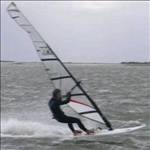


I know most of you hate them but advice from those that do use them please?
I find the sail wooden with no feel .[}:)] I was sailing in 10 -15kts with a 6.2m so didnt really get powered up till 15kts.Once powered up there was a bit more feel but when Im not how do I know if I have the sail at the best alignment & I'm not oversheeting? Going to windward & close reaching mainly.I just kept letting it off & changing position & pulling it back on..My non cammed sails give good feedback.I think I needed more downhaul too as I had some photos taken & the luff was wrinkled.( I had put less on than normal -Im still getting used to setting it up.)
I've got a range of cammed sails & love them. Prob helps that the first sail I learned on was a Gaastra GTX 7.5 cammed sail, and it's still one of my favs.
Great for cruising on flatish water & blasting along. I've sailed in heavy chop with a cammed sail, but it's much more enjoyable (if you're overpowered) with a wave sail. Can't beat closing off the bottom of the sail to the board, fully sheeted in & in complete control.
My only advice would be to make sure you're rigging it right as per specs?!? With cammed sails, if you don't have enough downhaul, they tend to be very top-heavy & awkward...you need the sail to twist off in gusts, but not enough that you lose power.
I'm sure someone here will give you a more technical answer, I just enjoy freeride sailing with cammed sails! 
My cammed sail is my biggest and therefore a bit more clumsy but trimming the sail is the same as the others. I don't even think about it.
Try varying your downhaul.


observations of a semi-noob;
I mostly sail in the 6.0-7.0 range on flat-water. My fave sail from about six years ago was a cammed v8; I sailed it until the panels blew; since I've dabbled with rotational foils from north and gaastra. despite persisting I found myself ultimately dissapointed, I gave in and got myself another v8 last season.
the major thing I find with cams is the leading edge of the luff is maintained regardless of the wind strength, so in lighter winds, the sail still holds a strong and efficient entry to the foil promoting early acceleration. with rotational foils, they need wind to form the shape, so their lower end range can be less than cammed. (dons flame suit )
but I should also say that clever design in the shape seems to negate this, the Naish Boxer from observation is a very powerfull cam-less sail.
the main reason i went back to cams was the conditions i was sailing in; generally marginal conditions where acceleration to get onto the plane was king.
but mostly I sail cams just like I sailed no-cams. no denying they are heavier, noticable sub-planing, waterstarting and in transistions. but under-power they are fine. i think you're right about tuning; more downhaul - your luff should be drum tight - which hopefully will make the sail more responsive. let us know what you find.
)
Hi Sue,
a well set up cammed sail is a joy to use. Very stable and large wind range. With my limited knowledge and skill I think cammed sails provide good feedback. They are not good for sail flips and tricks like helicopter tacks as the cammed sail always has shape and will always try to drive forward.
A badly setup cammed sail is a bit of a pain. Too much draft up top makes the sail top heavy and impossible to get settled.
)
 [}:)]
[}:)] Others have zips so you can get your hand in but this one you have to feed your hand up under the very tight luff from the bottom & feel around to try & get it back on.Which is almost impossible once the luff is tight enough to get it where you need it.Ive let the batten off a bit but I cant outhaul it anymore as the clew is already on the boomend at min outhaul.
You probably shouldn't try to use the sail with the cam against the mast-extension... it probably wont hurt it, but I personally wouldn't trust it.
[}:)]
 Maybe a problem if I use Windextasy's tips..
i suspect this won't work from what you've described, but my cammed sail is rigged like this;
1. sail onto mast and downhauled 90% of the way. Feed the sail on deliberately making sure the cams are not on the mast but to the side.
2. boom on and outhaul hard, usually right out to spec if you can.
3. "pop" the cams on; press down hard on the sail at the batten around 30cms out from the cam, and use your other hand to push the cam onto the mast from underneath.
4. downhaul the rest of the sail, refine your outhaul if necessary.
this is how the manual tells me to rig; your sail might not be designed to do this. but in your case, if the cam "off the mast" can slip past the mast extension cap (the thickest part) it might help you. fitting the cams afterwards can be tough so you need enough outhaul to start to pull the cams away from the mast, which makes it possible to pop them on by hand.
best bet is to save up your bickies for that 460...you'll find the sail rigs easier, responds much better in gusts and soaks up the chop.
im also only light so some times the extra weight is a bit of a pain if im buggered may be i just need to HTFU