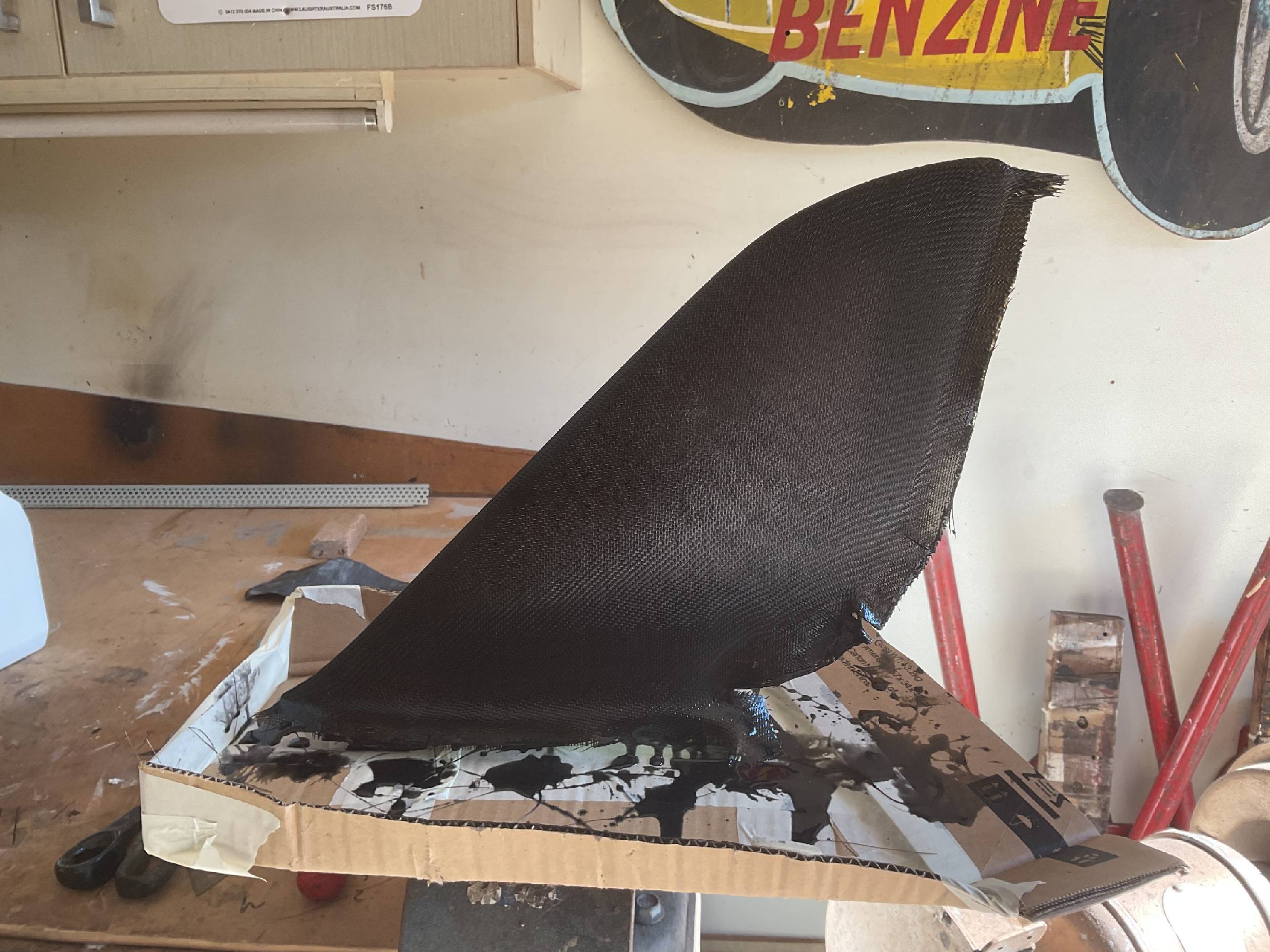


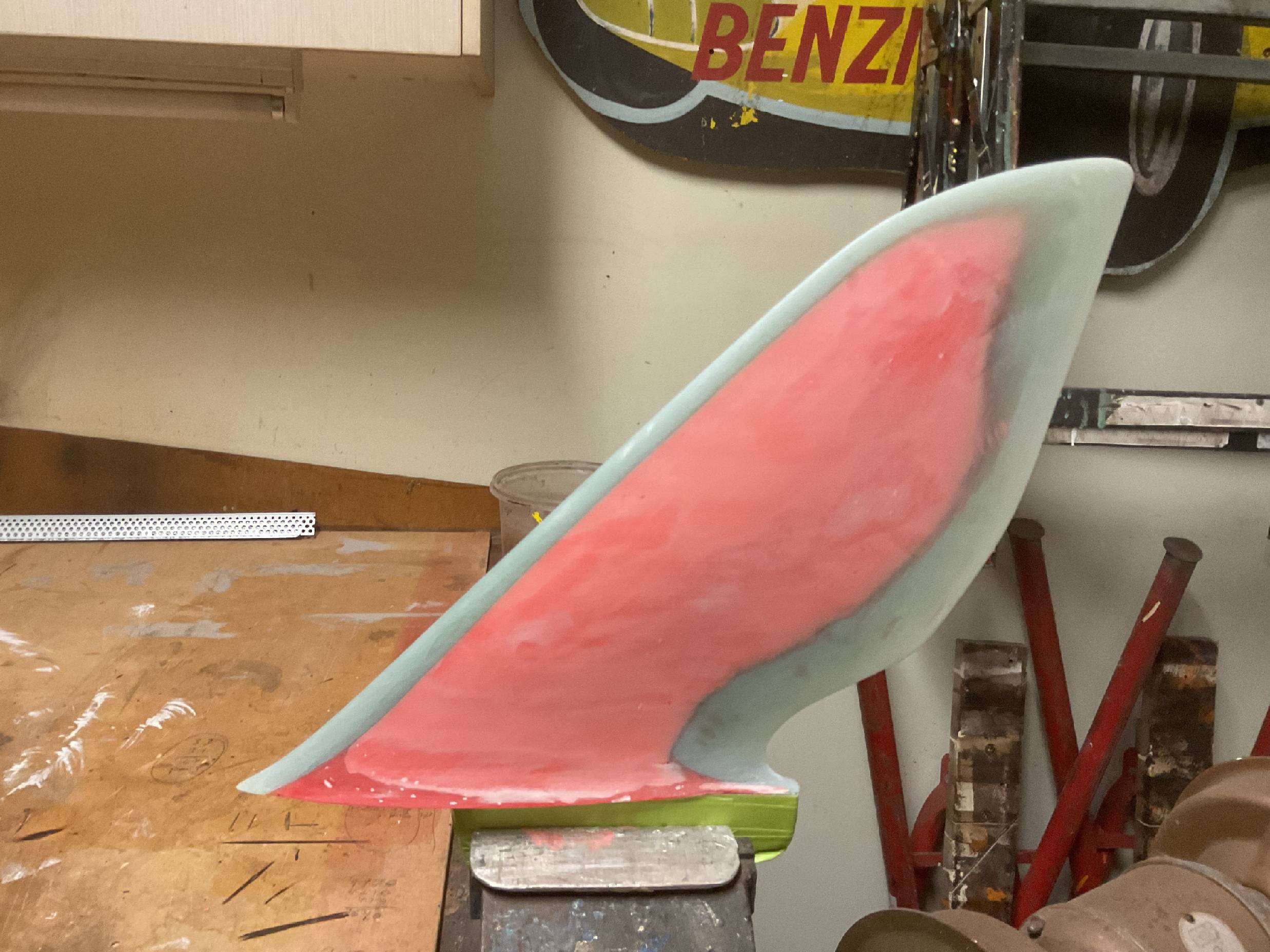
With much sadness we can’t buy much loved Fangy fins anymore . This is a possible DIY alternative. I started with a 30 cm Delta and reshaped the outline. Built up the bottom flange with glass filled resin. Built up thickness with Q,cell resin. Hand shaped with flapper wheel and finished with orbital sander. Leading and trailing edges are the original G10 fin material. Will cover in a layer of Basalt twill ,(easier to drape than carbon fibre ),to protect the softer sides.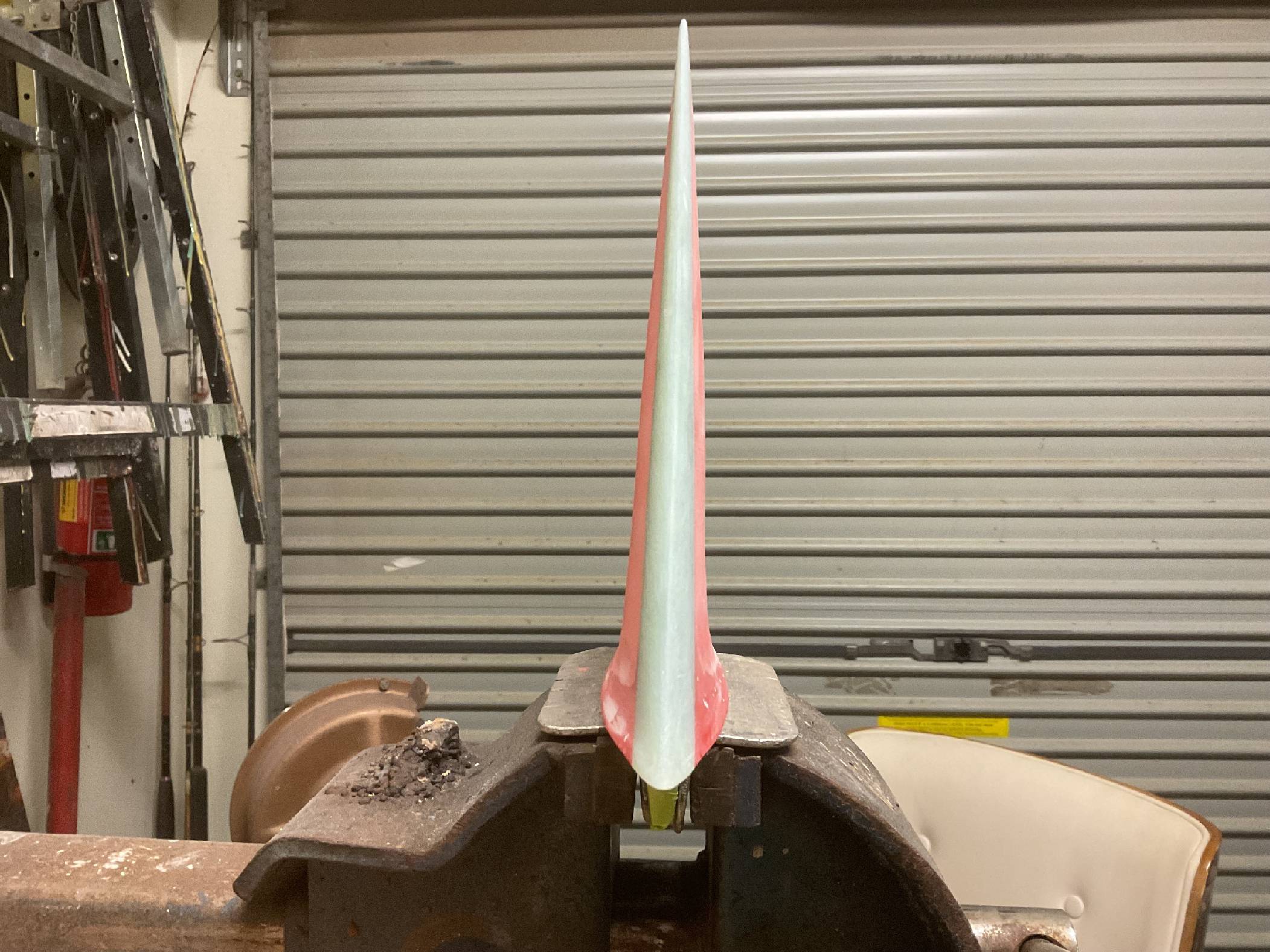
Select to expand quoteMeh said..
What's the angle?
45 deg. It’s for big sails , shallow water ,not heavy weed.
Nicely done mate, that will be a huge improvement. Just adding a flange to the delta's made them heaps better.
Smoothed over with Qcell. Hot coated. Possibly another hot coat after a light sand.
Does anyone know what the best performing wet and dry finish should be ? I believe a sexy gloss is not the best.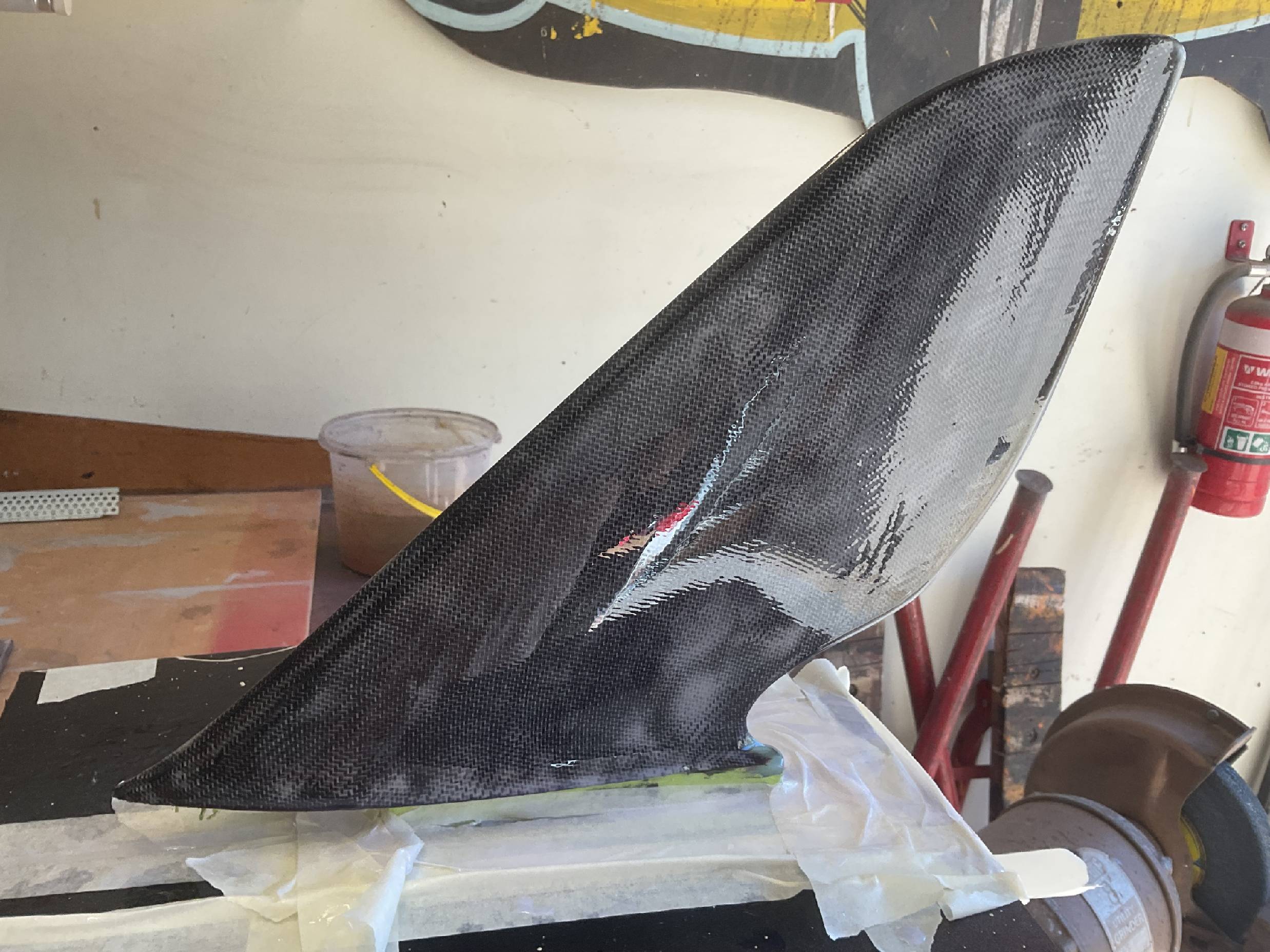
various thoughts on that, depends who you listen to. I think it depends on the R number. and how smooth the foil.
A good boundary layer helps the flow stay in contact, and the theory is it's a water on water friction.
The boundary layer is created by slight friction on the surface, starts water tumbling over itself.
A polished surface can give laminar flow, so no turbulence, and any foil irregularities can cause separation and stalling.
the slower the speed the rougher the wet and dry. higher speeds benefit from finer wet and dry. a rule of thumb for us is anything between 400 and 1000.
However Fangy's latest experiment was straight out of the 3D printer with no smoothing and he said it went surprisingly well.
Personally I haven't noticed any difference.
So ???
600?
I remember the same topic on board finish , and it ended up a sh.t show.
Some speed boards were polished and some purposefully kinda rough ,400 grit.
I had the belief is to go as fine as to not have the water beed .
But fins is a different black art , or is it ?
No same argument, laminar flow or boundary layer.
I forget the name of the guy, but he did some tests, with dinghys, towed 2 behind him and found the polished boat had less drag than the wet and dry one, but that was at a very slow speed.
I've no idea really, as you say it's a **** fight, people on both sides of the fence believing there argument is better.
My boards finished with 600 go well enough
My new fins I recently made I originally sanded them with 1000, they worked alright.... till they didn't.
The fin would cavitate then I'd almost come to a stop so it would reattach.
Re sanded with 400 and all was good for the red and furry
Select to expand quoteImax1 said..Imax1 said..
Ok 400 it is. 🤔 Thats the finish I give my boards. It’s a big fin for grip not so much speed. I suppose there could be difference in finishes of being fast and slippery apposed to grippy. But then a slower grippier fin could end up faster because you can push off it more with confidence. Cranking upwind or bearing off , must act differently on a fin. My head hurts.ps, I have a beautiful carbon Curtice fin which is a shiny piece of art. It’s horrible. Like Elmo’s shiny fins , it violently spins out and I have to virtually stop to get it to regrip.
on my new Tabou manta .bottom side .front part is gloss ,as its not in the water anyway once on the plane ,rear from half way is sanded ,looks and feels more like 400 grit ,
well it makes a noise when you run your hand on it .might even be 200 😀.looks like a water test is in the near future .I know in West oz ,weed does not stick to sanded weed fins ,
My friends fins where gloss - ish and collecting weed ,mine was sanded and not collecting ..I regular sand mine ...a quick sand to theirs and no weed build up .Does this mean sanded surfaces are more slippery .I don't know .but the test suggest it .
This is all good info, and makes sense.
Sanded fins induce a boundary layer, consisting of small rotations in the water next to the fin, (turbulence)
I guess these keep weed away from the surface of the fin.
The turbulence also travels around curves mu better than a laminar flow associated with polished fins.
Too much pressure, angle of attack on a polished fin will produce separation of the flow from the fin, this will drag air down and kill lift.
So conclusion from this thread is, a sanded fin is much more user friendly than a polished one.
Any difference in speed is undetermined.