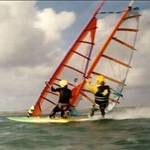


... or the opposite? Or not at all.
Just thinking about some spots that attract more wind. They have a large area of shallow water upwind. It seems to affect the wind. Same when you run alongside an exposed sandbank, the wind seems to pick up.
(I'm thinking of The Train in a NE and ...somewhere else).
the fetch effects the wind so you want to find areas with no land in the area the wind is coming from or an area of very flat land with no trees.
either that or look for a funnel effect.
i can't see water depth effecting wind. if the water is flatter you will plane earlier and get more lift from the tail of the board but that's about it.
I'd say yes.
Shallow water is flatter so there would be more wind closer to the surface where we need it. Wide flat sandbars have the same effect (Sandy Point is a classic example). This would also explain why Woodman Point in WA doesn't seem that windy; there is a narrow sandbar, but there are waves breaking on the windward side of it, disturbing the flow.
You often get the opposite effect when you sail a reef-break; there is wind in the lagoon but much less where the waves are breaking.
I'd suggest rough water causes air turbulence near the surface, resulting in less wind.
I don't think wind speed increases over shallow water, but I would think it plausible that wind speed is reduced less by shallow water than by deeper water. I think from a sailing point of view there are two factors here - transfer of energy from wind to water (which creates waves) and turbulence.
The maximum wave height possible in a shallow body of water will be much less than in deeper water. Irrespective of fetch or wind stength, you won't get 3 metre waves in a half meter lake, for example. So I think that the maximum amount of kinetic energy that moving air can transfer to water, i.e. by creating waves, will be dependant on the depth of the water. Only the air at or close to the air/water boundary will be involved. Wind speed is supposed to be measured at a certain height (10meters?) where the boundary layer effects do not affect wind speed. So in a shallow body of water, the disruption to the airflow is probably limited only to a very small elevation. Compared to a deep body of water, where for example three meter waves are possible, that would mean that the airflow is being affected to a greater elevation. So where a greater height of moving air is interacting with the water, so a greater amount of energy can be "lost" from the air to the water - hence slower air speed closer to the water.
Turbulence at the boundary layer is also likely to make the wind less sailable in bigger waves i.e. deeper water, as the aerodynamic efficiency is reduced.
I think this would also apply for smooth low sandbanks, where less energy is transferred from air to sand and only a few inches of sand at the interface absorbs kinetic energy from the air.
All this presumes that the sea is partially or fully developed, that is that the wind has been acting over the water for enough time for waves to form. The sea in a shallow body of water will be fully developed much faster than one in deeper water for the same wind strength.
hot air rises.
sun heats water, shallow water heats quicker, air over shallows rises, sucks in cool air of deeper water- wind.
Until the air over the shallows cools to match the deep water air and the wind stops.-then it does it all over agian and agian. I call it pulsing might last 30 minutes and starts agian, common experience Swan River, WA- especially south easters 
hot air rises. Land mass heats quicker sucks in cool air- seabreeze in WA.
Shallow water as in half a metre or less, and/or very low lying sand bank. That's what I was referring to.
I thought it was as MikeyS explains. Less wind energy is lost making waves. Also less turbulence from having no waves, although I'm really thinking of chop. All-in-all greater wind speed.
I wondered too if the very warm water in the shallows would also affect it? I guess the warm air above it would expand, pushing into the cooler air over deeper water. I also guess on such small scales it could be almost negligible.
See The Train in a NE gets a funnel effect and maybe a kilometre or more of ultra shallow sandbanks upwind. Explains why it can be 20 knots or more there and 10 knots 200m away in the ocean. Now I know scientific like. (And James Cook Drive gets the same in a SE)
Ask a Rower or Outrigger. They will tell you when they row or paddle in shallow water, the displaced water hits the bottom causing resistance, making it heavier to paddle, so theoretically it would be slower. Dr Karl also confirmed this once on his radio show. As to wether it affects us because w are planing and not displacing much wter would be hard to prove. Personally I love hammering along in shallow water
Interesting question. It does feel windier in shallow water but it may be due to better planing ability which creates apparent wind. This combined with less disturbance in the wind flow from reduced chop makes it feel windier.
The air temperature and the amount of moisture in the wind is interesting too. Like in West OZ the sea breeze (very saturated) has heaps of power but shows relatively few knots. But you feel like to can go faster in less knots of an offshore (dryer) breeze. Its like measuring the knots show the wind's speed only but not its power. So, is there a difference in the wind's speed and power?

When I was building the volvo boats the sailors said the wind had a lot more punch to it in the southern ocean as its so cold the air is more dense. Similar to drag racing most of the best times are at night, as the air cools it becomes more dense , effectivley getting more charge into the engine, they actually have to alter their fuel jets to compensate.