

How far away should be harness lines apart attached to the boom?
now I see from forum post that my setup was incorrect.
I use to have 20 cm between but here is close to zero ...
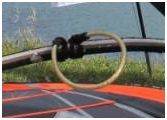

I have always had mine spread a good distance apart. My reason is to spread the load from my fat guts further along the boom and not just concentrate it in one small area.
I saw an article which said they should be at about a hand width apart, sounded like a good starting point to me. But comes down to what you like they say closer together for more response. Only what I read, like I say comes down to you and what works for you.
The closer together they are the more accurate the placement has to be to get the balance just right.
Closer will also mean slightly longer if you have fixed length lines, so if you change the spacing you may need to change boom height a bit too.
I used to have mine 20 cm apart, now I have them a hand with apart.
For freestyle/ wave I think close together as you want to have more manoeuvrability when hooked in, and for blasting/ speed you want them apart for more control/ stable rig, a pull on wider area. imo
Bump and jump, wave sailing a hand width apart works well, you need to be able to rest your arms when they are not really needed, used Guy Cribbs suggestion and it works well, measure distance from mast to clew around your boom with tape measure and the centre of your lines will be 1/3 from your mast, slight adjustment dependent on sail type. You should be able to sail one handed easily otherwise your lines are not set right IMO
Closer together its easier to find the balance point as you'll feel one hand is carrying too much weight, good if your gonna be moving the sail around a fair bit while sailing along hooked in(wave sailing and freestyle)
Further apart will hold the rig steady (what you'll want if trying to break the sound barrier )
)
I havent seen a boom break at the harness lines (yet) because theyre too close together, but I guess there's potential since all the weights on one point
I tried the Guy Cribb method, lost the cheap elastic cord not long after. Couldn't remember where my starting point was when I changed up a sail and remembered (read) somewhere along the way to pick up the rig with one finger (or a loop of string) while it is rigged and on the ground via the boom.
When you find the central position (balance point) on the boom where the mast and clew rises evenly that is your centre position for your lines disregardless of how wide I recall it saying. It's been a good starting point for me and can be done in seconds. I found tweaks have only been approx about an inch, this has worked for my 6.4 and 7.5 sails. Haven't tried it on my 5.8 coz I only just got it.
Oh and I like my lines a little over two fists wide.
Dunno if this theory is correct, but it seems to work OK for me.
With race sails one fist apart works for me. With soft sails wider apart as the draft is less stable. Not sure if harness type has any effect. Mine is seat.
There is no correct way to set them up. For slalom just look at the difference between Antoine Albeau who has his lines touching almost, then look at B Dunkerbeck who has his lines a mile apart. Both are very fast its just personal preference.


Slalom I think you can spread them apart a bit because your not moving much once sailing just lock in and go. Freestyle waves or even learning/freeride I would never recommend spreading them 20cm apart, fist width gives you way better control over your gear, right next to each other they are a bit twitchy. The wider the lines are apart the harder it is to do anything with the sail while hooked it which is a problem on non cambered sails that require way more sheeting in and out while sailing than slalom gear. I think you won't find many top wave or freestyle sailors using lines more than a fist apart. Slalom I know guys that do all sorts but most spread them about 1-2 fists apart. At the school we have them a fist apart.
I was told, as a beginner, that the closer together the quicker the control you have sheeting in and out - better for the more experienced. Further apart made the rig more stable, for beginners, but was less responsive when needing sheet in or out quickly. This doesn't obviate the need to have them centred about the balance point though.