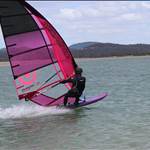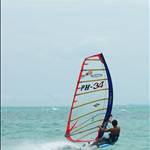


I've got a racing sail, which has a big wide luff sleeve. After a big crash the luff sleeve fills with water, so the tip of the sail becomes 300% heavier than it was before. The water doesn't drain properly so it's a real struggle to waterstart.
This prevented me from using it at the ledge to lancelin, because I knew it would sap half my energy just trying to waterstart the thing in big swell.
It already has two drain slits near the mast tip, but this part of the sail is very highly tensioned so the slits never open.
Can you retro-fit drain holes in a sail?
What if you stick some inflatable floaties in the the luff sleeve, should be pretty quick, easy and light.
Inflate them just enough so they don't distort the shape of the luff. They would take up the space that the water would and also prevent the sail from sinking at the luff sleeve.
i've heard of guys doing a similar thing with pool noodles up the sleeve cut between the cams.

bin it, put the FUN back into sailing
go Ezzy Freeride, Sailworks Retro or KA Koyote
if your comfortable your faster anyway
Not sure what sail you use. I find that the boom opening zipper on the Pryde sails gives you more time before the pocket fills up.
Otherwise practice your falls so the sail is close to water start position when you dunk. The other trick, when you fall, is to continue holding the sail high above your head and out of the water if poss, even if you completely submerge. This way your ready to water start as soon as your head pops out of the water.
and 300% heavier, that would be close to 500% in my book. After about the 5th attempt, I was tin fruited and Nebs had to boat out and change over with me
 crack me up mate....
Cement will fill the luff pocket nicely like Elmo says don't fall in and HTFU. 
or no more gaps, keep moving the mast so it doesn't stick and you might be able to gybe and it will definitely float, probably only use for LOC 
This wouldn't be a North WARP by any chance?
This is not unusual with race sails, especially over 6m. A luff pocket full of water will make the rig up to 5kgs heavier ( 5 litres of water )
I wear a buoyancy vest, gives you a little bit extra lift when you're getting the tip out of the water.
Word from the pros in the PWA is that after a big crash it can take up to five minutes to get going again. Especially when you've hit ocean swell at top speed and your rig submerges
"Racing kit is not about being relaxed and comfortable, it's about being the fastest possible"
Thanks for the replies.
The problem isn't the normal "stuff the rig flip on exit" style of falling in, it's the "Swim 30m to get to your board which has the mast pointing at the bottom" style.
In flat water it's not an issue, I can either muscle the sail up or stand on the board and uphaul (which then lets the water drain out the boom cutout). In swell that's over 1m high though, it's a right royal pain in the butt, and something that I think was addressed in later models of this sail....
I was just wondering if there was an easy fix.
I think the float of some sort on the mast top would work.
Same principle is used on the catamarans in South Perth.
If they go over they bury in the mud and are bastards to get out.
The mast's that is
Pool noodles are about the easiest things to displace some water.
Unfortunately, getting the sail up (race sail or not) from what you have described with the mast buried is always going to be a painfull and physically taxing job.
If I remember the way I have done it and it all really depends on which way the mast is pointing.
If the sail is downwind of the board then drag the board back into the wind hopefully the current will push the sail and level it out.
If the sail is up wind of the board, try to get the leading edge of the sail pointing to the wind.
With the sail in the water the filled luff tube will have no effect on the weight of the sail, that pleasure awaits you when you try to lift the sail from the water.
If all else fails get the tip of the mast upwind then starting from the tip lift it from the water, try to control the direction of the sail as the wind may try to push it under the water again, gradually work your way down the mast as the luff tube empties.
Unfortunately there is a detrimental side to be a competent gyber, that is you don't get much practice at this type of recovery.
Just think Shark
some guys who have been having the same trouble with big north race sails are using these floats on the end of the boom.(I say again) getting the floation size right is the trick.
All the sails I have above 6 meters are cammed sails. An older one, the Neil Pryde RX2 6.6 doesn't have a huge luff tube and I can water start it, its my favourite sail. The others, a North Warp 7.8 and Neil Pryde RS6 7.2 have wide luff tubes and are difficult to water start so I just uphaul them normally, unless I fall in the right position. So I'm not going out in ocean swells with them.
Its tempting to trade all of them in for some sails with narrow luff pockets like the Pryde V8s.
All of my sails over 6m are cambered wide-pocket sails. They're easy to waterstart (even the ancient 9.5) if you use the buoyancy of the board. As you drag the rig back into the waterstart position, slide the boom over the tail of the board; that will lift the rig and the water will drain out quickly.
On a board that's too short for the boom and tail to come in contact, you can grab the tail with one hand, bend the elbow of that arm, and then pull the sail over your head. That way, your body fills the gap 'tween board and boom and allows the rig to lift.
It's pretty quick and easy. Hard to explain, though!
With this sail, there's no easy way for the water to drain out the TOP of the tube. You can use the buoyancy of the board all you like, but all the water that's above the cutout won't exit the sail until it's up in the air -- and when it's level with the water it's really really sodding heavy!
Might talk to a sailmaker I think.
kinda off topic..what was that late nineties sail that had sausage floats inside the luff sleeves quite a help but another contraption you had to deal with
Nebs, grab a cam out of you sail, buy a pool noodle and cut the pool noodle to profile of cam. You only need enough to sit in between 2 cams above boom, this floats the sail tip enough to stop it sinking.
I started doing this with widesleeve VMGs, one day at redcliffe it must have taken over 20min to get sail up... couldn't up haul sinker and sizeable swell. Warp sometimes used it, 08 Stealth didnt use it though the sail was a bit annoying cause boom cutout was quite wide so it scooped the water into the sleeve if you dropped the sail but it also drained well from same point, Vapor all good sleeve floats sail well unless you stuff up really bad but it seems to drain alright also. I think the difference between the Vapor and Stealth compared to the really hard ones to recover is that the luff sleeve is more S shape where the VMG/Warp stays wide all the way up.