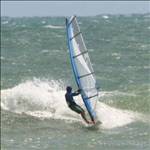


Going back to basic physic I wonder if anybody come across power calculations for our windsurfing sails. What is the power output for ie 6m sail at 10, 20 ,30 knots wind speed in kilowatts? For comparison similar size wind turbine generator (swept area) produce hardly 500W electricity at 20 knots wind speed. I think we have much more horse power under our windsurfing bonnets.
i think you should draw a simulation... 1x1 cm grid on a sail, drawn in it's position according to the wind strength,boom, twist, freeleech.... for each sqare cm draw an arrow that hits the sail at certain angle... count speed of wind, density in try calculating how much force comes in at each square centimeter and when you get the force of each part of the sail, sum it up. when you got htis, you are able to calculate everything... if you make a program to do it, you win otherwise it is a whole lot of work...
I'm too busy and lazy to do this... then again, there is probably a much better way, but I only took basic physics and statics (the more detailed mechanics) for now at uni...didn't get to dinamics yet :(
I need to correct myself. Obviously I am not so much interested in mathematical formula but rough output numbers in kilowatts power for average windsurfer gear. Considering complexity of windsurfing rig straight physical calculations are useless ( or better said I don't want to bother you guys such with boring things on this forum) But knowing if we have mere 300W paddle board or 1 horsepower sail under our control to get us planing speed or 10 kilowatts dragster to reach magic 50 knots can be fascinating. I guess that some empirical approximation is possible and was done...
w=Cf*q*A
w- wind force
Cf - aerodinamic coeficient for force
q- stagnation pressure (not completely sure if it's correct translation)
A- area
A=6m2
q(18,5;37,4;55,6 km/h) = 0.185;0,374;0,556kN/m2 --> For 10;20;30 knots
Cf= 1.3 for perpendicular surface let's put it 1.15 because it is not perpendicular to all areas
P - power = w*v
for approximate power generated in your 6.0 sail, if my calculations are correct :)
10knots=> P=1,221kW ==> 1,67Hp
20knots=>P=2,58kW ==> 3,52Hp
30knots=>P=3,84kW ==> 5,24Hp
I seem to remember that we did the calcs before on here, and it turned out to be a couple of horsepower... so sideskirt seems right on the money 
So, to complicate things more, a normal sail power range would be 2.5 - 4 Hp [}:)]
yep it was worked out,
then we got into a long debate about how 15knots in victoria is more powerfull then 15 knots in qld because of pressure at different temperatures.
i htink that just proved that qld sailors are faster 
also air density helps a lot... moisty air at same speed as very dry air gives more power :)
Excellent Sideskirt.
10knots=> P=1,221kW ==> 1,67Hp
20knots=>P=2,58kW ==> 3,52Hp
30knots=>P=3,84kW ==> 5,24Hp
(cit.)
That is good starting point.
I think estimates are close enough to reality.
I guess- because of turbulence flow , drag etc we are about as near as 50% to reality which is very good.
I propose then simple empirical experiment to verify and definitely put exact numbers.
If we can get our guinea pig on the windsurfing board and measure just three vector forces: at harness line, mast bast and foot rest at known wind speed - then we have at least one scientific factor. Name it: SurfFX :) (power output)
Considering your next sail purchase from Neil Pryde we can ask not only for Luff and boom numbers but also power output.
For those of you still in doubt: Do you think that all sails are equal- ie 7sm race cam sail has the same output as 7 m wave cam-less ?
I don't think so, the cam-less sail would spread the wind flow on to it very fast, since it has flatter boom... so when the wind hits the sheet it changes direction and doesn't give much power... looking from "vertical" center line to mast, while a Camed sail has larger boom and the "pocket" which is generated by cams at the mast gets additional wind force that comes from clew side and hits this pocket.
If I made this clear enough it should be logical? 
So there's a linear relationship between power and windstrength?
I'm sure I remember from somewhere a logarithmic relationship, ie force varies with the square of wind strength.
when talking about wind strength, I ment wind speed, just to clarify. dunno about sqare relation...
I don't think that relation is either linear or cube shaped .
Aerodynamics of our gear is so inefficient that plain simplified equation doesn't works better than long term weather forecast.
Simply put : if sailing boat could travel three times faster then actual wind speed than
at 50 knots Antoine Albeau should be sailing 150 knots not mere 49.09 at Saintes Marie de la Mer canal. http://www.boardseekermag.com/special_features/speed/windsurfing-speed-record_061.htm
Anyway nobody bother to compare Lamborghini to Fiat Uno based on energy dispersed in fuel oxidation process because such data could be misleading. In some cases we can prove old junk disperse more energy then super car at same distance.
it is more of a comparison of mazda rx8 and ford mustang... mazda RX8 with 1,3L engine generates about 250Hp and mustang 3.7L engine generates 305Hp....
almost 3x larger engine volume but only 20% more power...
also: Wangl engine and Otto engine in another way of comparison of sails with cambers and without cambers :)

That is all fine on paper but not in real life.
Human being is fluid too and even glass is.
But for specific windsurfing gear computation is not that easy as for NASA space shuttle.
I regret that our airfoil is a bit less efficient that theirs.
Otherwise I will take a small trip to lower orbit say "hello!" to ISS and land safely on Runaway Bay. I guess my airfoil to mass ratio on my 7.0 Gaastra and / my 80 KG is not worse then shuttle / wings and belly
)