

Came across an interesting article while wandering aimlessly thru the WWW. It's quoting from 1991, from well back in the days of full headed sails!
www.tspeer.com/Planforms/Planar.htm
"
Day (1991) used simulated annealing with a lifting line analysis to determine lift distributions which maximized the performance of a sailboard. Both induced drag and a simple viscous drag estimate were used to model the sail. He found that due to a constraint on heeling moment, the optimum spanload distributions had a negative lift at the head. "
and a bit further on
"
Reduced Moment Sail Rigs. The heeling moment of the sail rig can be reduced by changing the design induced velocity distribution so that it tapers linearly from a maximum value at the foot to a minimum value (which may be negative) at the head. In principle, there is no limit to one's placement of the center of effort, provided that it is permissible to have negative lift at the head of the sail. It is even possible to have the center of effort at the surface for complete cancellation of the heeling moment. However, there are practical limits to this, as will be seen."
These were about the only two paras I tried to follow, it's a bit mathematical in places, but it seems like they are proposing a bit of twist past neutral to provide lift in the reverse direction Because this little bit of negative lift is acting right at the top of the sail its slow-down effect is counteracted by its benefit with the righting moment. You can then more than compensate by designing for more lift down low (It's a small force but on a long lever arm). If you sheet out the top would increase angle of attack and help with overpowered situations?
Because our current twisty sails only twist under air pressure from the windward side I doubt that they reduce lift up there all the way to zero. I couldn't see how they are currently twisting to negative?
I liked the inclusion of the word "permissible". Of course! What we need up there is a latch to hold it super twisted with a negative angle of attack, maybe latch it in with one or two big pumps after each gybe.
Thank you Dr Spock. Now please tell us how to best utilize sail twist to get planing in lighter wind. 
Does'nt Dr Spock relate to childbirth? and Mr Spock relate to star trek's (too much information bloke) ?
That'll explain those nasty red thumbs WW
Only issue with this is that it does not apply to windsurfing at all.
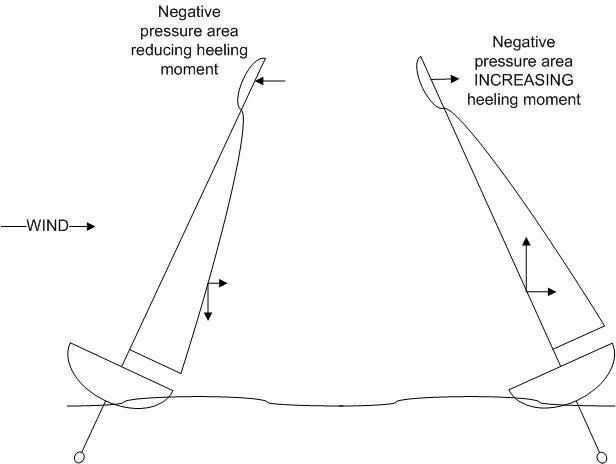
In a yacht that heels to leeward it "may" be beneficial to have the head of a rig producing lift to reduce heeling moment. So while the bottom of the rig provides drive, the head of the rig provides righting moment lift.
A windsurfer heels to windward. "negative" lift would actually force the rig to heel more, not less. This is not good.
JB
The twist in windsurfer sails is similar to that proposed above, but not negative.
I understand twist is there because wind speed is greater at top of mast so apparent wind is at different angles of attack at top/bottom of mast. Top of sail basically sheets out.
I guess there is now a more laminar flow across the entire sail and power can be set down lower in sail, less leverage required.
Importantly twist off was invented so we can forever debate about the correct amount of downhaul and mast bend curve.
Also it looks cool.
I got the impression that Day in 1991 mentioned sailboards because they are one craft that has the maximum righting moment locked in. Keel boats might be better off adding more lead if they need more sail power, skiffs can add an extra gorilla to the trapeze on wider wings but a windsurfer is stuck with his body weight and arm length.
You could just look at the concept as generating extra righting moment aerodynamically. I've seen some designs for proas where they generate righting moment hydrodynamically by putting a foil in the water at the end of a long beam to windward. With a negative angle of attack the foil holds the proa upright. Not much different in concept?
MAJOR EMBARRASSMENT - I got an arrow wrong
Diagram should be
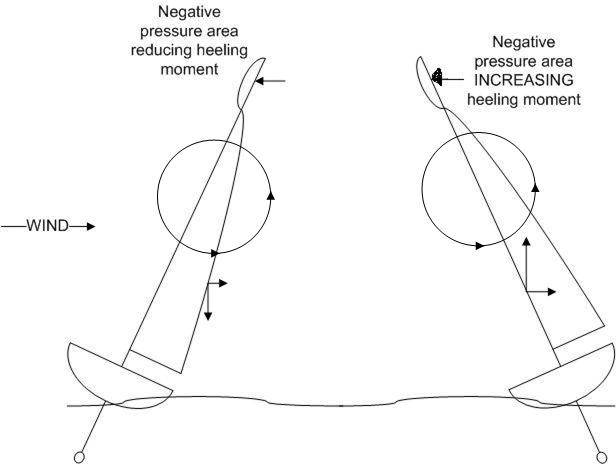
Logically the effect is a net turning effect - shown by the circles. In a yacht (Left) this is beneficial.
On the windsurfer substitute (Right) the effect is such that the top of the rig tries to make its way to windward - over the sailors head. I think the net result is that the rig will rotate, slamming the head of the rig into the water and spitting the sailor out the bottom.
We could always ask KA4 - he sailed with a sail that had an inverted cambered head just over a week ago. He didnt like it - it didnt work at all.

Basically the same effect that was used by that land sailor dude who broke their record with 3 million GT31s in the back the other week. He was regulating the sail lift force by controlling the sail AOA with a small tail plane with reverse camber. That kept the lifting force relatively constant regardless of shifts in apparent wind angle. It seemed to work great in that app.
For us it should work in theory as long as the reverse lift in the top were small enough not to produce more torque about the mast base than the main lifting part of the sail. It would also allow higher aspect ratio sails. Problem of course is that any forces generated at the top of the sail are amplified by the time we feel them on the boom, so when the wind is turbulent and there is considerable and varying wind shear, stability could be a problem that outweighs the performance gains. Might work at Sandy Pt though
If anyone remembers those old cam sails with virtually no cam pressure (eg NP warp speed circa 1986) you'll remember the camber derotating in the gusts and slamming you onto the water. I think thats a good example of having too much reverse camber in the top. Gotta love the backslam action.