

has anyone thought of putting trim tabs on the tail of a sailboard much like a speedboat to adjust the attitude of the whole board? what about a rigid jib that is pre-tensioned to
adjust to wind angles..what about getting back that old idea of pumping air into a board to a certain p.s.i. to determine the volume i think Doyle was the inventor of that but never took off..what about ballast? sliding lead weights or water inside the board to and from the length of the board to get the exact equilibrium at speed and chop..drag reducing components like teardrop shaped masts like the hobies..all the companies are thinking of refining sail design and aesthetics so much so the board makers but if one company just think of the rig as a whole and experiment with not just say the fin am sure a few more kts. is easy done than said..look at the french they think of the contraption as a whole and they always break records...just something i'd like to daydream about

 or, either that your parked under that great big tree, sinking frosties and its getting a tad hot

Because of recent conditions here I have also been wondering if good speeds could be reached in say 6-10 knots of wind?
Maybe a hydro-foil or two could be designed to take off at low speed.
I think rigs for such conditions would want to be very light with possibly an adjustable draft while accelerating.
It is something fun to daydream about on a calm day jp747.
how about a solar powerd turbine airfoil made from computor fans carbon&divinicell, thats if you can get any, theres a world shortage of carbon because decrepit has restocked
A turbine blade for an axial-flow turbine includes an intrados generating a positive pressure, and an extrados generating a negative pressure, wherein the intrados and the extrados are provided between a leading edge and a trailing edge. An inflection point is provided between a concave portion on an upstream side and a convex portion on a downstream side in a region extending from a position of 80% on the intrados to a rear throat, and the length of a normal line drawn downwards from the intrados of one of the turbine blades to an extrados of the other turbine blade has at least one maximum value in a region extending from a front throat of the one turbine blade to a rear throat. Thus, it is possible to disperse a shock wave generated from the intrados at the trailing edge
man o man you guys are right am goin' real nuts the wind direction can't make it's mind..played tennis in the heat of the midday sun with just boardies and sneaker's..so damn hot! t'was nice though soaking wet.. spoke to a first generation german windsurfer who lives in our island now and exchanged stories who, how and what had the best time..he had something to say for this thread though, according to him he once cracked the nose of a wave board in a stack and decided to cut of a foot long instead of repairing and swears it went faster and responsive to the chop i just listened and just couldn't swallow that ya gooscrew why hasn't anyone tried that yet
 min1 i was debating on frosties or sodapop and the latter was better 2 bottles in 10gulps how's thatkeefy looks like you've been the one who's been smokin' somethin..i've tried thrice to read your reply regarding the turbine i can't understand a thing..help
 f2 should have thought farther by making "foot pressure actuator pads" to adjust the trim just like a throttleman does in
  . would go well with your pyjamas when you get home after a big day wave sailing,and mummy cooks you a nice dinner.
. would go well with your pyjamas when you get home after a big day wave sailing,and mummy cooks you a nice dinner.
. would go well with your pyjamas when you get home after a big day wave sailing,and mummy cooks you a nice dinner.
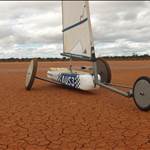
Yes but landyacht sailbaords are dealing with two elements.Wind and water...
The wheel has been around since the dawn of time.Thats a long time to perfect something that is ...simply...round... If you held your towel up on a land yacht you could beat water speeds.
You can't compare landsailing speeds to water sailing speeds , if thats what your getting at.
I think some of the finest engineers spent three million bucks on a thing called "Yellow Pages " only to be beaten by a windsurfer.. Sooo i don't think we're doing too badly.
. would go well with your pyjamas when you get home after a big day wave sailing,and mummy cooks you a nice dinner.
If you held your towel up on a land yacht you could beat water speeds.
Sorry to take it all so seriously, but heres some food for thinkin on. Yuor speed boareds get all the attention ,down to the slightest flaw, but it your rig really aerodynamic or just a best fit for the materials. I took this photo of a cammed sailboard leading edgenext to some wings that are designed to a NACA formula the fatter one is Collin Palmers offerin to the wind Gods that came from his class 2 as raced in Argentina. The skinny one is an offering from Richard Jenkins Windjet . Yuo can see that ,basically the sailboard has a fat rounded edge not unlike an early experiment in flight. .

In the early 1980's ,landyachts had big pockets on thier sails,this when sailboards were just moving up to glass masts AND aluminium booms, and even radial cut sails.
A smart sailor called Stan Sharpe decided that the fat rounded leading edge wasnt fast enough and built a decent leading edge for his mast. 
This gave a more aerodynamically accurate and cleaner entry for the 12" pocket on the sail.this particular mast had a rotation spanner that connected to a swinging seat and in total was known as "BANDIT" The wing proved very good in racing and gave Stan an edge for 2 years until swinging seats were banned
Just something to consider when next you ponder your magnificent flying machine and wonder how to make it fly better