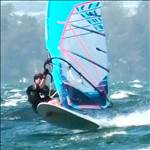


I have only been sailing a couple of months and find I spend most of my time going slow with the sail back just trying to keep position.I don't use a centreboard but am thinking it may be my only option.How do people stay in position without a centreboard?
Generally three options to get upwind. Firstly displacement mode and use a centreboard with a board equipped with one or the board rail if the board doesn't have a centreboard. There are a bunch of other things you can do too to keep upwind but on a short board its generally boring and a pain to stay upwind.
Secondly planing and comfortably powered up, point into a tight reach. Much quicker and more fun.
Thirdly in the waves, use a wave to get upwind.
Tacking instead of gybing means you don't lose ground in transitions.
i had the same problem at first , with out planing in the harness it is really hard to get up wind it was always a battle just to get back to the stairs . The only easy way out is a bigger fin .
look upwind, and rake the rig back a touch. if you are on a small board you will most likely need to sink the windward rail a bit as well.
this guy cribb sheet is a pretty good reference
www.guycribb.com/userfiles/documents/Look%20Depressed.pdf
I use a pretty small fin, 18cm, and I don't find I need to sink the rail as much as guy cribb suggests but your mileage may vary
basically if you aren't planing, you should be sailing upwind and looking for that next gust.
Even not planing it is important that you try to maintain some speed, also don't sheet in too much as it will just push you sideways. Try and put your feet on the windward rail and tilt the board upwind 20-30 degrees. Also it is important to rig ther sail properly, check downhaul and outhaul settings.To gain even more upwind you need more power and speed, you need to be planing in the straps for that. Cheers
without a centre board this is a normal stage in the learning curve.
As you gain experience, you'll be able to go faster, this powers the fin up allowing you to push against it to get up wind.
My subplaning technique is to sheet out a bit, sink the leeward rail a bit trim the board so most of the flat part of the rocker is in the water, without sinking the tail too much. You want to minimise forward resistance and maximise sideways resistance, and have the sail pulling you forwards not sideways.
you should teach me what your doing
I CANT STOP GOING UP WIND and stalling lol
best tip i can say - get to gether with some guys from here and chat and hopefully meet up with some of them
i learn more watching and listen to moby in 2 hours then 6 week trying it for my self
I also have had this problem. As a beginner aswell this is how i go upwind. Firstly a big fin help heaps. In light wind shuffle ur feet forward closer to the base and rack the sail back a bit. Worked for me but i have a wide board so im not sure if this will help u.....
Billyboy- Tilt ya mast forward a little and slightly sheet out. You shouldn't round up into the wind then.
Kpd- Do the opposite. Mast slightly layed back and pull boom towards you (Sheeting in), and put weight over the wind-ward side rail. You should go up-wind nicely then.
Let us know how you go

I put the centreboard back in today then sail at Manly for 3 hrs got out where I got in had heaps of fun so looks like baby steps for me.
This is one of the more difficult skills to explain and usually it would be easier to have someone coaching you because it has a lot to do with 'feel'.
Its to do with the push of the sail and the resistance of the board. To go upwind well, you want the push to be very very slightly more toward the tail of the board than the resistance of the board, but not too much or the board rounds up into the wind.
I remember when I was learning, I had moved so far toward the nose of the board I was up to my calf in the water and leaning the sail forward and I couldn't understand why the nose wouldn't turn downwind. It was because the resistance of the board had moved so far forward because I was sinking the nose so much.
You want the board to be flat in the water. You do not want the nose up and tail down or to sink the nose too much. The movements required are quite small and subtle that make the difference between going upwind or not.