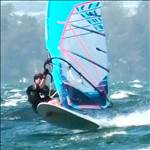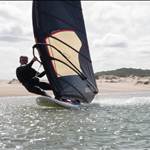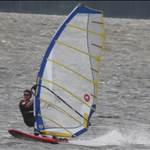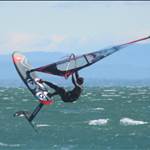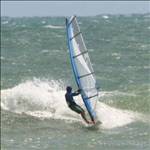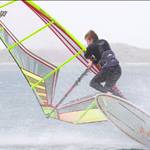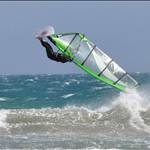


I sail a 105ltre bump & jump board & am 65kgs odd.I can uphaul it if it isnt too choppy & Im very careful.Sailing in gusty 5 - 20kts winds .The wind drops to buggerall I'm out of the straps . I start to gybe with the rail weighted but then some chop will throw me off balance & I'll weight the other foot & go straight for a bit and then wobble all over the place trying to get my balance & the board under control & generally fall in..@#$$!!!!... If I try & use the sail as well I find it heavy & hard to control & generally lean too far back & fall off .
Gybing used to be so easy..?

If I try & use the sail as well I find it heavy & hard to control & generally lean too far back & fall off .
i sail on a 75l board and i weigh 65 .. i handle chop by bending my knees huge .. and trying to bend ya knees as ya go over the chop and puch down hard on the other side to help keep ya board in contact with the water ..
I think Gingerpom is right. The key is to keep the sail powered up as much as possible to keep as a counter balance. Flip the sail after the turn.
subplaning in gusty conditions its easier to tack then gybe in my opinion. 65kg on a 105L board shouldn't be too hard with a little practise.
I'm having the exact same problem as sboardcrazy at the moment. My main problem I gybe (planing) and the wind will hull unexpectedly (usually during my foot switch), the wave behind will then make me go faster than the wind at the critical time, the sail back drafts.. and a proverbial cropper ensures. I put another nice ding on my board before I giving up yesterday and going back to tacking .
GP: what do you mean by putting back hand against ear ?
Ja
it basically moves the coe and the sail way forward. ie. like a flare gybe on a longboard.
when you have no wind you are steering the board with the rig.
Here's a quick video of what those guys are talking about:
If you're not planing, then rail pressure will do nothing...
Aha! I've certainly found I have to wrestle to get any result...Where are your feet supposed to be when you do all this? I can usually do those kinds of gybes in flat conditions or on a bigger board but find it easy to wreck on the smaller board in chop.
I'll try using the sail more to steer but I seem to always get into trouble when I start to try and manhandle sails..I've tried to keep sailing all winter so I'll be fit for summer but I think the lousy gusty conditions are just giving me bad habits!  Since I started reading this forum & trying to gybe like everyone says to I just get worse..too much thinking..
 not enough instinct..
im no expert with my gybes but i allways keep my knees bent and sail sheeted in hard ... as my board passt dead down wind i step my old front foot into the new position imbetween front and back strap amd straight away ajust my font foot further forward .. ruffly equal with mast base .. come out clew first on a broad reach and flip rig when stable .. if over powed i keep further back on board a lil for the rig flip so i dont CATAPULT but the only way to get better at jybeing is by doing them .. al the time ... no tacks
> If you're not planing, then rail pressure will do nothing...
> Where are your feet supposed to be when you do all this?
Concur with the fine instructions given above.
(I wished I didn't know these things, but I live in a place that goes from planing to non-planing very quickly - annoying.)
You pull yourself through with the sail only, the clew hand is that one that keeps the sail full. My son has this problem that he stops pulling the clew in, which stops the turning of the board. Not sure the video is that relevant - board too big, but that part is right: she keeps pulling the clew past windward as she turns around to keep it full.
Feet: they do little, as sinking of rail does nothing. However, in stronger non-planing, you will feel the twist of the body through your feet: this is what turns the board underneath. (Like many freestyle moves too.)
Technically, you can practice these kind of gybes... in planing conditions. Just slow the board before doing it. Methink the learning of some non-planing moves should take place in stronger conditions first.
I personally disagree that tacking should be done instead: both are useful to master (in these parts anyways).
your feet stay pretty much in the same spot as when sailing. unless you standing up near the mast in which case you need to move back further on the board to initiate the transition. the thing is to make the transition fairly quick and throw the rig forward and to windward as ginger pom said.
the longer you stall the gybe or sail dead downwind, the more chance of falling off as the swells keep unbalancing the board. to start with it's ok to fall backwards into the water as you scissor the board. you will be in a clue first waterstart position. with practice you get used to it and learn to use the rig to stop yourself from getting wet.
i agree with pierrecs comments also. it can be very helpfull to sail along clew first to practice the technique. easiest way to do this is to come out of your normal gybes and just keep sailing along clew first. the local freestyle guys practice sailing along switch stance all the time.
with your normal carve gybe.....
i reckon you're right, thinking about it is a killer. i read somewhere (may have been guy cribb) that a gybe takes 4 seconds. so if you think about what you are doing it's too late to release the sail. like nicko i also usually start to change feet when pointing downwind. that is a step gybe. also try to keep my knees well bent.
just be carefull with the sheet in advice as this can lead to oversheeting the gybe and getting hammered on the sail flip. you need to start to sheeting out before you are pointing dead downwind.
that said, i am certainly no expert at gybes. i only really plane out of 2 or 3 in 10 gybes. people like guy cribb and Co are the experts. the 2 incorrect things i seem to do are 1. stall the gybe by not timing the rig rotation. 2. exit on a beam reach instead of a broad reach.
If Im powered up for a planing gybe (with my rare good ones  ) I usually change my feet after I have come out the other side & flipped the rig...Although I often end up with a foot in both front straps so i suppose I must change something... I think one problem I have is in the old days I used to do a large radius planing turn so i didnt lose speed.Now I am thinking so much of not losing ground upwind that maybe Im trying a too tight radius turn which then puts more weight/power in the sail...? I used to just get it carving flat out & then let the rig flip early & grab it as I came out planing..the rig would be weightless ..none of this pull the rig on & battle it as you do the gybe like I seem to do these days...

I change my feet position prior to getting dead-downwind. This enables me to keep the board turning.
Flickyspinny said
I change my feet position prior to getting dead-downwind. This enables me to keep the board turning.
Is that in a planing or non planing gybe?
before I giving up yesterday and going back to tacking .
) I usually change my feet after I have come out the other side & flipped the rig...Although I often end up with a foot in both front straps
in my mind and without seeing you you are not flipping early enough. try flipping earlier. if you are doing tighter arcs then you need to release the rig earlier still.
(planing gybe)
It works! I went back to my old habits for the more powered up gybes & concentrated on turning the board & flipping early & in non planing I used the rig ..Mind you it makes a difference having a lovely consistent 10 - 15kt NE for once rather than 5kts or 30kts +!
Love the cat avator Gestault..it doesn't look happy!
i'm stoked things work out sbc
the cat isn't happy cause to be honest i am also guilty of not flipping the rig early enough . i know i'm doing it but i still do it.
there really is some quality advice from the guys above. i'm thinking ginger pom is actually guy crib.