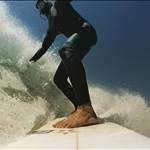


There isn't a lot of technique discussion on this forum sub but hopefully my post is still welcome. I had a breakthrough while gybing the other day, after practicing in the carpark and on the water, i found that intentionally keeping my leading hand over my head during gybes and tacks made a big improvement on my balance, leading to a much higher rate of gybe success.
Furthermore, I made an adjustment to the mast position (1.5cm forward of where i was), which also seemed to massively improve the balance of the setup, which led to both going faster more comfortably, and further improvement in gybing success.
Needless to say, I came off the water pretty psyched.
Reflecting on this, I recall a surf instructor talking about being stacked on the board (knees above ankles, hips above knees and shoulders above hips) leading to good balance and therefore good board control. I feel like this is also the case winging, but we are often not stacked when powered up (we have to counterbalance the pull of the wing and therefore spend a lot of time leant over) and have to transition to being stacked when unpowered. I think up until this point i wasn't appreciating the moment/weight of the unpowered wing, and how having this in front or beside me was ruining my weight distribution. By placing my hand over my head, it 'stacks' the wing, and then my centre of mass was directly over the centre of lift, giving me additional balance.
In the second scenario, I wasn't appreciating that my board probably wasn't as balanced as it could be, and that I could still ride with an unbalanced board, but this was forcing me to compensate, leading to reduced top end and a higher gybe fail rate. By improving the balance of the board, it meant that there was a reduced moment (in this case nose weight) on the foil, once again leading to improved balance and better performance.
I have seen many discussions on mast position, but i thought that mostly related to getting on foil or achieving stable powered flight. I haven't found much on wing position while flagged. Is this just so obvious to all other wingers that it barely needs saying? Or are there other wingers, like me, who keep ogling new gear and then realize (or not) that they could massively improve their performance by 1. improving their own and 2. improving their system's balance?
Select to expand quotekookfoil4 said..
i found that intentionally keeping my leading hand over my head during gybes and tacks made a big improvement on my balance, leading to a much higher rate of gybe success.
I am teaching the exact opposite to the beginners - don't bring the wing above you in the jibes, keep it more forward. For the beginners a common problem through the turns seems to be the weight being too far back, which results the foil to stall and the speed to decrease to a point where it's not possible to fly through the turn,
Here's a clip showing how to keep the wing in front of you, even exaggeratedly so.
Thanks, thats really interesting!
I was pushing my wing in front of me previously, but I would find in the last quarter of the gybe, what started as a wing in front would end up as a wing to the side of me (because of the turn), and this would mean i would either have to reach with my back hand (causing an overbalance and crash) or I would have to pull the wing towards me (upsetting the rhythm of the turn and leading to a mid turn correction).
The wind looks pretty light in your video, I don't have film but i usually sail in 18-25kts with a few 1-2ft bumps.
If a beginner falls off the back of the foil with the wing over their head, could this mean that their body is not far enough forward?
Select to expand quotekookfoil4 said..
this would mean i would either have to reach with my back hand (causing an overbalance and crash) or I would have to pull the wing towards me (upsetting the rhythm of the turn and leading to a mid turn correction).
Different conditions (like the wing size, wind strength, and your riding speed) definitely require slightly different approach while initiating the jibe. But the general idea is that you shouldn't need to reach for the back handle. Instead, if you concentrate on turning, the back handle will eventually come to you.Select to expand quotekookfoil4 said..
If a beginner falls off the back of the foil with the wing over their head, could this mean that their body is not far enough forward?
Yes, exactly.
Select to expand quotekookfoil4 said..
There isn't a lot of technique discussion on this forum sub but hopefully my post is still welcome. I had a breakthrough while gybing the other day, after practicing in the carpark and on the water, i found that intentionally keeping my leading hand over my head during gybes and tacks made a big improvement on my balance, leading to a much higher rate of gybe success.
Furthermore, I made an adjustment to the mast position (1.5cm forward of where i was), which also seemed to massively improve the balance of the setup, which led to both going faster more comfortably, and further improvement in gybing success.
Needless to say, I came off the water pretty psyched.
Reflecting on this, I recall a surf instructor talking about being stacked on the board (knees above ankles, hips above knees and shoulders above hips) leading to good balance and therefore good board control. I feel like this is also the case winging, but we are often not stacked when powered up (we have to counterbalance the pull of the wing and therefore spend a lot of time leant over) and have to transition to being stacked when unpowered. I think up until this point i wasn't appreciating the moment/weight of the unpowered wing, and how having this in front or beside me was ruining my weight distribution. By placing my hand over my head, it 'stacks' the wing, and then my centre of mass was directly over the centre of lift, giving me additional balance.
In the second scenario, I wasn't appreciating that my board probably wasn't as balanced as it could be, and that I could still ride with an unbalanced board, but this was forcing me to compensate, leading to reduced top end and a higher gybe fail rate. By improving the balance of the board, it meant that there was a reduced moment (in this case nose weight) on the foil, once again leading to improved balance and better performance.
I have seen many discussions on mast position, but i thought that mostly related to getting on foil or achieving stable powered flight. I haven't found much on wing position while flagged. Is this just so obvious to all other wingers that it barely needs saying? Or are there other wingers, like me, who keep ogling new gear and then realize (or not) that they could massively improve their performance by 1. improving their own and 2. improving their system's balance?
Sounds like you are doing some good analysis on your own technique, which is definitely the key to progression. New gear might allow some improvements but the age old, pro's can rip on anything, is always true, and that mainly comes from practice and time on water/foil.
For me the learning was in focusing on the foil, your body position for how to carve, either with or without the wing should be the same. If not, you are overcomping on something. Initially that riding foil sensation is hard and feels so foreign but with time it feels just like riding a board, and your body position is the same. Think about what would happen on a skateboard if you put more or all your weight on your back leg - it wouldn't be pretty. I reckon this is probably harder for folks that don't come from a board sport to foiling, but we all get there in the end.
Have fun
So for me that stacked posture is about the relationship between wave energy and speed. If your body is bent your muscles are going to absorb the vertical component of wave energy where as if your vertical the energy has no place to go but into ride height and speed, conserving energy. Also it forces you to fly the foil more which is a better technique for turns