
Surfboard Fins: Match Your Setup to the Surf

Quick summary
Your fins determine how your board drives, pivots and holds in a turn - changing them costs less than a new board and can transform how a session feels.
Two plug systems dominate: FCS II (tool-free, slightly looser feel) and Futures (single-tab screw, stiffer and more direct). They are not compatible with each other.
The how-to
After reading this you can match your fin setup and material to the waves you actually surf most often in Australia.
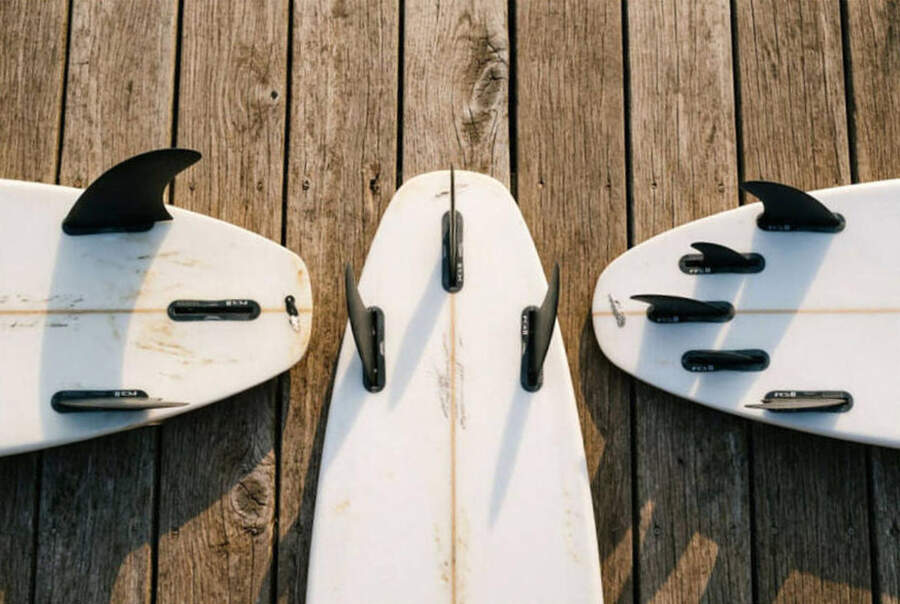
Simon Anderson was a Sydney shaper from Narrabeen when he paddled out at Bells Beach in 1981 with three fins on his board and won the Rip Curl Pro.
The thruster was born that day, and it still defines how most surfers think about fins - but it is one of four configurations, and the others suit Australian conditions more often than people realise.
FCS II vs Futures: the system you are locked into
Before choosing a fin, check what plug system is in your board.
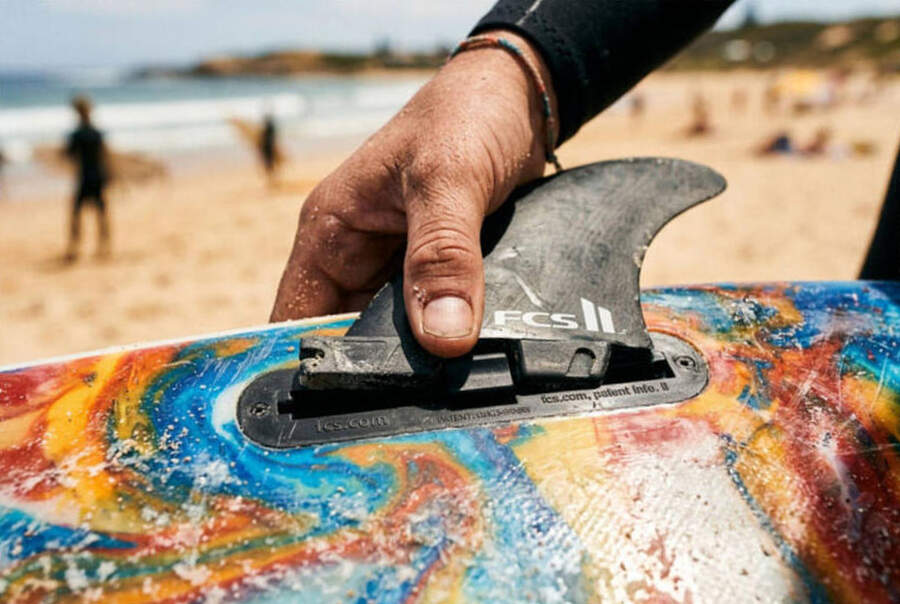
FCS II uses a two-tab, keyless system - press the fin in from above and it clicks into the box with no tools required, which means mid-session swaps take seconds.
The two-tab connection has a small amount of flex at the base, which most surfers describe as slightly looser and more forgiving through turns.
Futures uses a single-tab system requiring a grub screw to lock the fin in place.
The solid single-tab connection is stiffer, transferring energy more directly from fin to board - most surfers who have ridden both describe Futures as more connected, with crisper feedback on rail.
The systems use completely different base geometries and there is no reliable adapter between them.
If your board has FCS II boxes, buy FCS fins; if it has Futures boxes, buy Futures fins.
Australian shaper output skews toward FCS II on high-performance shortboards and Futures on heavier-swung, bigger-wave shapes - but both systems are widely stocked at surf shops nationally.
 Thruster: the starting point for most surfers
Three fins - two side fins angled inward and one centre fin - give you the combination of drive, pivot and hold that works across the widest range of Australian conditions.
The centre fin creates drag, which is exactly what gives you control in steep, punchy beach break: it keeps the tail from washing out when you drive hard off the bottom.
Thruster suits beach break well because Australian beach breaks tend to break fast and section quickly, rewarding pivot over projection.
Vertical snaps, tight pocket surfing, lip hits - all of these movements work best when the tail has a braking point to push against.
If you surf one break 90% of the time and it is a typical east coast beach break (Manly, Maroubra, Bells, Currumbin Alley, Scarborough, Bondi) the thruster is the right default.
"Running the wrong fin setup on a pointbreak is like trying to drive a racing car on the wrong tyres - the board can make the right line feel like hard work."
Quad: more speed, wider arc
A quad removes the centre fin and replaces it with a second set of smaller side fins set further back, eliminating the main drag source in the middle of the tail.
The result is noticeably more speed down the line, a longer turning arc and a looser, more skate-like feel in between turns.
Quads perform best in two distinct conditions: small, weak surf where you need to generate your own speed, and long open-faced surf where you want to project through sweeping turns rather than snap back to the pocket.
For Australian point breaks - Snapper Rocks, Kirra, Margaret River main break, The Pass at Byron - quads pay dividends when the swell is running with long open sections.
The downside: quads can feel squirrely in steep hollow beach break, and they do not hold as well as a thruster when you try to drive straight off the bottom in a fast-pitching wave.
Many intermediate surfers keep a quad set and a thruster set and swap based on conditions rather than buying two boards.
 Twin fins: loose, fast, for specific conditions
Two fins with no centre fin is the oldest shortboard fin setup and it is having a genuine revival, partly driven by wider fish shapes that suit Australian summer conditions.
A pure twin is the fastest flowing setup you can ride - speed generates easily, the board pivots off the front foot rather than the rear, and you feel everything the wave is doing through the bottom of the board.
The trade-off is release - there is no centre fin to stop the tail washing out, which means you cannot drive as hard on your back foot as you would on a thruster without the board spinning out.
Twin fins suit experienced surfers comfortable making micro-adjustments to weight distribution, and they work best in smooth, powerful surf rather than choppy close-outs.
For Australian conditions: summer points and reefbreaks in 3-to-5-foot surf are where twins shine; commuter beach breaks in short-period windswell are where they frustrate.
2+1: for logs and mid-lengths
A large centre fin with two small side fins is the longboard and mid-length standard.
The single large fin provides drive and direction; the two small side boxes let you add stability and eliminate spin-out without locking in the full pivot-resistant feel of a pure single fin.
If you are riding a board longer than 7 feet, the 2+1 is almost certainly the right choice - the physics of a long board require a centre fin that tracks, not three equal-sized fins that produce excess drag at low speed.
Fin materials: what actually matters
Plastic fins come standard on most beginner boards and work adequately in small surf, but they flex unpredictably and damp the feel between board and wave in a way that makes reading conditions harder.
Fibreglass is the right step up for any surfer past the beginner stage: the material loads under pressure in the bottom turn, stores energy, and releases it as you redirect up the face.
You can feel a fibreglass fin working in a way plastic fins do not allow.
Carbon fins are stiffer, lighter and significantly more expensive - the performance gap compared to fibreglass is real but narrower than marketing suggests, with testing by fin manufacturers suggesting a 5 to 8 per cent difference in real-world conditions.
Fin template and foil shape matter more than material: two fibreglass fins with different designs will feel more different from each other than a fibreglass fin and a carbon fin sharing the same design.
For most intermediate surfers a quality fibreglass set represents the best value - equivalent performance to carbon in everyday surf, a fraction of the cost, and harder to damage in the fin box.
Sizing: the dimension most surfers ignore
Fin manufacturers publish sizing guides based on body weight, and those guides exist for a reason: an undersized fin on a heavier surfer produces a loose, spinny board that is harder to control, not more manoeuvrable.
A 75 kg surfer running fins sized for 60 kg will feel the board washing out under load in solid surf.
Start with the weight range your fins specify, then experiment one size smaller if you want more pivot or one size larger if you want more drive.
FCS and Futures both publish weight/size charts on their Australian sites and in most retail surf shops that stock fin accessories.
 How to trial fins without buying blind
Buying three sets of fins to find out which suits your local break is expensive - there are cheaper paths.
Second-hand fin sets in FCS II and Futures are plentiful on local Facebook Marketplace and Gumtree listings for 20 to 40 per cent of retail, with negligible performance loss from previous use.
Some Australian surf shops - particularly independent shapers' stores rather than chain retailers - maintain demo fin programs that let you borrow a set for a session for a small deposit.
Swapping with other surfers at your local break is the fastest education available: an hour on someone else's quad after riding your thruster for months tells you more than reading about the difference.
Check current conditions at your local before swapping - the same wave can suit a thruster on a low-tide hollow day and a quad on a high-tide open-faced day, and that switch is only worth making if conditions align.
Track the swell and wind before your next session via the Seabreeze wind forecast , then decide whether today is a thruster day or a quad day before you even hit the car park.
Frequently asked questions
Can I run FCS fins in a Futures box? No. Adapters exist but introduce flex and instability at the base - buy the correct system for your board's boxes.
Is a quad faster than a thruster in all conditions? No. Quads produce more down-the-line speed in weak or open surf but give up pivot and control in steep, fast-breaking waves where the centre fin's drag is what keeps the tail honest.
How often should I replace fins? Fibreglass and carbon fins last years with normal use; replace them if the foil is chipped, the base shows cracks, or the flex pattern has noticeably softened, all of which indicate delamination.
Do I need different fins for winter? Not for fin type - but stiffer fins suit colder water because cold water requires more input to produce the same flex response. If you feel your board has gone dead in winter, try sizing up half a step before assuming your board needs a re-wax.
 rye, VIC