
Duck Diving: Getting Through the Break

Quick summary
Duck diving works on shortboards and lower-volume boards under about 36 litres - not longboards, and not your foamie.
The two things that determine success are timing and depth: start too early or stay shallow and the wave wins every time.
The how-to
After reading this, you'll be able to time your entry, sink the board to the right depth, and angle your way through overhead surf without getting washed back to the beach.
Duck diving is what separates the surfer who's in the lineup from the one still fighting the whitewash.
Get this right and a 2-metre shore break becomes a manageable paddle-out.
Get it wrong and you'll be swimming backwards through the impact zone while your board skyrockets toward the beach.
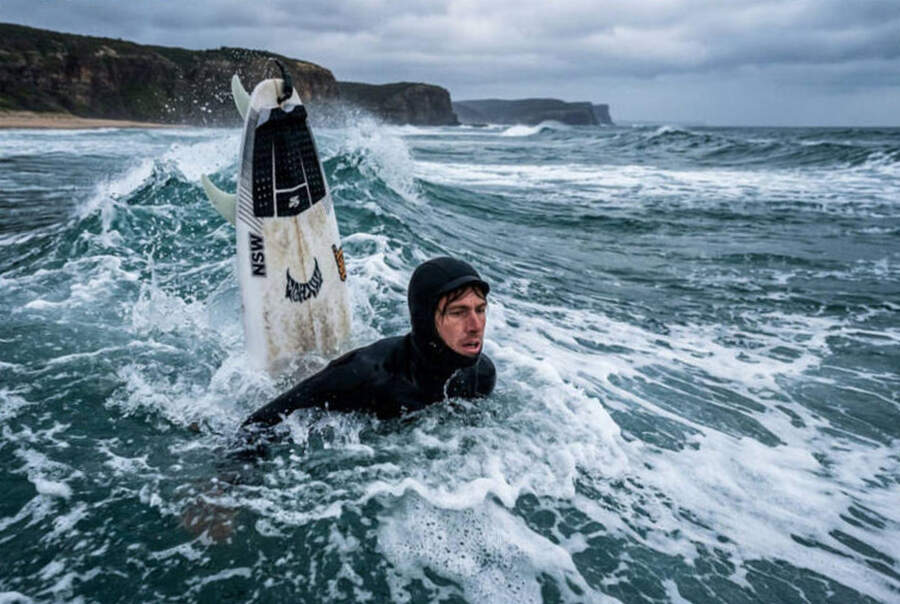
First: will your board actually duck dive?
Volume is the deciding factor. A shortboard under 30 litres dives cleanly for most surfers.
A standard 6'2" shortboard sits around 27 to 32 litres - manageable for a surfer weighing 70 to 85 kilograms.
Above 40 litres, including most mid-lengths, hybrids, and any foam learner board, duck diving becomes a battle you won't win.
Longboards and boards 9 feet and over need a turtle roll - lie on your back, grip the rails, and let the wave roll over you.
As a working rule: if you can push the nose 30 centimetres under calm water while kneeling on the beach, the board will duck dive in surf.
"Timing is 80 percent of duck diving. The strength needed is less than most people think - what beats surfers is starting too early or committing too timidly."
That observation from coaches at Let's Go Surfing, Bondi's longest-running surf school, lines up with what the data shows: most failed duck dives aren't strength failures.
Preparation - building the paddle speed
You need momentum going into the wave or the dive won't carry you through.
At least three hard sprint paddle strokes before you start the dive is the target - the board needs to be moving at near-sprint pace when your hands hit the rails.
Stop paddling and look at the wave early and you've already lost the dive before you started.
Stay low on the board with your chest close to the deck - a high body position lifts drag and kills your paddle speed.
The entry - hands, timing, angle
When the wave is 1.5 to 2 metres away - roughly one board length - move both hands from paddling to the rails, positioned about 30 centimetres back from the nose.
Arms straight, shoulders over the board.
You want to start the push just before the lip breaks, not as it crashes.
Diving into a breaking lip pushes you down violently - aim for the shoulder of the wave face, just ahead of the whitewater.
A useful visual cue: watch the curl at the top of the wave.
When you see it pitching forward, start your dive.
Sinking the board - the push and the kick
Lock your arms straight and drive your body weight through the nose to push it down.
You're not bending your elbows and pressing like a push-up - you're leaning your full weight over the board with locked arms, letting gravity do the work.
The nose needs to reach 40 to 60 centimetres below the surface.
Anything shallower and the wave catches the board's underside and rips it back.
Once the nose is down, bring one foot to the tail pad - your back foot works better than your knee.
Using your knee reduces use and dents foam over time.
A single foot on the tail gives you the control to angle the board back toward the surface at the right moment.
Getting through - staying down, angling up
The urge to surface early is the most common reason duck dives fail.
Once you're under, hold the position until the turbulence passes over you - typically two to four seconds.
If you feel drag pulling the board back toward the beach, you haven't gone deep enough.
Once the pull eases, shift your weight forward off the tail and tilt the nose gently upward - think 20 to 30 degrees, not vertical.
The board will angle you back toward the surface and you'll emerge facing the open ocean, already in paddling position.
Do not push off the bottom of the wave with your legs to resurface faster - it disrupts your board angle and brings you up too early.
Let the buoyancy of the board do it naturally.
Failure diagnosis - five patterns and their fixes
Getting pushed backward despite a clean dive: you went too shallow.
The bottom of the board is catching the wave's energy.
Next session: consciously count to three after the nose goes under before thinking about resurfacing.
Surfacing just as the wave hits you: you started too early.
If you're coming up into the foam, delay your entry by half a second - wait until you can almost touch the wave face with your leading hand.
The board bucks upward and slaps you on the way through: you're not getting the nose deep enough before the wave arrives.
This usually means you need more speed going in - focus on the sprint paddle stroke before the dive, not the dive itself.
Exhausted after two or three duck dives: you're muscling it.
Drop your arm position forward by 5 centimetres and use your body lean rather than your arm push - less fatigue, same result.
Success on chest-high waves but getting washed on overhead: the depth required scales with wave size.
In overhead surf the board needs to be at least 60 to 70 centimetres under, which means committing earlier and pushing harder than you would on smaller waves.
Board size and winter swells
June through August brings the most consistent overhead surf to NSW and southern QLD beaches, with Southern Ocean groundswells running 1.5 to 2.5 metres on exposed points and beach breaks.
This is the time of year when a reliable duck dive matters most.
If you're on a board bigger than your usual shortboard - transitioning from a bigger-wave gun back to your daily driver - recalibrate the depth and timing.
More volume means the board wants to resurface faster, so hold the nose down for longer before angling up.
For any session over 6 feet, consider whether the current board is right for the conditions - a board you can't dive is a board that exhausts you before you reach the lineup.
Check the Sydney surf and wind forecast before sessions to assess whether incoming swell will demand duck dives or whether a turtle roll will be sufficient for your board size.
Questions surfers ask
Can I learn duck diving in small surf? Yes - waist-to-shoulder-high surf is the best place to build the muscle memory. Work on depth and timing in small waves so the technique is automatic when size doubles.
What if I'm on a mid-length and can't duck dive cleanly? Turtle roll. Flip the board upside down, grip the rails at chest width, and wait out the wave. It's slower getting out but it protects your body and the board.
Does wax or tail pad placement affect the dive? Yes - make sure your back foot landing on the tail pad is a clean, deliberate placement. A slipping foot costs you the use on the tail and kills depth control.
How do I know if I went deep enough? The feedback is immediate: if the wave moves you toward the beach, you were shallow. If you slide cleanly through and emerge with forward momentum, depth was right.



 Stafford, QLD