


I don't know ! there's got to be a better way to run an economy than this. Boom ....Bust.....Boom.....Bust...Is this our ONLY option.
Is it possible to run a command style economy in a democratic country? Is it possible to have the benefits of an entrepreneurial private sector with the ability to for the government to dictate a "direction" in investment. Personally I'm pretty underwhelmed with the economic system we're running now. OK ,one example. The government allows people to own as many houses as they like, they encourage it by allowing tax breaks (negative gearing), then younger people can't afford to buy a house because the investors have the cash behind them. First home buyers are constantly outbid by investors at auction. So the younger people are forced into renting in an over inflated housing market. We now have some of the most expensive real estate in the world. What a ****ed up system. How about this..... The government removes housing as a form of investment by limiting the amount of housing anyone can own. OK, so you can own 2 houses a residence and a holiday house or farm or whatever and if you want to invest your money then invest in something meaningful like shares or whatever. I await my flogging!
One thing is for absolute sure and that is if we continue with the current system then the framework that supports the whole bangshoot, the environment, is going to break beyond repair. This does not mean the end of the world but it does mean the demise of the human species.
Hell, all I know is that a system that benefits the few at the expense of the others is a ****ed system.... get a better system
I don't think that negative gearing is the big baddy that every one makes it out to be?
And I don't own any houses at all ( the house keeper ended up with that one)
The investors get to claim the losses as a tax deduction and have to pay tax on any profits.. Just like any other business..
I think the problem years ago when negative gearing was taken away, was that there was a sudden lack of rental accomodation, it was about then that gov worked out that the gov housing was not adaquate, and could never catch up
^^^^
You can sure pick the young ones in the room!
Yes... pretty sure it was the Hawke Labor government in its early years. They scrapped the tax breaks then given to rental property investors. Rents skyrocketed as investors bailed out and there were very quickly eff all properties available for anyone to rent.
Sanity soon prevailed and Keating (re)introduced negative gearing on property and shares (among others). The thinking was exactly as someone here said - it's a business and so it should be treated as any other business. You pay tax on the income but can claim on your expenses. The capital gains are taxable on sale.
When it was introduced, CGT was much tougher - it was based on the CPI from when the property was bought to when it was sold. The tax office did (and probably still does) publish tables to use in working it out. It was later simplified to the current 50% taxable scheme that's currently in force by Little Johnny and his treasurer Scrooge McOstello.
So sayeth my memory... but it's Friday... and I've had some Friday beers. So my memory may be a little shyte. And so here endeth the lesson.
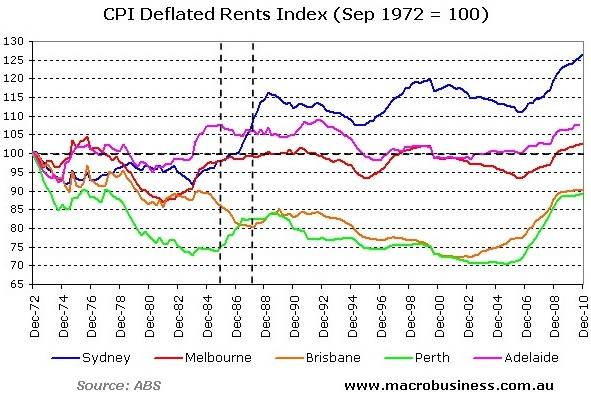
FN, I'm guessing your chart shows dollar rental values over time adjusted for 1972 dollar values. Looking at your chart, I wouldn't have wanted to be renting in Sydney or Perth. Sydney rents were already on the increase before the scrapping of negative gearing and they rose even more sharply afterwards. Rents in Perth also started rising when it was scrapped. The other capitals were either unaffected and in Brisbane they continued the fall that started before the event.
What you say about markets is all well and good over the long term. But rent/house situations can take years to turn around.
People who are renting either don't want to buy or can't afford to. Scrapping NG means more investors are likely to sell which increases supply and puts downward pressure on prices. So eventually, some renters can afford to buy that couldn't previously. BUT it can take significant time for them to raise a deposit, find a suitable property, find finance, etc, etc. So there is significant lag in the system.
If you think about it, it's also not true that selling a rental property just means that another one becomes available somewhere else. Sure, that'd be the case if there were a fixed number of houses and people in the market. But there isn't - population increases in most of our capitals which means that every year, more property is needed and only some of that will become available as a rental. If investing is unattractive, there is less demand to build new houses and so rental supply dries up. Again, there'd be significant lag in this.
Negative gearing is nothing more than claiming a tax deduction for the cost of investment, it is the basis of the whole ecojomy in that people will not invest unless they are rewarded with return greater than the bank rate plus a premium for the risk they take on, governments encourage investments through the tax break and hence lowering the required rate of return and hence increasing investment.
Negative gearing is also balanced by the fact investments attract capital gains tax where a principal place of resident does not and also how do provide housing and business premises without investment from the private sector into the housing / commercial prpoperty market, not all people can afford to by or some have no interest in doing so.
As for the first homeowners grant this is an example of a government artificially causing rising prizes as they basically said to every one the market is now priced higher by the factor of the home owners grant, however the real issue was the ease at which people could borrow money and hence the demand of housing was higher as more people had the funds to purchase, will the market correct? Who knows if these people cannot pay their loans they will default, banks will foreclose and the market will be lowered by the fact that the bank is selling house at a lower rate. Very much what caused the first GFC in the US.
Think I'll stop there, starting to feel like an essay.. Beer time..
Funnily enough I agree to a certain extent with both Pweedas and SomeOtherGuy. It makes sense that removing negative gearing for property will reduce the attractiveness of new property and over a period of time reduce the supply.
What I don't agree with is that the removal of it caused the immediate increase in rents, which is what is commonly claimed.
Either way, I also agree that removing it would be bad, and definitely political suicide. I do worry that the investors are getting an advantage that owner occupiers are denied and this skews the market towards investors and increases the prices.
It is interesting to me that the tax office allows a business to claim losses against their profits, but only for businesses that are intended to ultimately run at a profit.
Negative gearing on property seems to be an exception where it is fully expected that the properties won't ever return a positive income. Well, not in this decade at least. Not much of an investment, and very different to a regular business.
As an example, if I created a business to buy windsurfing equipment and rented it out (to myself) and ran at a loss, there is no way the tax office would allow this. It would be nice though.
So, allowing tax deductions for owner occupiers is probably the only practical way to increase the affordability of housing. Of course increasing the supply would help too. Why does such a big land like Australia have such an artificially limited supply of residential land?
I don't think that you can rent a house from yourself and claim a deduction, just like your wind surfing gear.
Owner occupiers already get a tax deduction for the houses they buy.. They don't pay CGT.
Really very simple.... If you open your mind
renting out a house is not a business it's speculation. Speculation that the market will increase in value. If you run a hotel or a motel then that's a business.
Command economic systems have been proven to not meet the demands of people and just lead to waste and inefficiencies. Command economies allow the economy to be used as weapons against the enemies of those who are commanding the system.
A policy to limit house ownership in Australia would kill the residential building industry completely dead and financially ruin many Australians. Capital would flee Australia as investors would fear such a policy was the first step towards the government locking down and confiscating private property.
People would flee as before you know it food production and distribution would be controlled so everyone gets their "fair share". Of course some people deserve more than others. Those who are the enemy of the controllers would be deemed not to deserve food as they are enemies of the state.
Without investment the economy stops dead. You will all be unemployed have no wages no assets and be truly f Ed. End of story ........

"Command economic systems have been proven to not meet the demands of people and just lead to waste and inefficiencies"
Yeah I know, people say things like that and also things like, "all white cats are blind", " Socialism doesn't work" and something about putting a spoon in the neck of a wine bottle. BUT.... how is it that we do somethings on a united national level(like going to war, having a central Bank etc ) and then on another level have to put up with a disorganised chaotic economic system that craps itself every 5 years.
All economies go through cycles of boom and bust, that is just how markets work, so there will always be crashes or corrections as they should be known, nothing you can do about it. It comes down to the cost and use of available capital and labour. I agree with your sentiments that there have been some major stuff ups and none more so than the US government but the economic system is not the problem, it usually comes down to lax regulation or practices which undermine the market, hence why we have regulation.
Well no, haven't there been examples of monarchs or despotic rulers or marxist leaders that have dictated this and that in the economy? I just get a little bolshy when people say "well that's just the way it is"
Well yeah there have been and at that point in time that may have worked but the world has changed and so has the economy, most of those feudal type system where closed markets, usually limited by national borders. I guess china is one example where it was a closed economy and is moving to a more free market cause there system didn't give what they wanted, you said it well above, does not meet the needs and wants of the people. A true free market in theory would need no government intervention or regulation but like politicians are going to stay out of it.
& nothing wrong with getting bolshy when people say that's the way it is. Need more people with that attitude
Yep. Capitalism is often confused with corpratism. They are two completely different systems though corpratism can develop from capitalism. The boom bust cycle is not a necessary result of capitalism. However it can happen and is a correcting mechanism in capitalism. Command systems lack this mechanism so resources can continue to misallocated without the crash to force corrective actions.
If you believe housing is too high in price, just wait a while and if you are right you will buy at a discount to today's prices. If you are wrong then oh well, you win some you lose some.