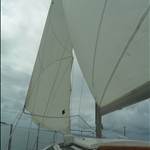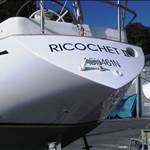


Enjoy Bird, pull that anchor and go and enjoy. The rest of us will keep the country running until your return Don,t forget the photos and trip report when you,re back.
Cheers
Ken
Engine failure on take off. About 5nm out the engine died. We were cruising at 2200rpm when she suddenly dropped to 1600rpm and hovered between 1200 and 1700 as we limped back in. She was on the point of dying as we got to the boatyard.
We need the engine to get into the lagoon at LHI (non negotiable) and to avoid getting becalmed in the east Australia Current, so we had to turn back to do what I thought would be a simpe filter change and buy more spare filters. I replaced the fuel filters, bled it as I have many times, the boatyard manager spent two hours on it, all to no avail. Take her for a run and she goes normally for a few minutes and then dies away, the last time back to idle revs.
She starts normally.
The tank was out to find that leak (still not resolved) and it is probable that the tank has a problem or air has got into the lines but we just couldn't clear it.
A new mechanic is coming along tomorrow and may solve the problem. If he does we will get away tomorrow sometime.
Not likely to be air in the high pressure side or it would not run or start easily. Sounds like its fuel related though. Do you have the fuel return line set up correctly, ie directly back to the fuel tank? The symptoms are similar to my mates fishing vessel who installed a new motor and had the factory set up where the fuel return line went back to the fuel filter instead of the tank. This is OK in trucks but not boats.
The other possibility is the stern gland since you have been tampering with it. Did it get hot and tighten up on the shaft. If you travelled 5 miles and then had the revs drop this could have the same effect. It should only get warm to the touch.
On our way for the 2nd time. Had Petrie in the diesel, too hard to explain.
All good now. Doing 4kts in 10. Kt breeze in tight direction. Fleming steering. About
5nm off Terrigal.
Talk again on our return.
Unberflukingleavable !!!!!!
So lucky he wasn't caught out big time .
Refund of money coming his way.
More news. Engine shat itself about 50nm out. Lord Howe eludes me for a second time.
Now to figure out what to do about the engine. I need a reliable donk, this is a cruising yacht not a cocktail boat so it may be a new engine is needed. I could do without the hassle.
What is the engine you have John??
If it runs for a while and then stops (ie the mechanics of the engine are right), it sounds like the problem is fuel supply or lack of more than anything else.
Make sure the surrounding engine systems (fuel supply,air supply, electrical, cooling and exhaust) are right before blaming the engine itself.
If it is a "Green Death Volvo" it might be a good idea to get rid of it. If it is a Yanmar, Kubota or Buhk, they usually only fail because of something around the engine.
A friend had a similar problem which he spent much time and dollars trying to fix and it turned out to be cockroach wing that kept getting sucked to the fuel tank outlet and blocking it.
You have had a fuel tank problem which more than likely has not been completely solved.
I would be making sure that system is completely right before ripping the donk out.
I have a Sole (Mitsubishi based) 3 cyl 20hp engine. I rebuilt it myself and apart from it being a bit noisier than modern engines it has performed well and has been a reliable little motor.
The boatyard appears to have indavertently mixed petrol and diesel in a container and put it in my tank. The engine ran for about 4 hours with petrol in the diesel, probably about 50% petrol, as we set off for the first time. It was displaying starvation symptoms so we suspected filters and returned to the boatyard under engine. When the mechanic recognised it had petrol in it we drained the tank and he got it going again with pure diesel. It ran well but we knew damage had been done due to the petrol. As you know diesel engines rely on the lubricating qualities of the diesel, petrol being a solvent removes the lubrication.
After about 6 hours running the engine suddenly made mechanical disintegration sounds, not main or big end bearings but more like a pump breaking down. I put it in neutral and the noise reduced but as I put the throttle up it started again. As I pulled the throttle back the engine revs ran away and by the time I got to the kill switch it was screaming.
At the mechanics direction we started it again and the noise symptoms returned. Diesel was spraying out of the injection pump itself.
Now to have it fully diagnosed. It might be just the injection pump and injectors but reading about petrol in diesel engines the news isn't good. The damage can be widespread, including the bores and rings, and not show itself for some time.
I will have to work it out with the boatyard over the next couple of weeks.
Sounds like the boatyard should bear the cost of repair as it was their stuff up in the first place. Or are they one of the "No Care - No Responsibility" type of operation?
I would think if they care one hoot about their reputation they should bear some of the brunt.
Doesn't sound too good at all John.
If you are stuck with a rebuild or replacement you might consider a Diecon marinised second hand Kubota engine.
A friend replaced his 2 cyl Volvo with a Diecon 3 cyl Kubota in his Adams 31. He is very pleased with it's performance over the last two years.
Hand starting with them is not an option as they have pre combustion chambers and glow plugs.
Diecon has been acquired by COR cooling and their web site lacks for links. You would have to phone them to see if they still offer the same services.http://www.diecon.com.au/index.html
John,
From my experience with diesel engines, if you put anything, other than diesel, through the injector pump it means a rebuild [by a diesel injector specialist] of the pump and injectors. Especially the pump.
I think you are right about the pistons etc, but you will have to strip it down to see what there damage is.
Phil.
Thank you for the advice. I am heading in the direction of a full dismantling, inspection and repair of the fuel system, head and at least the top of the cylinders and pistons.
It is likely the noise we heard wasn't the pump as the engine still runs ok but instead it was an injector remaining open. It indicates the petrol has damaged the engine.
The boatyard have been good and honest with me and others for 7 years so I accept sometimes **** happens. I am confident they will work with me to sort it out appropriately
Yep she is FWC and has less than a 1,000 hours. Before I got her she went from her mooring to the start line and back, 10 min each way, once or twice a week for about 30 weeks a year for 15 years.
I had confidence in her before this, properly repaired she should be ok again.
Just spoke to the boatyard and they are proposing to do the work I requested under their insurance. There are benefits from being loyal over many years to people you trust!
Now to go outside and get the front axles off the Triumph. Too many toys.
They are good blokes, I'm confident it will be ok.
Lord Howe next year is the plan. Want to come?
^^^ Want?.....Yes!!..........Possible???.........Don't know yet!.... I'll work on it.
The engine has been completed so I took her for a 30 minute run on the way to the mooring. Starts perfectly, runs smoothly and holds full power (3000rpm) easily. I ran her at 2600 rpm for about 5 minutes (speed 6.6kts) and at full power for 5-6 minutes (speed 6.9kts). Idle is a bit fast but otherwise smooth. No leaks.
I'll take her for a 4-5 hour run on the engine to make sure but all seems good.
The insurance company may put up a fight as the specialists couldn't find anything specific that could be attributed to petrol in the fuel. This is the boatyard's problem but I wouldn't want to see them not be able to claim. They can argue that the engine had to be dismantled to look for damage and the cause of the symptoms experienced. While damage can't be seen now, the injector letting fuel through the engine was caused by something and damage to pump and injector seals won't necessarily be apparent straight away as they deteriorate over time.
I came to this thread a bit late and noticed a statement by Ramona earlier in the thread. He said: "... where the fuel return line went back to the fuel filter instead of the tank. This is OK in trucks but not boats."
I have seen a few boats where the fuel return line goes to the filter (CAV type) and not the tank. So I'm wondering Ramona - can you expand a bit on the disadvantage of such a setup?
Diesel fuel normally comes from the bottom of a tank at low pressure to the primary and secondary filters and lift pump then onto the injection pump where it becomes high pressure. A lot of care is taken to exclude air. With a return line that goes back to the top of the diesel tank air in the system introduced then does not matter. Air introduced to the extra inlet of a Cav filter from the return line will cause running problems. The fishing vessel parked behind my old vessel had an ex navy Perkins installed recently. Superb engine but it came with the return lines to the Cav filter. Would run well but after 20 minutes or so the revs would fall. Diesel mechanic told him to rectify the return line and now its one of the sweetest motors about.
MorningBird said....
"The engine has been completed so I took her for a 30 minute run on the way to the mooring. Starts perfectly, runs smoothly and holds full power (3000rpm) easily. I ran her at 2600 rpm for about 5 minutes (speed 6.6kts) and at full power for 5-6 minutes (speed 6.9kts)."
That is a great result John. The performance you are getting is great too. Minimum 6 knots under power is where all yachts should be.
G'day Cisco. I have to say she hasn't run better since I first installed it after my rebuild (touch wood as I need to give her a long run to properly test it).
I had a 15" by 9" Gori two bladed folding prop which was way under propped. I could just get 6.2 kts at full power just after an anti-foul, cruise was 5.1 kts at 2200rpm with a clean hull and less when the growth started.
I have just fitted a new Gori 15" by 10" and coated it with prop speed. Cruise is now 5.7 kts at 2200rpm and other speeds as per the previous post. This is admittedly in smooth water so she will get less offshore in a chop.
Provided she is reliable on a long run it is a vast improvement.
I agree with Ramona. The injector spill return line should go back to the or a fuel tank.
If you have one main fuel tank and a day tank, I suggest the spill return line is better run back to the day tank which would help to prevent it running dry.
Also if your fuel gets contaminated, the day tank is less of a volume and easier to drain as it it is usually sited higher than the main tank.