

Hi,
my boat is fitted with a "PSS" shaft seal, a no drip contact seal. Since a recent anti foul the seal has squealed at certain engine revs. The noise starts at around 1400 rpm and disappears at higher revs. The noise can also be there when sailing and the prop is spinning due to the boat movement. The noise starts as soon a the engine reaches the critical revs and stops once revs change, so I do not think it is temperature related.
I have owned the boat for a few years, and the noise has previously happened after anti fouling, but not for very long. After some internet research I have pulled the seal back to let some water through and this helped for a short period of time. I have also added a gravity feed water supply to the bleed point.
Any my other ideas?
thanks
A bit more information, the noise starts just above idle, and goes away at 1400 rpm.
I just looked up the PSS seal and it works through a steel and a carbon plate being pressed against each other to form the seal. Is it possible the seal is worn out, the carbon plate has worn down and there is metal to metal contact at some revs.
I would ring the distributors, it is likely they have had experience of this already.
Morningbird, good idea to call the distributor and I will do that. I had thought about wear but the noise started immediately after the anti foul so that seems like a bit of a coincidence.
Does the PSS shaft seal require grease inserted as well as burping the water after slipping?
Ramona,
No, the instructions are very specific stating that oil, grease, silicon are not to be applied to the seal. They also state that a squeal can mean there is no water, but I had checked that by burping the seal, and checking that the bleed line is clear.
web site for PSS is here. http://www.shaftseal.com/en/product_categories.
LMY,
Check that amount of preload on the seal face is correct, The s/steal collar can be moved along the shaft to adjust this whilst the rubber boot provides the preload spring. There is a specific measurement for this that comes with the particular size seal you have.
I have a PSS seal and it works great, no squeaking
Jolene,
thanks for the feedback, it is interesting that you do not have the problem. I do not have time to work on the boat for a couple of weeks but am planning to talk to the supplier, check the breather / vent line then if the problem persists check the preload.
If anybody has the type of dripless seal that has a rubber carrier clamped to the stern tube for one half and a stainless collar on the shaft for the other, the collar will have two grub screws securing it to the shaft at 90 or 180 degrees to each other.
The pressure applied to the sealing faces is adjusted by the positioning of the collar on the shaft.
Of great importance is that the grub screws each have a locking grub screw on top of them. Stainless grub screws are available these days.
That is exactly right Cisco, doubled up grub screws, a real trap, especially if you didn't fit the seal yourself. Also the collar /seal face can be reversed if you have corrosion pitting in it.
I run raw water from the engine cooling pump through the seal so it exits out the cutlass bearing aswell, this helps with removing air and lubrication.
Select to expand quoteJolene said..
Also the collar /seal face can be reversed if you have corrosion pitting in it.
And if both sides are buggered it can be removed and have both sides re machined next time you slip.
l have them on a 30 ft mariner flybridge cruiser ( l know, l know...not a yacht LOL ) with twin 315 hp mercruisers,
the problem l have is the starboard grub screws vibrate loose for some reason after leaving the mooring and spray sw over the transmission and rear of the recently replaced donk,
each time we go out l adjust the flange and tighten the screws, only for it to happen again, which also sprays water on some sensors which causes the donk to surge and alarms to go off,
only does it at the the start of the day, works fine after that...until we go out again
Select to expand quotebayview said..
l have them on a 30 ft mariner flybridge cruiser ( l know, l know...not a yacht LOL ) with twin 315 hp mercruisers,
the problem l have is the starboard grub screws vibrate loose for some reason after leaving the mooring and spray sw over the transmission and rear of the recently replaced donk,
each time we go out l adjust the flange and tighten the screws, only for it to happen again, which also sprays water on some sensors which causes the donk to surge and alarms to go off,
only does it at the the start of the day, works fine after that...until we go out again
Sounds like a job for Locktite bayview......
regards,
Allan
Bayview,
Like Cisco said there are two grubs in each locking thread, if you are not removing the top one and tightening the one in contact with the shaft you will never get it tight. Locking grub screws like this( one on top of each other) is a real trap, I have come across it before on other equipment and usually there has been damage done because somebody was unaware of the locking method. You may be aware of this Bayview, it is just fairly uncommon. Check the shaft for excessive end float and that the shaft is tight in the gearbox coupling too.
On the subject of dripless seals I was told if you get a rope around the shaft it can build up like a Spanish windless and drag the shaft backwards causing the rotating section of the seal to be pushed up the shaft by the fixed section
When the rope is removed the shaft will slide forwards again but the rotating section of the seal will stay forward on the shaft and no longer seal against the fixed section causing the boat to take on water
I assume the rubber engine mounts would deflect enough to Spanish windless effect to occur
I don't know if this is fact or myth but looking at mine (not sure of the brand of seal in it) it could happen and it is something to be aware of if you pick up a rope around your shaft
Regards Don
Select to expand quoteJolene said..
That is exactly right Cisco, doubled up grub screws, a real trap, especially if you didn't fit the seal yourself. Also the collar /seal face can be reversed if you have corrosion pitting in it.
I run raw water from the engine cooling pump through the seal so it exits out the cutlass bearing aswell, this helps with removing air and lubrication.
Jolene,
the water line to the seal is interesting, mine is set up as a vent only. Is the line to the raw water line connected to the suction or discharge side of the pump?
Do you allow your prop to free wheel when sailing? I do, and the spinning prop can generate the noise under sail, but only at speeds around 6.5 knots.
Select to expand quoteLMY said..
Do you allow your prop to free wheel when sailing? I do, and the spinning prop can generate the noise under sail, but only at speeds around 6.5 knots.
Allowing your prop to spin while sailing is like putting a speed governor on your sailing performance. Also it can cause excessive wear in your gearbox or even ruin it if your gearbox depends on forced (pumped) lubrication from the input side of the mechanism.
It also causes excessive wear in your stern gland, stern bearing and P bracket bearing.
If you have a mechanical clutch as opposed to a hydraulic clutch, the shaft can be locked by simply having it in gear when sailing. I usually put mine into reverse. Don't worry. It will not involuntarily start your engine. 
A locked propellor causes less drag than a free wheeling one.
Select to expand quotecisco said..LMY said..
Do you allow your prop to free wheel when sailing? I do, and the spinning prop can generate the noise under sail, but only at speeds around 6.5 knots.
Allowing your prop to spin while sailing is like putting a speed governor on your sailing performance. Also it can cause excessive wear in your gearbox or even ruin it if your gearbox depends on forced (pumped) lubrication from the input side of the mechanism.
It also causes excessive wear in your stern gland, stern bearing and P bracket bearing.
If you have a mechanical clutch as opposed to a hydraulic clutch, the shaft can be locked by simply having it in gear when sailing. I usually put mine into reverse. Don't worry. It will not involuntarily start your engine.
A locked propellor causes less drag than a free wheeling one.
I thought that I read that Yanmar recommends that the gearbox is left in neutral while sailing but I could be wrong
Here it is
www.catamaransite.com/files/YANMAR_MSA08-003_Neutral_Sailing.pdf
Regards Don
It's going to depend on how fast the vessel is sailing. Fixed propellers are very inefficient and wont rotate that fast when we are sailing along at 4 knots anyway. I doubt whether my folding prop moves at all when I'm sailing. The shaft probably rotates at something like a quarter of the speed when sailing at X knots than it does when at the same speed under power. Yachts travelling at 15 to 30 knots under sail will have folding props or retractable. So if you have a fixed prop your speed through the water is not going to be a problem for the gearbox just possibly a bit of annoying noise.
Select to expand quoteLMY said..
Jolene,
the water line to the seal is interesting, mine is set up as a vent only. Is the line to the raw water line connected to the suction or discharge side of the pump?
Do you allow your prop to free wheel when sailing? I do, and the spinning prop can generate the noise under sail, but only at speeds around 6.5 knots.
The water passes through the seal from the engine output/discharge. Water travels through the engines heat exchanger, exits the motor, travels up through an anti-siphon loop (above the seawater level) then down to a T where most of the flow continues to the exhaust elbow, a small line from the T takes some flow to the seal and exits out the cutlass.
I have a feathering prop that stops the shaft from turning whilst sailing. Because my gearbox allows the shaft to free wheel in the direction of drive, I need to select reverse to lock the shaft from being able to spin in the forward drive rotation so that the prop will feather. Alternatively I can grab the propshaft with my hand, stop its free wheeling rotation and the prop will feather.
A good example of the drag created by a spinning propeller is a helicopter. If a helicopter has an engine failure and the rotors can still spin, the pilot can lower the collective to keep the rotors spinning from the air rushing through them, "Autorotation". The drag from the spinning rotors can reduce his decent rate and give him a chance of landing or crashing with style.
However! if the rotors stop spinning, the pilot returns to earth at 32' second/second for a catastrophic landing.
Select to expand quoteJolene said..
Bayview,
Like Cisco said there are two grubs in each locking thread, if you are not removing the top one and tightening the one in contact with the shaft you will never get it tight. Locking grub screws like this( one on top of each other) is a real trap, I have come across it before on other equipment and usually there has been damage done because somebody was unaware of the locking method. You may be aware of this Bayview, it is just fairly uncommon. Check the shaft for excessive end float and that the shaft is tight in the gearbox coupling too.
thanks mate,
we are removing the locking screw and then tightening them both...as much as you can tighten a very small grub screw with an allen key....took it out yesterday arvo and it did it again but this time we could feel a noticeable vibration from the starboard donk at around 1500 revs that we hadn't noticed before,
could be shaft issue or the engine mounts but just guessing at the moment,
will think about locktite once we get the right adjustment
And a interesting article with test data www.catamaransite.com/propeller_drag_test.html that comes to the conclusion that a stationary 3 blade tested had 3 times the drag of the same prop allowed to rotate
Regards Don
Well those two articles settle the debate. I will freewheel my prop from now on, albeit with some finger crossing for my gear box.
Hi Cisco
On mine I let it freewheel but the previous owner who used to race it a lot replaced the original 3 blade with a 2 blade and marked the shaft so he could line it up behind the skeg and lock it in position
Regards Don
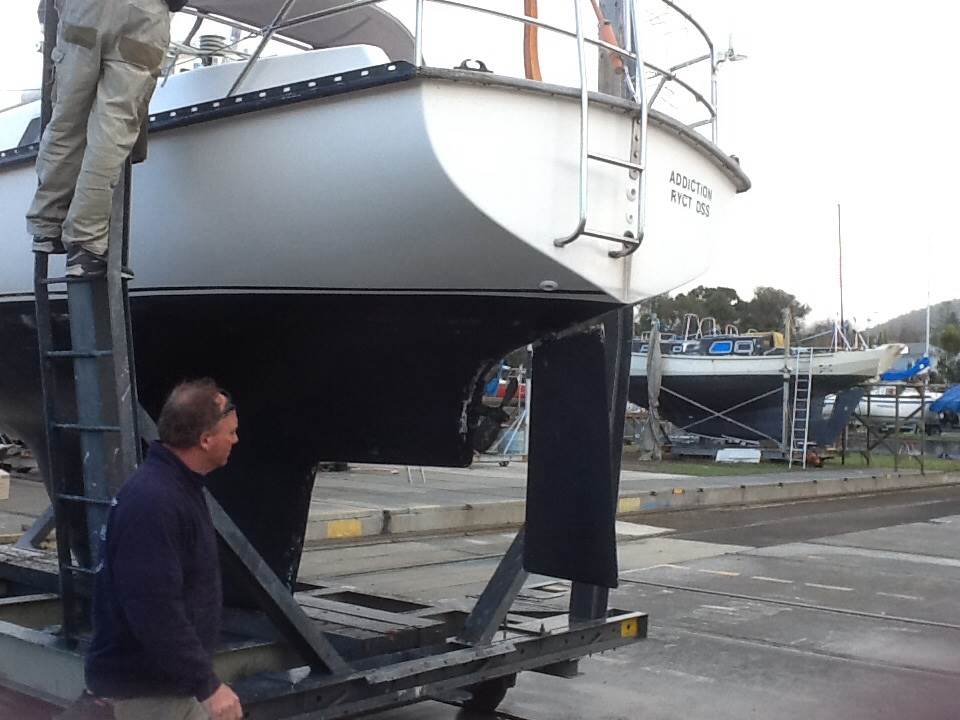
I read that article with some scepticism as it only applies to that 3 blade prop. The drag a prop creates is a factor of the diameter, blade chord, pitch. The chord is the distance from the leading to trailing edge of the blade. A prop with a long chord will have a lot more drag when stopped than a prop with a short chord. A low pitch prop will have more drag than a high pitch prop. A prop with narrow blades is likely to be much better stopped than spinning.
For most of us with folding and feathering props a spinning prop will create massively more drag than when stopped.
The science is never settled, especially on the basis of one amateur experiment.
i would have thought that a feathering prop would most definitely have to be in gear when sailing , to flatten the blades out .
and a folding prop likewise to allow the blades to fold back , and not spin and open .
??????????????????
Select to expand quoteDonk107 said..
And a interesting article with test data www.catamaransite.com/propeller_drag_test.html that comes to the conclusion that a stationary 3 blade tested had 3 times the drag of the same prop allowed to rotate
Regards Don
Hmmmm.
It would be interesting to see what happens to their test results if they slowly increased resistance to the shaft of their freewheeling propeller, bringing the rpm of the prop down to simulate resistance from bearings stuffing boxes and gearboxes. Down to 20 turns a minute or less.
I don't believe that their test really proves anything other than with there set up a freewheeling prop had less drag. Select to expand quoteSandS said..
i would have thought that a feathering prop would most definitely have to be in gear when sailing , to flatten the blades out .
and a folding prop likewise to allow the blades to fold back , and not spin and open .
??????????????????
I have to use either my hand or the gear box in reverse to stop the shaft rotating to feather the prop. Once the prop is feathered it doesn't matter if the gear box is in gear or neutral as it ain't turning. If I select reverse to do the job, I can then go back to neutral and take a peek at the shaft to check the prop has feathered.
I have to use either my hand or the gear box in reverse to stop the shaft rotating to feather the prop. Once the prop is feathered it doesn't matter if the gear box is in gear or neutral as it ain't turning. If I select reverse to do the job, I can then go back to neutral and take a peek at the shaft to check the prop has feathered.
That's very smart !!!!!
Hi Jolene
In the article it mentions that there was preload applied to the test rigs shaft bearings to create a drag on the shaft similar to the authors own yacht shaft in neutral
Morningbird
I think in the article there is reference to 2 other tests carried out by others that came to the same conclusion
Regards Don
What are the variables??
1. Folding/feathering props.
(a) Folding/feathering props:- Need to stop shaft for blades to fold/feather.
(I) Will sudden stopping of shaft by putting in gear damage clutch when shaft is spinning at hull speed???
2. Fixed prop.
(a)Test indicates three blade prop freewheeling causes less drag.
(I) A freewheeling prop WILL cause wear to P bracket and stern bearings as well as the stern gland and output shaft bearings in gearbox.
(II) Possible further damage to gearbox with hydraulic clutch which dictates having a separate prop shaft lock.
(b) A mechanical clutch locked shaft.
(I) How can damage happen to gearbox if nothing is turning??
(II) Possible Yanmar and Volvo recommend freewheeling shaft so as to sell more gearboxes/parts when you have worn gearbox out with all the sailing you do????
I think the Jury is still out.
Select to expand quoteDonk107 said..
Hi Jolene
In the article it mentions that there was preload applied to the test rigs shaft bearings to create a drag on the shaft similar to the authors own yacht shaft in neutral
Regards Don
I did read that Don and like I said they proved that a freewheeling prop has less drag with their set up. I seem to think that the key word here is energy and not so much the word drag which probably gets used incorrectly as I did. Drag may not be the issue, It may be possible that a rotating prop creates equal or less drag but it dose take energy to turn it. Did they measure the energy required to drive the test boat. That energy must come from the wind via the sails.Your not going to turn that prop for nothing. I wonder if it is possible that it can take more energy to spin the prop than what it takes to overcome the drag? Its a long time ago that I went to school.