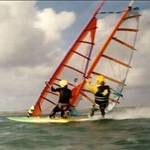


Just wondering why our boards are built the way they are? To me it seems like our boards are heavier than they should be. Why are the boards we ride that are under 8ft long around 6kgs, when they are building production moths that are 11ft long weighing 8kgs? Would it not be better to be building hollow boards if they were reinforced properly?
Obviously I'm no board builder
have you checked the prices and amount of carbon fibre in a 11 ft moth? Guessing from weight and construction, there is probably about $5000 in one of them in materials alone.
You could build a board with the same proportional weight as a moth. It would cost a bit more than your average board though.
Moths and sailboards have to do pretty different things. Sailboards get jumped and slammed around in chop a lot more than a moth.
I think the extra glass and reinforcements you need to build a strong enough hollow sailboard end up weighing more than a styrene core. The styrene core also spreads loads a lot better than having stringers in hollow boards.
Do you have an idea of the volume of a moth hull? It would be interesting to know so we could have something to compare weights with.
You obviously weren't sailing back in the eighties with gear that weighed a tonne and doubled in weight when wet!! All in all IDE say the designers are doing a pretty good job taking into account strength/weight/price ratio.
Price is a bit iffy your probably right, though a moth hull is around $5000 which isnt a great deal more than $3000 that you can pay for a brand new board considering size etc. One positive which got me thinking about this in the first place would be the ability to drain water. I spose this would have already been thought of, does anyone know of it being done? Maybe a wave board's out the question but what about a slalom or speed board? Sorry dont know the volume
There were hollow performance (for their time) boards built in australia, I used to have a McTavish slalom board which had a stepped bottom. I don't know if they ever perfected the construction or not, but is was light for its time and went well. It was noisy in chop thats for sure!!
I think 7-8kgs for a board with straps on is plenty light, especially considering the boards last a good amount of time. The current board building method allows designers to shape one offs and see how they perform with the construction close to the production board. Surfboard shapers say that the move to different construction methods has had a big impact on the way a board feels and performs.
Hollow boards have been done a few times. AHD did one a few years back. Air Inside was another earlier go at it. I don't know the pros and cons. I think they were pretty much the same weight as conventional construction. I know they were noisy. The ability to drain them is an obvious plus. Possibly they were more difficult to construct?
Actually 6kg is pretty efing light for the major part of your kit.
Are you that fussy about your booms and extensions and foot straps etc?
However if its light weight that you crave maybe aerogel is worth a look.
en.wikipedia.org/wiki/Solid_smoke
Well i wish my board was heavier, not lighter, son. most the time when i am windsurfing the bay. i end up in the air, while trying to do speed runs. I even had a idea of putting some weights in the middle of my board. just to keep the girl down on the water.
hey big zacd you coming to inverloch tomorrow, son? you should down, son. should be a good day. come and meet the Ka boys. there a good bunch of dudes.
And 6 kg of landfill is minor compared to the kgs of CO2 we let go in getting that 6 kg to and from the beach over 3 years.
If every one that whinges about it stops windsurfing that should make a difference.
It's all good to have a rant about sustainability on a public forum, but if you're still buying and using the products you're just as bad as everyone else.
Now what was the subject again?
I probably should have said could be lighter than they are, I seriously doubt i would have the skills to actually notice 2kg lighter but if we just said yeah our boards are great so dont change them everyone would still be lugging around 10kg boards down beach, which I'm sure people thought they really light comparing them to the 13kg boards they had before them. Swoosh, I know you could buy a hull from Fastacraft in WA for just over 5000 but they've taken there price list off there website the only price I could find for a hull was 2600 pounds from aardvark in England so $4730 which is including labour and materials.
"try US$16,995 (excludes taxes and import duties)
www.bladerider.com.au/xseries/vrx.html"
Im talking just the hull, that price is including foils mast sail boom etc...
nice find... didn't know that. Given the strength of Bamboo I wonder how this compares to wood veneer.
Also, remembered that Fanatic at some stage used a honey comb structure inside their boards. It did result in ultra stiff boards... I do remember the main problem being the out skin construction having issues. At that stage boards were not made in an Expoy/ Carbon composite like today... instead the boards consisted of "two shells that were essentially glued together" (of course this is a highly simplified way of describing it).
The problem with this construction was that the boards had a tendency to fold between the foot straps and mast track. They never really broke all the through they just kind a crumbled between around the edges and messing up Scoop/ Rocker line in the process.
jUst for the record I've been going to tips (both landfill and recycling) once or twice a week for 18yrs aprox and you know how many board I've seen in there....... Zero. Things like boards have a habit of recycling themselves.
 )
)
I think if they make boards much lighter we'll have to worry about them blowing away when we're not standing on them.