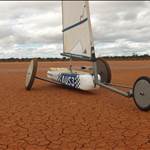


Check out this. It's a wind powered vehicle that can travel faster than the wind speed, dead down wind.
just did some research
the prop is turned by gearing in the wheels, so the faster the wheels turn the more thrust
managing friction and drag must be the key to making it work
try this
peswiki.com/directory:directly-downwind-faster-than-the-wind
My initial thoughts on the device would be it has to be going down a hill at anytime that's it's going faster than the wind, or, fluctuations in wind speed. IE a gust gets it up to a speed and then the wind drops, hence for a period it is traveling faster than said wind. At the end of the day energy in = energy out (of said system) it's as simple as that. There is no way it can travel faster than the wind on a dead flat surface in a 100% constant wind.
The treadmill scenario is a no brainer. It's a treadmill on a slope, the cart is going to want to roll down the slope, however if you managed the force of the cart wanting to roll off the treadmill with the force created by the treadmill turning the wheels, turning the prop etc then of course it will 'sit there' or 'climb up'.
However to start that experiment they HAVE to hold the cart still with the treadmill going at the outset. Otherwise the cart will simply just roll off. The energy required to overcome the initial startup friction etc is to great.
So at this stage i'm highly skeptical :D
If it works as described it's a perpetual motion machine - violating the conservation of energy law.
There'll be a catch - it might be using the fan as a flywheel to store gust energy to speed thru the lulls.
It might not be going directly downwind.
To get energy from the wind the device has to slow the wind down. Going directly downwind at greater than windspeed will only speed the wind up.
You people wth brains...tsk....
Thanks for the nuclear bomb, machine guns, mustard gas and automobiles, guys....where would we be without you?
Yep, perpertual motion machine and that rubbish. I reckon it's being towed by another vehicle.
hi there,
I am pretty sure Make Magazine made one of these and found it didn't work, i will have a search through my collection today.
If you think a cammed race sail is technical to set up then check this out:
while it is possible that there is a remote control unit to steer the thing (black box in the middle) the concept is bull. directly off the wind...impossible, that is almost to perpetual motion stuff... 120 degrees to the wind, possible
That's a good one DL. The portion of the wheel where it touches the ruler is moving at ruler speed. If you replaced the ruler with wind, the top of the wheel would be able to move a little slower than the wind, extracting the energy for the device from the wind. All OK energy wise. The sails or spinnakers mounted to the wheel would have to fold and unfold as they rotated with the wheel otherwise the drag of the lower bit going faster than the wind would stop it. But I suppose it only has to go a ****teenth faster than the wind to prove the point and in a very slick system it might do that without furling and unfurling. The wind profile would help.
So I'll change my mind, it's theoretically possible to go downwind faster than the wind, but I can't see that the one in the other video is using any clever gearing up techniques.
Still think it's a gust and lull trick in the first video. The energy in the wind is proportional to the cube of windspeed, that's why they measure wind very carefully before installing a wind farm, if they're out by 10% in mean wind estimation the farm's output is down by ~30%.
It's going to be particularly gusty in a suburban street.
Any good physicist knows about the energy of the wind being cubical proportionated to the wind speed, thanks Ian. 
In laymans terms (I'm not a layman anymore, I had 6 hours to pick the brains of a real physicist recently) it means if the wind is going at 6 knots, a good sailor can travel at (36 knots/weight*sqaure root of boom length) + fin length in cm. Easy really.
But as far as the first video goes, the pitch of the fan is wrong, wont work.
Fascinating stuff.
So the wind pushes against the breeze from the prop, making the cart faster than the wind speed.
The key is that the cart wheels have to be geared so that they travel forward slower than the prop blade tip speed.
So there is no reason why a k*ter should not be able to exceed windspeed directly downwind, just pushing out from side to side as the kite gybes back and forth above him.
Anyone for the dark side?
Thanks DL.. that got us thinking for the afternoon yesterday!
Check out the youtube videos on : http://peswiki.com/index.php/Directory:Downwind_Faster_than_the_Wind_(DWFTTW)
Spork runs his one on a treadmill, simply because it is easier to use a treadmill than it is to find a smooth straight piece of road with a constant tailwind (and it all works out the same anyway once you account for frames of reference). Whats even more impressive is that he has set the treadmill up so that the device not only stays ahead of the treadmill, but actually climbs UP a hill at the same time.
It certainly seems possible to me - it even makes sense, but it is definitely NOT intuitive!
Spork is so sure that it works that he's thrown out an open bet - at 10:1 odds. If you say it's Bvllshirt, put up $10k. If he's proven wrong, he's pays you $100k.
Wish someone had have put a spot of paint on that treadmill, I can't see which way it's going. The fan is turning awfully fast seeing it's in, on average, zero apparent wind. The finger the device is bouncing off is a third force. Still thinking about this. If the treadmill is moving towards the finger it makes sense. The power is coming from the treadmill working against the finger through a gear system during the short bounce.
Might be wrong, wish there was a white dot on the treadmill. Don't treadmills normally have a dot on them to indicate speed and direction??
In one of the videos (on the page linked above) they address this concern and put a line on the treadmill so you can easily see that it (the treadmill) is moving away from the finger. And in another, they take the finger away, and slightly increase the uphill slope so that the cart stays on the treadmill with no external inputs other than the treadmill/tailwind for about a minute and a half. Also proven is that if they disconnect the propellor shaft, the thing gets thrown off the back of the treadmill.
I have to admit, having read a few threads on other forums, that I quite like their style.
Yeh it was easy until I saw the spot on that other treadmill. So out in the open the propellor throws air backwards slowing down the wind, extracting energy. The tips of the blades are on a broad reach, but the whole device goes directly downwind.
With a cyclic pitch control out of a helicopter it might go well in other directions as well. Drag might kill it on water but blow carts and ice yachts might give it a go.
Good one DL.
I was sceptic at first myself, but now I'm a "believer".
In fact, the propellor on the cart is doing exactly the same as a sail on a downwind run. And as ice-sailors can go downwind faster than the wind (VMG-wise), this device might very well be able to do the same.
It's definately not a perpetuum mobile, it is just harvesting in an smart way the power in the wind over the (fixed) ground, as ice-sailors do...
But it is really very counter-intuïtive at first sight!
I knew ice yachts were fast but had always assumed those slippery things worked best on a close reach rather than broad one. Can anything on the water beat the wind downwind in the vmg sense? 12 metre yachts? Formula boards? They can double the wind speed, but is the downwind angle good enough? Always hard to measure the windspeed accurately though.
Got anything else to stir us up with DL? Hope I don't have to change my mind on this one again.
Ice and landyachts dont quite go completely downwind, but in a really fast one sheeted hard the rig can Gybe without you altering course.
30 years a go there was a small keel boat on Cockburn sound (WA)that had a 2 blade air prop driving to a gearbox and clutch, then to the water propellor. It could 'sail' in any direction simply by rotating the mast . With gearing it looked amazing going directly upwind. they wouldnt let him race as he was too fast upwind
An old fashioned treadmill just uses friction to slow itself down, whereas modern ones use motors.
If you could make a friction limited treadmill, put this device on it (tethered so it won't run off the end) and give the treadmill a bit of a push, will the system keep running forever?