

probably showing my ignorance here, but surely its only "proof" if they can confirm/prove that the treadmill is working at the same speed as the wind.
i.e. if the wind is blowing at 10 kmh, then the treadmill is running at 10 kmh in the opposite direction thus giving you a potential 0 point.
Discounting friction etc. if the device was doing the same speed as the wind it should stay stationary on the treadmill. If its going faster than the wind then it will move forward.
I might have missed it but I didnt see anything indicating what speed the wind and the treadmill were travelling
Thought of another approach to understanding the phenomena while repairing a hole in the fence. If there was good wind within a 3hr drive I'd be sailing.
Imagine there's one of these devices going downwind at 12 m/sec in a 10 m/sec wind.
From the devices perspective it has a 2 m/sec headwind which it has to accelerate rearwards.
If the prop has an "effective" radius of 1 metre and a blade pitch of 20 degrees in 1 rev, when freewheeling, it will go forwards
2 pi Sin 20 = 2.148 metres.
So in a 2 m/sec relative airstream it will freewheel at 0.93 Hz
If it spins faster it will generate an angle of attack throw air backwards with a lift to drag ratio appropriate to a propellor.
Let's guess that 1.2 Hz is fast enough and that the lift to drag ratio is 10:1
(This would all be subject to tuning in a real device but just trying to see why it could work at this stage)
And then lets guess that the prop has blades of a size and number that under the above conditions the blades generate 10 Newtons of lift (~1 kg)
From the props frame of reference 10 cos 20 Newtons of this lift is in the forward direction and 10 sin 20 of the lift is in the lateral direction, opposing rotation of the prop shaft.
Of the 1 newton of drag 1 cos 20 opposes shaft rotation and 1 sin 20 opposes the forward thrust.
Total forward thrust = 10 cos 20 - 1 sin 20 = 9.05 Newtons.
Torque on the shaft = 1metre * ( 10 sin 20 + 1 cos 20) = 4.359 Nm
Power to turn fan = Torque X angular velocity
= 4.359 X 2 pi X 1.2 = 32 watts
But this 9.05 of thrust can be applied to the wheels via the ground speed of 12 m/sec
Power into wheels and gearbox = force times velocity
Power input = 12 X 9.05 = 108 watts
So you've got 108 watts to put in the gearbox and only need 32 watts to turn the fan - there's a lot of drag, ( gearbox, windage of the chassis, rolling resistance) we've neglected but it's not surprising that it goes and will even have a bit of power left over to climb a hill.
So basically the power to drive the fan in a 2m/sec headwind is less than the power that can be obtained from the thrust by running wheels against the fast moving ground below.
I think the key is the magic of a lift to drag ratio. We have accepted it in traditional sailing,
but don't we baulk when we see the same principal used differently.
This first video was subject of much discussion a couple of years ago on www.ozreport.com (which is a hang gliding forum). In the end I think it turned out to be a fake. I'll try and dig out a link for it.
In the end you cannot get away from the fact that this is a perpetual motion machine and therefore a breach of the laws of physics. If it really worked you should be able to remove the wind and it would continue moving (once moving it is running directly into the apparent wind so the wind is ceasing to provide it thrust). If it worked the world energy crisis is solved.


I can see I may regret posting on this one. 
If the vehicle is moving 2 knots faster than the wind, then it is moving into an apparent wind of 2 knots. The wind now stops - if the physics remains the same you would expect it to slow, but to continue moving forward to maintain an apparent wind of 2 knots. (i.e the vehicle would slow to a ground speed of 2 knots and then maintain speed). We would then have the situation where an unpowered vehicle maintains a constant speed with no external forces acting on it (apart from frictional forces). This is also effectively the situation that is claimed to be shown in the treadmill video. This is a breach of fundamental laws.
This is quite different to a windturbine that is simple extracting energy from wind. The situation shown in the video is of a vehicle extracting more energy from the wind than the wind is theoretically able to impart.
I don't have $100k to bet but I do have a $1,000k. So if anyone can build a working model and bring it round to my place in Hampton I'd gladly pay up (as long as you'll allow me to commercialise the technology).
 Sorry I think I missed something, how does this make my board go faster...and where do I stick the fan with the 10:1 props.
So I need some sort of paddle wheel in the back to drive the fan..... hmmm maybe I'll just try a new fin..

Sorry I think I missed something, how does this make my board go faster...and where do I stick the fan with the 10:1 props. hmmm maybe I'll just try a new fin..
I'm sure this will run and run...but here goes.
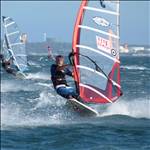
A wind surfer on a reach is a false analogy. On a board we are using the sail to deflect the wind and create a force with a forward vector. When crossing the wind our boardspeed makes little difference to the lateral force our sail experience (so the force on the sail remains roughly constant irrespective of board speed - a gross simplification but will do for now). This allows us to accelerate beyond the wind speed. The geometry of this situation starts to change quite markedly as we turn directly downwind. Here the faster we travel the less force our sail experiences.
Perhaps I can find another way of explaining why the machine in the video doesn't work. A propellor turning in one direction will only push air one way. Equally wind moving through a prop will only turn it in one direction. In the case in the video the prop is first driven by the wind. This wind is coming from the back of the vehicle. As ground speed exceeds wind speed the wind direction seen by the prop reverses (it now appears to the vehicle to be coming from the front). The wind should now be slowing the prop and therefore slowing the vehicle. It is absolutely no different to running directly down wind on your windsurfing board, as board speed approaches wind speed the force on the sail approaches zero. If board speed exceeds wind speed (say in a lull) then the sail is now slowing the board. This is why running downwind is so different to a reach as far as your ability to exceed wind speed goes.
I suppose it doesn't get away from the fact that I can't tell $1,000 from $1,000k!!!
Hi all.
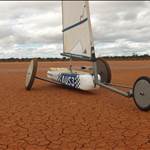
I'm JB and I'm the guy you see in the treadmill videos posted here. My partner and I have built and tested several of these carts in various situations.
It's not perpetual motion. It's not a hoax. Is simply and basic and long utilized sailing principles packaged in a untintuitive way.
The prop is simply two sails on a broad reach while the chassis goes DDW.
The treadmill set at 10mph in a still air room is the exact equivalent of going straight downwind at 10mph with 10mph wind blowing.
Our best device (so far) will beat the wind with as little wind as 2.7mph on the level and at our highest treadmill setting (10mph) will climb a 4.4 degree slope.
Someone previously said they would give $1,000 for a working model and commercial rights -- sold! Actually, we've posted the parts list many places (can here if people wish) and you can build one for ~50 US.
It truly is a novelty with no new technology and no real value other than creating a unreal amount of hubbub on the internet. We had no idea it would cause this stir.
Happy to answer questions if there are any.
JB
DL .......WHATS BROUGHT THIS ON ........HAVE THE BATTERIES RUN OUT ON YOUR AVATOR PICTURE
Like a flying fishing out of water ? traveling down wind ? motion less in time ?
I CARNT PLAY  my heads hurting
Select to expand quote[quote
Or from a bipartisan's perspective you could say the device is extracting energy from the velocity discontinuity between the two mediums.
Yeah, thats what I thought too, the old velocity discontinuity trick between the mediums...
I was tempted by the forecast too, then put off by the big dark clouds, but its quiet as a mouse now, no rain, no wind.
Thanks, JB. Your modesty should not trivialize your achievement.
You have messed up the minds of a whole generation of self proclaimed yacht club experts including the crustiest of commodores. Impotence and cruelty to pets and children may even have increased in certain demographics as a result.
We all now instantly see the solution to the question of who wins the race between two yachts, one heading downwind in a 12 knot breeze with with a 12 knot following current. One in the same situation with a dead calm.
Select to expand quote.
Mr T speers makes for some interesting reading. If you then jump in your landyacht with a GPS and leave someone taking readings on the wind meter , you usually find that 2 times windspeed is normal upwind and 3.5 -4 downwind.
last year Bill Finch recorded a tad over 6 times wind speed with a 4m solid symmetrical wing ,broad reaching. in 20kph winds.
I dont think that fits Mr speers graph too well
So you're just saying that Mr Finch's landyacht outperforms by far the figures of Mr Speers, so that simply confirms again the point that VMG downwind can be (significant) bigger than windspeed. BTW, do you have any links or polar diagrams about that? Maybe there are some far better landyacht now, since the 1994 study from Mr Speers... but that was just the first (only?) webpage I could find that "proves" that downwind VMG > windspeed is reality.
yup. from memory he calculatedthat youd need a 50mph wind to crack100mph. the current record of 116mph was in 30mph.
without trying to knock Speers and his work , landyachts simply perform better than his mathematical models.
Bills VINDICATOR was designed in 1992 and completed in 1993 so it isnt covered by those graphs.

Speers online work is however one of the few technical works on landyachts to be found on the web and for that I salute him
How I hate to be the messenger, as people then wish to kill me.
As surfers of the wind we are very aware of wind gradient, ie decrease in windspeed closer to the water due to friction between the air/water mediums.
To minimise this effect the next experiment must be to cover the treadmill surface except for tracks for the wheels.
No doubt that a propeller sailboat could point higher, maybe that is all