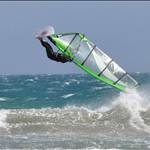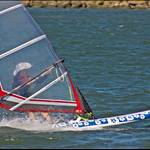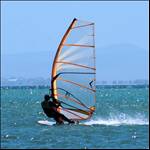


7.0m North Natural on an old Bombora board. probably at least 18 knots....anything less than 20 for me is painful
 the 5.8 on the other hand had me fully powered in close where all of the waves were.

Thanks guys for all this info, it's been good to read through it all.
the difference between planing and now planing. When you plane your resistance grows a lot less, and your apparant wind is more, so you will move a lot faster
Sailed Brisbane Waters today on a Starboard Carve 145 fin 52 sail 7.5 Gaastra.Wind was 6-16 knots gusting on and off at times from the NNW and may be a little NE in there as well. Brisbane Waters gets pretty sloppy as the wind picks up which makes turning hard. With my weight of 73kgs I plane quickly in these conditions.
How in the world do we truly verify the wind speed on the water? Are we calling gusts, or averages, and what do we call "gusts"? I seem to recall (from Bureau of Meteorology lectures before the Sydney-Hobart) that what they call a "gust" is the highest average speed that is sustained for 30 seconds. Gusts themselves are often 30% higher (or more) than mean average speed. The bottom of the lulls is often 25-30% or less of gust speed, IIRC.
I'm not precise about the figures, but it seems that guys could be calling 7 knots (measuring the bottom of each lull) when it's actually 13 or so in the gusts and 10 average; or guys could be saying they plane in "X" knots when that is the lowest figure reached and the average is a lot higher, the gusts higher than that, and the peak of the gusts higher still.
HTH do you work that out? And then how accurate are the wind meters?
With the big gear on (Lechner A390, ex 1992 Olympics) and tight leach North 9.5, I'm starting to plane before a national champ on Formula gear, but then again some people would (wrongly) say that a Lechner cannot plane!
As skiff designer Julian Bethwaite says, defining "planing" becomes harder, the more you learn about what it actually is.
some hand held meters read average but they are costly. my $40 meter reads realtime so i hold it up for a few minutes over a period of 15 minutes or so and just look at lulls and gusts. i also read the trees, water, other sailors, tide etc.
i can't speak for anyone else but i am referring to planing hulls and not displacement hulls. i listed the volumes to help with this. my definition of planing with a planing hull (shortboard) is being hooked in, in the straps and able to sail upwind and down.
I weigh 62Kg
25kts and above - 4.5 or sit out 
20-25kts - 4.5
15-20kts - 5.5
12-14kts - 6.5 usually ...
10-11ks - I just bob along, as I only have a 120L shortboard
I agree with gusts making a difference though.
I think that WOD has really hit the nail on the head. I have what I believe to be a good Anemometer but it only tells me the wind speed where I am standing. At Kurramine Beach I often do not get planing till I get out about 200 meters because the palms etc on the dune reduce the wind where I measure it. I do know that if I get 14 kns on the beach I will plane with a 6m when I get out a bit. I never declare what the wind is because I know I would only be guessing.
There are locations where someone could stand on a sandbar and record the wind speed and the exact time and later compare it with a passing sailors speed.
This would be of interest to me.
Lala, very good question and people may differ in their opinion but they are all useful under various conditions , it seems !
I was out yesterday on Lake Connewarre where it was blowing 10 - 12 knots. I had a 8.5M KA Formula sail rigged on my 155L GO and only managed to get up on the plane with a bit of hard work as the 12 knot gusts came through. As I havent worked out a decent pumping technique, I dare say a more experienced sailor may be able to get going a little earlier. Once up on the plane, as long as the wind held at 10 knots, I was able to maintain speed.
In light winds I rig up my light wind slalom gear. JP 134 Slalom 80cm wide 134 Litres. JP 36cm weed fin. Rig Ezzy Infinity 8.5m can get planing in 10 kts of wind with that, and glide thru lulls of 8kts.