
Winter Flathead: Cold-Water Lure Tactics

Quick summary
Dusky flathead don't go anywhere in winter - they just slow down and move to warmer pockets of water in the estuary.
The key shift from summer to winter is retrieve speed: colder fish need the lure almost dropped on their head before they'll commit.
The how-to
After reading this you'll know where to find cold-water flathead, which lures work, and why office hours fishing beats the dawn alarm in June and July.
Flathead don't disappear in winter.
They shift, they slow down, and they stop chasing lures that worked easily in autumn.
The anglers who catch them consistently through July and August understand two things: where the warmer water sits in the estuary, and how slowly you need to work a lure when the water temperature drops below 16 degrees Celsius.
Why the cold changes everything
Dusky flathead are most active in water temperatures of 16 to 19 degrees Celsius in south-east Queensland estuaries.
In NSW estuaries they adapt to colder water and feed in temperatures well below that range.
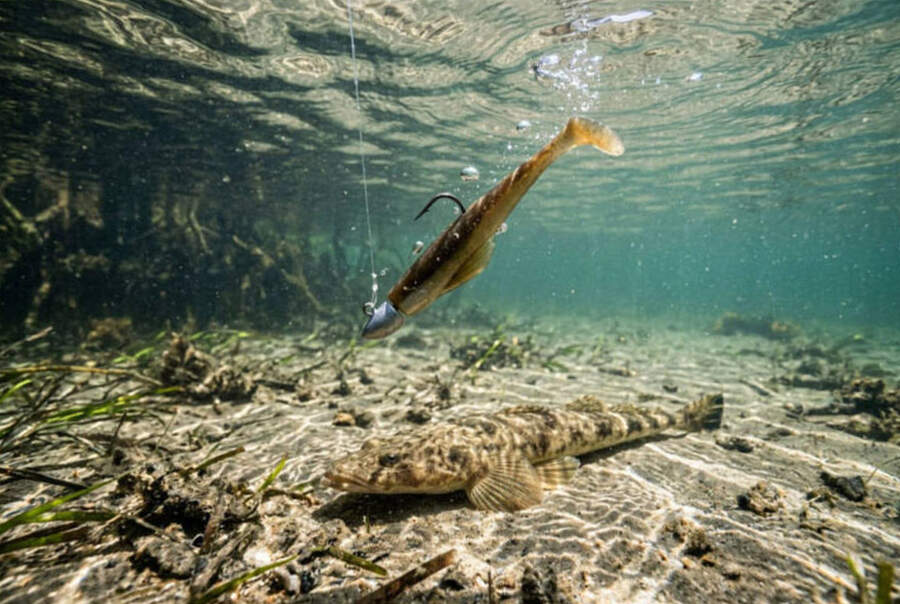
Below 15 degrees they enter a near-dormant state, partially burying in sand or silt and barely moving unless a meal lands directly in front of them.
According to Queensland angler and Fishing World contributor David Green, in cold conditions flathead "just shuffle in the sand or silt and lie dormant in an almost hibernation-like state" - requiring the lure almost dropped on their head.
The practical result: a retrieve that worked in April, when fish were chasing and hitting hard, will ghost straight over the top of a cold-water flathead in July.
Where warmth pools in the estuary
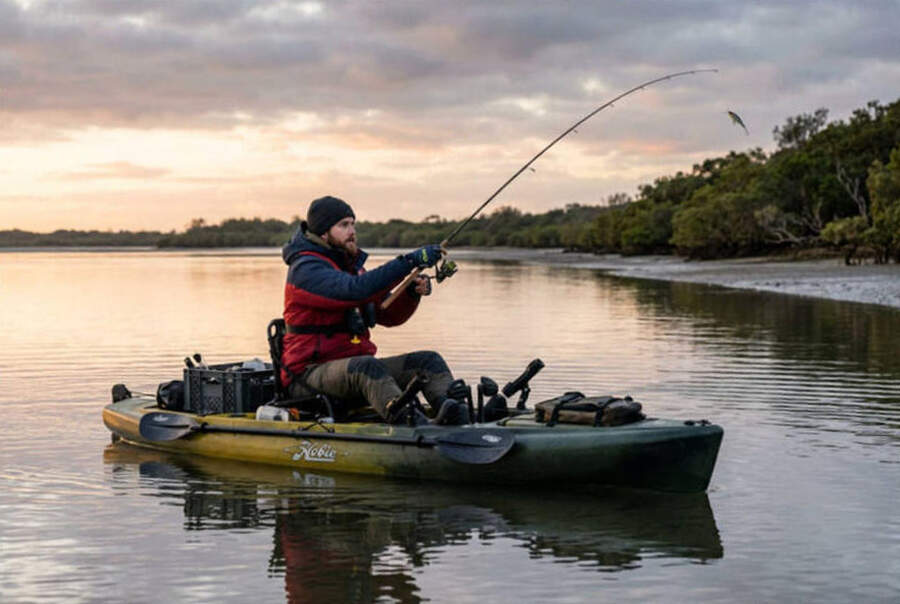
The run-in tide is your friend.
In winter, water running in from the ocean is measurably warmer than estuary water that has chilled overnight in shallow reaches.
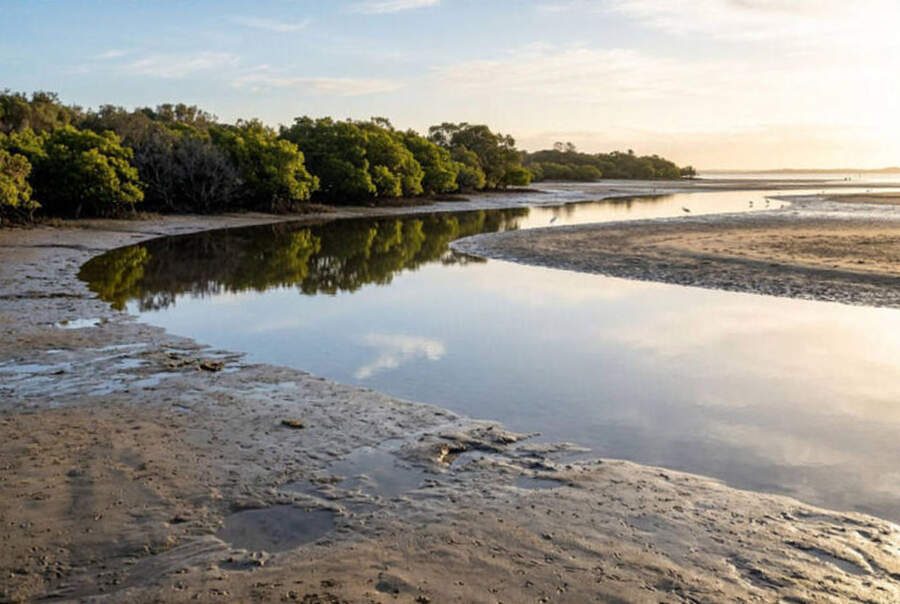
Shallow weedy flats that trap solar warmth - especially those sheltered from cold westerly winds - warm faster on sunny days than deep channels.
Green describes the last half of a run-in tide on a shallow flat as one of the most reliable winter patterns: the flat catches the afternoon sun, the tide brings in slightly warmer ocean water, and the flathead move up to feed.
Deep channels and drop-offs hold the large dormant fish but require a different approach - slower, targeted, nearly stationary presentations.
On really cold mornings, deep holes are where the fish sit. They don't start moving until around 9am when the sun is high enough to take the chill off the water.
"On sunny winter days the mornings are often a lot quieter than the afternoons. The fishing often starts off very slowly and it isn't until the sun is high in the sky that the flathead will start to feed."
That observation, from David Green's extensive winter estuary work in south-east Queensland, runs counter to the dawn-or-nothing instinct of most lure anglers.
Office hours fishing - 9am to 2pm on sunny winter days - often outperforms the first light bite that flathead anglers rely on through the warmer months.
Three lure categories for cold water
Soft plastics: the foundation.
A four-inch white Gulp Swimming Mullet on a 1/8 oz 2/0 jig head is the standard cold-water flat-head lure in south-east Queensland estuary systems.
The scent in Gulp-style products matters in winter: cold flathead will grab a lure and hold it longer than they would a hard lure, giving you more time to detect the hit.
The winter retrieve is very small hops and long pauses - the total opposite of the fast rip-and-drop used on active summer fish.
In deep holes you can leave the lure sitting nearly stationary on the bottom for 5 to 10 seconds between hops.
Blades: when you need to cover water.
Small bright blades in chartreuse - the 1/8 oz TT range is commonly used in SE QLD estuary systems - are fished with a slow sink-and-draw retrieve.
They cover more ground than a soft plastic and trigger reaction strikes from semi-active fish that won't bother chasing a slow presentation.
Use a soft rod for blades: they carry tiny trebles that dislodge easily if you strike too hard.
Lipless rattlers: for active fish.
When baitfish schools are present - mullet, hardiheads, pilchards - flathead switch into active chasing mode even in cold water.
A 1/4 oz chartreuse rattling lipless crankbait, worked with a fast horizontal rip followed by a sink and pause, can outfish everything else when bait is around.
The window is short: the moment baitfish move on, rattlers often go dead.
Clear water: the shadow problem
Winter estuaries in Queensland are typically clearer than summer, and flathead on shallow flats become very aware of overhead movement.
Flathead have learnt to associate passing shadows with sea eagles and ospreys hunting from above.
Work with electric power and long casts downwind.
On calm, clear days, backing off to 2 lb braid and 6 lb fluorocarbon leader makes a real difference in flat, gin-clear water.
Overcast days reduce the shadow spook factor and often produce better flat results than direct sun - a useful thing to remember when planning sessions around the winter forecast.
Tackle for winter flathead
Winter flathead in SE QLD and NSW estuaries run smaller on average than spring - most fish in the 30 to 60 cm range, with fewer of the big females.
A 2 to 4 lb braid with 6 lb fluorocarbon leader handles most sessions.
For blades and rattlers, go to a 10 to 15 cm length of heavier mono at the lure end to protect against the sandpaper-like teeth on the head.
Rod choice is lure-dependent: a stiff 2.2 to 2.6 m rod with a sensitive tip for rattlers, a much softer rod for blades.
Regulations: know the slot
In New South Wales, dusky flathead have a minimum legal size of 36 cm and a bag limit of 10, with a maximum of one fish over 60 cm allowed per person, according to NSW DPI.
The slot limit protects large females - a 60 cm flathead is almost certainly a breeding female, which is why only one per bag is allowed.
In Queensland, sand flathead and dusky flathead have a minimum size of 23 cm and a bag limit of 20 combined, according to Queensland Fisheries.
State limits differ - always check current NSW DPI or Queensland Fisheries rules before heading out, as regulations are reviewed periodically.
The pattern: how a session builds
Arrive mid-morning when the sun has had two hours to warm the water surface.
Start on shallow weedy flats sheltered from the wind on the last half of the incoming tide, working soft plastics with very slow hops.
If the flat doesn't produce, move to channel edges and drop-offs with blades covering more ground.
When you find a fish - anchor up rather than continuing to drift. Cold-water flathead group in thermal pockets. The flat that held three fish will often hold ten more in the same 20-metre section.
If rattlers start producing, you've found a bait school. Work the area with fast retrieves until bait disperses, then revert to slow presentations.
Your next session
Check the tide before you plan the outing - the run-in bringing warmer ocean water matters more in winter than any other factor.
Pick a sunny, calm day and plan to fish from 9am to midday on the first session to understand your local estuary's thermal behaviour in cold conditions.
Track local conditions via Seabreeze tide forecasts before you head out.
What lure weight if the current is strong? Move up from 1/8 oz to 1/4 oz jig head. The lure still needs to stay near the bottom but must not be lifted by current. If you're losing bottom contact, go heavier.
Does trolling work in winter? Yes. Trolling with four lures staggered from 10 to 70 m behind the boat is one of the best methods for covering ground and finding the few active fish on cold days. Pink and chartreuse small bibless lures at slow speeds in water shallower than 3 m work consistently.
Do big flathead feed in winter? Large females (over 60 cm) become harder to target as their activity drops further in the cold. They sit in deep channels and take very little. Targeting them specifically in winter is difficult - most winter catches are smaller males in the 30 to 50 cm range.
What's the best state for winter flathead? SE Queensland estuaries - Moreton Bay, the Pumicestone Passage, Gold Coast waterways - offer milder water temperatures and more consistent winter action than NSW and Victorian estuaries. The Hawkesbury, Port Stephens, and Gippsland Lakes in NSW and Victoria produce well but require more patience in the cold.


 Flinders Reef, QLD