
Downwind SUP: Bumps, Runners and Going Fast

Downwind SUP paddling is one of the most exhilarating disciplines in the sport - a pure, wind-driven dance between paddler, board, and open ocean.
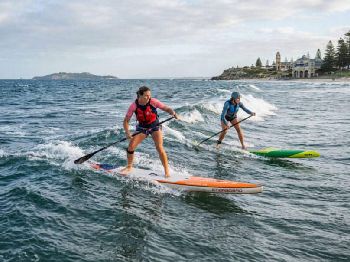
Unlike flatwater racing or surf SUP, downwinding asks you to read the living energy of the sea itself: those rolling, wind-generated bumps that, if you time your strokes just right, can carry you for hundreds of metres at speeds that feel almost effortless.
Eight-time Molokai 2 Oahu champion Connor Baxter puts it plainly: "Downwinders are about quick sprints and glides - you're only paddling for about half the time." This guide will take intermediate paddlers through everything needed to start catching bumps safely and confidently in open ocean conditions.
What Is Downwind Paddling?
A downwind run is a point-to-point paddle where the wind and swell travel behind you or at a slight downwind angle.
As the wind blows across open water, it generates rolling bumps - wind swell - that move at speed in the same direction as the breeze.
Your goal is to accelerate your board onto the face of one of these bumps and let it carry you forward, expending minimal energy while covering maximum ground.
On a well-timed run, the feeling is like surfing without a break: the swell does the work while you sprint to the next connection.
Board and Gear Selection
Equipment choice is the single biggest factor in how quickly you progress. According to Robert Stehlik, founder of Blue Planet Surf in Hawaii and one of the world's most respected downwind SUP coaches, wrong equipment makes the learning curve unnecessarily steep.
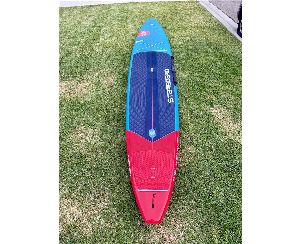
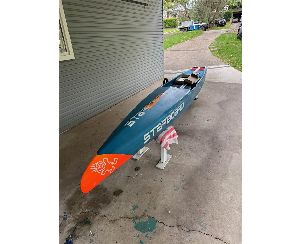
- Board length: 14 ft is the standard for open ocean downwind running. A longer waterline means more glide speed and the ability to stay on a bump longer. Starboard team manager and long-distance SUP legend Bart de Zwart uses the 14 ft All Star in rougher conditions for better control in powerful swell, and the 14 ft Ace when bumps are smaller and more subtle - noting the Ace "picks up any little bump."
- Volume: Intermediate paddlers should target approximately body weight (kg) x 1.3 to 1.45 litres of board volume. An 80 kg paddler should look for roughly 104-116 L. More volume means more stability in chaotic ocean chop.
- Width: Boards in the 19-21 inch range suit intermediate downwinders. Wider boards add stability but add drag; narrower shapes glide faster but demand better balance in confused seas.
- Paddle length: Use a shorter paddle than for flatwater - roughly chin height. A shorter shaft encourages the high-cadence, short-stroke technique that downwinding demands.
- Safety gear: A 3-4 m coiled leash, an inflatable PFD, and a waterproof phone or VHF radio are non-negotiable for open ocean runs. Bright or high-vis clothing significantly improves your visibility to passing watercraft.
Reading the Ocean
Before you can catch bumps, you need to see them. Ocean downwind bumps are not uniform - they are irregular, overlapping, and constantly merging and splitting.
Developing your ability to read the water well ahead of your board is the skill that separates intermediate paddlers from advanced ones.
- Look far ahead, not at your feet. Train your eyes to scan 20-40 metres downwind. A forming bump appears as a slight darkening and steepening of the water surface.
- Identify the trough in front of the bump. The pocket of accelerated water between two bumps is where you want to position your board before the next bump arrives and lifts your tail.
- Use diagonal wind chop as a stepping stone. Robert Stehlik notes that smaller wind-blown waves crossing the primary swell direction are often easier to catch than the main groundswell, and can be used to redirect momentum onto a larger bump running ahead of you.
- Ideal learning conditions: 15-20 knots of steady breeze generates defined, regularly spaced bumps without overpowering swell. Contrary to popular belief, conditions above 25 knots do not make downwinding easier - bumps move faster and the sprint requirement becomes more intense, not less.
Catching Your First Bump
The timing of your sprint is everything. The most common instinct - to paddle hard once the bump is directly under you - is almost always too late.
The correct sequence, as refined by coaches at Blue Planet Surf and validated by competitive paddlers on the APP World Tour circuit, is:
- 1. Spot the bump 10-15 m behind you as it approaches. Begin your sprint before it arrives, aiming to match its speed as it reaches you.
- 2. Take 3-5 short, explosive strokes at high cadence - roughly 50-70 strokes per minute. Keep each stroke short: from the nose of the board to your front foot only. Extending the stroke past your feet levers the tail down and kills your glide.
- 3. Feel the board accelerate and the tail lift. This is the catch. Shift your weight slightly forward to prevent the nose from riding up the back of the bump ahead of you.
- 4. Stop paddling and glide. This is the step most beginners miss entirely. Once you are riding a bump, putting the blade back in the water creates drag and will knock you off it. Rest, steer with subtle weight shifts, and let the bump carry you.
- 5. As the glide fades, scan immediately for the next bump, sprint into it, and repeat.
Heart rate spikes significantly during catch sprints, which is why the glide phase is essential recovery - not optional downtime. If you skip the rest, you will not have the power to catch the next bump.
Linking Bumps
Once you can reliably catch single bumps, the progression is stringing them together. This is where downwinding becomes genuinely addictive.
- Stay in the energy corridor. As one bump flattens beneath you, look immediately ahead and to either side for the next formation. A slight weight shift or single corrective stroke can angle you diagonally into an adjacent bump and transfer speed without braking.
- Run diagonally, not straight. Elite downwinders do not travel in a straight line. Moving at a slight angle across the face of a bump - before transferring to the next - keeps your speed higher than punching straight through troughs. Think of it as connecting dots across the surface of the ocean rather than drawing a straight line.
- Match your strategy to wind strength. In lighter winds (10-15 knots), bumps are slower than your maximum sprint speed - aim to stay with each one as long as possible. In stronger winds (20-25 knots+), bumps move faster than you can sustain, so the emphasis shifts to rapid acceleration and quick hand-offs between successive bumps.
Safety and Logistics
Open ocean downwind runs introduce risks absent from flatwater and surf paddling. Build good habits from your very first run.
- Never paddle alone. The minimum for a safe downwind run is two paddlers. For runs over 5 km, a support kayaker or chase boat is strongly recommended. Connor Baxter's consistent advice to anyone new to a run: find a local who knows that specific stretch of water before venturing out independently.
- Plan your vehicle shuttle. Point-to-point runs require a vehicle at the finish and another at the start - sort this logistics puzzle before you launch.
- Know your exit points. Identify potential landing beaches every 2-3 km along your route in case conditions deteriorate or fatigue sets in earlier than expected.
- File a float plan. Tell someone ashore your launch and landing points, your expected duration, and at what time they should raise the alarm if you have not checked in.
- Wear a coiled leash - always. In open ocean downwind, a separated board can be driven hundreds of metres downwind within minutes. Your board is your primary flotation device.
Common Mistakes
- Paddling at a constant pace. Downwinding is interval training by nature. Steady-state paddling is the enemy of efficient bump-catching. Learn to sprint and rest.
- Starting the sprint too late. By the time the bump is beneath you, the acceleration window has closed. React when you first see it approaching from behind.
- Standing too far back. Weight on the tail kills glide. Move your feet forward of your usual flatwater stance and stay centred - or slightly forward - when riding a bump.
- Looking at the nose of the board. Eyes down means you cannot read the water ahead. Practise lifting your gaze until scanning far downwind feels natural.
- Learning in the wrong conditions. Very light winds produce barely perceptible bumps, making learning frustrating. Very strong winds produce fast, powerful bumps that are hard to manage. The 15-20 knot window is your sweet spot for skill development.
Start Your Downwind Journey
Downwind SUP rewards patience, observation, and a willingness to unlearn the steady-stroke habits of flatwater paddling.
Equip yourself with a 14 ft board matched to your weight, practise the read-sprint-glide cycle in 15-20 knots of breeze, and build your ability to link bumps diagonally across the ocean surface.
As Bart de Zwart describes downwinding at its best: the ocean does the work - your job is simply to be ready to jump on for the ride.
Find a local mentor, book a coached session on a known run, and give yourself a handful of sessions before judging progress.
That first moment when a well-timed sprint locks you onto a running ocean bump and carries you silently forward at speed is one of the finest feelings in all of paddle sport.


 WARRIEWOOD, NSW