
Paddling a SUP: Stroke, Balance and Turns

Stand up paddleboarding is one of the fastest-growing water sports in the world, and for good reason - it is accessible, low-impact, and rewarding from your very first session on the water.
But getting on a board and flailing with a paddle are two entirely different things. Learning correct SUP paddling technique from the outset will save you energy, protect your body from injury, and make every session significantly more enjoyable.
This guide breaks down the fundamentals of flat-water SUP paddling, drawing on guidance from the International Surfing Association (ISA) - the world governing body for SUP - and the coaching expertise of Seychelle Webster, a multiple-time APP World Tour competitor and certified SUP instructor whose technical clinics are widely referenced across the paddling community.
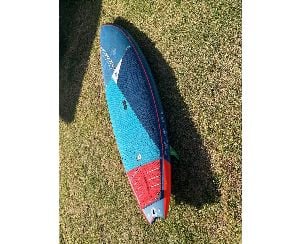
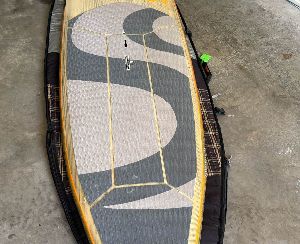
 Image supplied by justinstuart
Equipment Check Before You Launch
Before stepping onto the water, take two minutes to confirm your setup is correct. A poorly sized paddle is one of the most common causes of bad technique and unnecessary fatigue.
- Paddle length: For flat-water touring and fitness paddling, your paddle should reach approximately 15-20 cm (6-8 inches) above your head when you stand the blade on the ground beside you. This is the standard sizing guide used by ISA-certified instructors worldwide.
- Blade orientation: The blade should angle forward - away from you - when you paddle. The concave power face is the side that catches and drives through the water. A reversed blade is among the most common beginner errors and will feel immediately wrong once you have tried it correctly.
- Leash: Always attach a leash to your ankle for flat water. Your board is your primary flotation device if you fall.
- Fin setup: For flat water, a single centre fin provides the best directional tracking. Check it is locked securely before launching.
Getting Your Stance Right
Your feet are the foundation of every stroke. Poor foot placement undermines everything else you do on the board.
- Stand with your feet parallel, roughly shoulder-width apart, centred over the board's carry handle (the mid-point of the board).
- Keep your knees slightly bent - never locked. Soft knees act as a natural shock absorber and lower your centre of gravity.
- Keep your back straight and your gaze on the horizon, not looking down at the deck. Looking down shifts your weight forward and destabilises the board immediately.
- Your toes should point forward, parallel to the stringer. Avoid a surf-style angled stance when paddling on flat water - a parallel stance allows full hip rotation, which is the primary engine of an efficient forward stroke.
The Forward Stroke: Step by Step
The forward stroke has four distinct phases. Working through each one carefully is the key to efficient, powerful, and injury-free paddling.
Step 1 - The Setup and Grip
Hold the paddle with your top hand gripping the T-bar handle and your bottom hand around the shaft, arms roughly 60-70 cm apart. When paddling on the right side, your left hand goes on top of the T-bar.
This is counter-intuitive for many beginners - your top hand is always on the opposite side to where you are paddling. Getting this wrong is one of the most common errors in a first session.
As you prepare for the stroke, rotate your top shoulder forward to maximise your reach. This is not an arm movement - it is driven by hip and shoulder rotation that engages your core.
The ISA coaching framework consistently emphasises that core rotation, not arm strength, is the fundamental source of power in an efficient SUP stroke.
Step 2 - The Catch
Extend the paddle forward and plant the entire blade fully into the water approximately 50-70 cm ahead of your feet. A common mistake is beginning to pull before the blade is fully submerged - this wastes energy and dramatically reduces propulsive power.
Get the whole blade in first, then pull.
At the moment of entry, your paddle shaft should be as close to vertical as possible - approximately 60 degrees from horizontal when viewed from the side.
A shaft angled sharply away from vertical causes the stroke to push the nose of the board sideways rather than driving it forward. This forces you to take constant correction strokes and wastes significant energy.
Most SUP paddles have approximately 10 degrees of built-in blade offset from the shaft - this is by design and optimises the power face angle at the catch.
Step 3 - The Power Phase
Rather than pulling the paddle backward through the water, think of it as pulling yourself past a fixed point. The paddle is anchored in the water; the board moves forward past it.
This mental shift, advocated by Seychelle Webster in her coaching clinics, immediately improves stroke efficiency for most beginners.
Drive the stroke by unwinding your core and shoulders - your top hand pushes down and forward, and your bottom arm stays relatively straight. The power comes from your back, core, and legs, not your biceps.
Keep the blade close to the rail of the board throughout the power phase - a paddle that sweeps wide turns the board rather than drives it forward and will require a correction stroke on the following side.
Step 4 - The Exit
Release the blade from the water when it reaches your feet - no further back. Once the blade passes your feet it enters a negative angle, where it begins to lift the tail of the board rather than driving it forward.
According to technical analysis from Paddle Monster, one of the leading SUP coaching platforms, elite paddlers deliberately exit early and prioritise a fast, clean recovery over a long, inefficient follow-through.
Exit the blade with a slight outward flick led by the knuckles of your bottom hand, and smoothly recover forward for the next catch.
Switching Sides
On flat water, most beginners need to switch paddling sides every 4-6 strokes to maintain a straight course.
As technique improves and core rotation generates a more vertical, on-rail stroke, you will find you can complete more strokes per side before the board yaws off course significantly.
To switch sides, simply release your top-hand grip, slide it down the shaft, and bring your other hand up to the T-bar - the whole transition takes less than a second. There is no need to pause or lose momentum between strokes.
Common Mistakes to Avoid
- Bent top arm: Your top arm should stay straight and firm, acting as a lever. A bent top arm collapses power transfer and places unnecessary strain on the shoulder joint.
- Paddling with arms only: The biggest power source is your core. If your hips and shoulders are not rotating with each stroke, you are using only a fraction of your available strength and will fatigue far more quickly.
- Blade facing the wrong way: Double-check before every session. The angled, concave power face points away from you - toward the nose of the board.
- Stroke too long: Extending the stroke well behind your feet feels powerful but is mechanically inefficient. A shorter, slightly faster stroke rate delivers more speed with less effort and is far easier on the lower back.
- Looking down at the board: Fix your gaze on a point on the horizon. This keeps your posture upright, improves balance, and helps you paddle in a straight line naturally.
- Gripping too hard: A relaxed grip reduces forearm fatigue and improves your feel for blade angle in the water. Hold the shaft firmly but not with white-knuckle tension.
The Insight Most Beginners Never Hear
Here is a non-obvious truth about flat-water SUP that most beginners are never told: your paddle is also your primary balance tool. Many new paddlers treat the paddle purely as a propulsion device and panic when the board wobbles beneath them.
In reality, placing the flat of the blade lightly on the water surface - a technique called a low brace - instantly stabilises the board. The water surface supports the blade; the blade supports you.
Before you focus on stroke power or speed, get comfortable using the paddle as a third point of contact with the water. This single habit will transform your confidence and dramatically reduce falls in your first several sessions on the water.
Build Consistency Before Chasing Speed
In your first sessions, prioritise technique over power. Paddle at 60-70 percent effort, focusing on a clean catch, full core rotation, and an early blade exit.
A smooth, relaxed 20-stroke rhythm at moderate intensity will teach your body the correct movement pattern far faster than paddling at full effort.
As the ISA notes in its SUP education framework, the fundamentals of the forward stroke - vertical shaft at catch, full blade immersion, core-driven power, and early exit - remain identical whether you are a recreational paddler on a lake or competing at the APP World Tour level.
Get them right from the start, and every aspect of your paddling will improve quickly and naturally from there.


 Twin Waters, QLD