

The problem , Chris, is there seems to be a big shark out there everyday nowadays. Does this mean we should always stay out of the water?
Nobody made a call to "cull them all'. I certainly dont agree with that, and I personally believe they have an integral part in the marine ecosystem.
There seems to be heaps more GW s sightings in coastal areas which suggest that there numbers are increasing. I suspect that this is due to their protected species status.
Gill nets are used successfully in some other countries by reducing shark numbers, though they do have uneccessary bycatch.
I personally think that the only option we have here is using baited drumlines or taking an active approach in destroying large sharks(when sighted) in close proximity to our beaches, though the latter would be more expensive to do.
Also, would be interesting to know how many of you shark lovers out there have no qualms on pulling a dhufish or snapper from the bottom of the ocean.
Even note that one of you has photos boasting of their shark fishing prowess on their profile.
Select to expand quote
In recent years more people have been critically injured/ripped limb-for-limb and/or killed on blood thirsty, marauding dirt bikes at Wedge/Lancelin than all shark attacks around the entire country...
Use of motor vehicle carries an inherent risk (i.e. accidents occur anywhere in the World), and there are numerous initiatives and regulations to minimise the risk. Being ripped apart by a shark is not an inherent risk of surfing, swimming, snorkeling or crabbing. There are many places were one can partake in these activities with minimal or no risk from killer sharks. The risk of being killed by a shark in WA or Reunion is high due to external factors, namely the artificially high number of killer sharks in coastal waters. This risk is hence not inherent to the aquatic activities mentioned. Rather, it may have been forced upon us due to ill-conceived conservation policies.
Cull the whales and the shark sightings will diminish. (or possibly try and co-exist with nature)
Also I like your post chris except the sharks are always there. Just have a look how many appear when there's a whale carcass.
Select to expand quoteBeelzebub said...
In recent years more people have been critically injured/ripped limb-for-limb and/or killed on blood thirsty, marauding dirt bikes at Wedge/Lancelin than all shark attacks around the entire country...
Use of motor vehicle carries an inherent risk (i.e. accidents occur anywhere in the World), and there are numerous initiatives and regulations to minimise the risk. Being ripped apart by a shark is not an inherent risk of surfing, swimming, snorkeling or crabbing. There are many places were one can partake in these activities with minimal or no risk from killer sharks. The risk of being killed by a shark in WA or Reunion is high due to external factors, namely the artificially high number of killer sharks in coastal waters. This risk is hence not inherent to the aquatic activities mentioned. Rather, it may have been forced upon us due to ill-conceived conservation policies.
Surfing/diving/kayaking anywhere (except a wave pool) does carry an inherent risk of shark attack, stingers, coral cuts and infection, drowning, hypothermia, the individual weighs up those risks with any activity, likewise with dirt bike riding, driving a car, sky-diving, getting married...
You can reduce the inherent risk of a GWS attack by killing off some of them but the only way to actually remove the inherent risk of a GWS attack is to cull them to extinction. Then you only have all the other species known to have attacked humans to worry about, if you cull the GWS you might as well actively target bull sharks too.

I can't help this.
Internet forums, a marvellous living example of the human social animal.
Shark attacks are a very low base rate event worldwide, let alone on the coast of Australia, or one part of the coast of Australia. Out of 6-7 Billion people, a few tens a year go down, give or take. Its very difficult to say there is an increase in sharks locally, or even shark attacks by sampling one particular year at one particular location. Shark attacks are emotive, they are easily recalled and vivid, so we all suffer availability bias in this discussion (en.wikipedia.org/wiki/Availability_heuristic). Recognise your own bias here (I do, flame me!).
Taking a few observations, drawing a conclusion, then on the basis of that conclusion deciding to systematically kill them, is exactly what stuffs up the planet in my opinion. Bloody humans, just leave it alone.
Should we kill all the snakes? Hippos? They dont choose to systematically go to war with us.
Sharks live in the water. If you're afraid, don't go in there. The next person might be less afraid, let them choose. But know that its one of the safer places we expose ourselves to daily. And I love toasters.
Killing all GWS over 2.5 meters would destroy the numbers to a critical level. a baby shark is 5 foot when born and they wouldn't be mature enough to breed at 2.5m
Why are people so surprised a boat throwing dead fish in the water as bait attracts a shark. yes there may be more sharks in WA now than 20 years ago. but it could also be that with everyone having a camera and all the video footage that we are just hearing about it more.
Humans- the most intelligent and advanced creatures on the Earth- are responsiblefor the wellbeing of our planet. Why? Humans have caused the extinction of thousands of species of animal and polluted it with poisonous fumes and littered it with their unwantedgoods.
I think we should all get our pitch forks and head to the beach. We should organise ourselves, maybe wear a uniform. I was thinking to make things easier we could just use white sheets, everyone has those. we could fashion pointy hats that cover our faces too.
The apparent increase in Human and Shark related interactions in Western Australia needs to be considered carefully before action is taken. More data on the effects on the food chain by human fishing is needed, if you take away any animal's food supply you force it to seek out alternatives! Beach netting is hugely expensive, offers no guarantees and captures and drowns many unrelated species. Sea pools are costly to build and maintain and only offer a small percentage of people an answer to bathing in and enjoying the sea, most people would not use them. Tagging offers good data about shark movements but is very a long term project. Sea temperature changes need to be considered, how and do they relate to more shark sightings in our coastal waters? Humans have been culling Sharks for years; this practise has to be looked at in depth for the long term effects. The culling of large Sharks offers no realistic answers to the problem of Shark attack and is only an “eye for an eye” knee jerk approach to the problem.
Pete
www.gyropatrol.com.au
For up to date Shark sightings check out www.sharkalarm.com.au you can report any sightings here to, be informed and be safer
To the people who keep harping on about us nasty humans 'taking away the shark's food supply'.
Apparently and evidently all of the recent shark sightings and attacks have involved some big suckers of sharks.
As was mentioned in another one (of many) shark threads on this site- sharks of the recently reported sizes, target marine mammals as their primary food source.
Wikipedia and other information sites across the web backs this up.
So let's get specific with your claims; are you complaining about the whaling practices of the Japanese taking away the poor shark's food supply?
It can't be that you're complaining about us over fishing the seal population, as they are currently thriving and expanding.
Possibly you mean that the declining population of the poor overfished Dhufish is forcing the sharkies to add us to the menu?
Instead of latching onto a baseless claim, think about what you are saying instead of just towing a line.
Why the hell would a shark or sharks hang around in an area virtually barren of food for so long and only occaisionally take a bite of some unfortunate water user?
If the food situation was so dire for them shouldn't we expect them to be munching people everyday?
Especially since there have been so many sightings lately?
I agree that food is actually plentiful for them, they're cruising around enjoying the buffet, unfortunately our water usage overlaps their food cruising, we get mistaken and get chomped.
I don't believe that they don't like to eat us, a meal is a meal.
We drive cars and know the risk, but the risk is a managed risk.
Some of us participate in extreme and 'extreme' sports/activities, but they are also managed risks.
Not enough risk management is being done for the shark problem.
I've always been very anti culling of any animal. But the question has to be put out there, how many of these attacks are repeat offenses by one shark? I mean if one attacks people more than once I can see it as being justifiable to kill that shark.
If a dog attacks and kills a kid I am fairly certain it would be getting put down soon after.
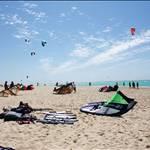
from a very limited experience with sharks with boat, beach fishing,spear fishing, suping and kitesurfing i have found they follow the food sources . seen myself and heard from other boaters of gw's being a hundred meter from shore hunting the pink snapper schools, in summer when the southern salmon run its not uncommon to see 2 or 3 bronzies over the summer period while on the water with supping or kitesurfing. once the salmon have moved on so seem to have the bronzies and same with the gw's regarding the pinkies, at least from a visual basis as im sure both sharks are further out around islands going for the cubs and calves.
few questions that would be interesting to be answered regarding the shark attack areas
are these spots gw migration area's
are these locations known to have high levels of commercial and recreational fishing and/or low levels of fish stock.
are many other breeds of sharks spotted along the coast. bulls, tigers or bronzies?
i think bulls prefer places like the swan river, estuaries?
bronzes from my experience prefer the deep holes along the beach created by beach breaks (at least with the salmon in summer they do)
are tigers more a reef shark? (btw i have seen a tigershark as far down south as esperance in summer and my guess is its followed the tropical water fish down here - which has been fantastic to fish but unsual to have this far south)
are the places also known to have a higher number of human activity. more chance of being in wrong place at wrong time if more times and more people in the water higher the probability of an attack.
the last question is, localized conditions at time of attacks, overcast, murky water, at sunset or sunrise etcetera.
my guess is none of the answers to the questions offer to a solution to protecting water users at least over the short time frame, killing sharks would at least make it seem to have helped to reduce a chance of being attacked by reducing their numbers, but the underlying reasons may still be there.
i wouldn't rule out a rouge shark if sharks are as intelligent as some say - as it happens with lions (apparently) that conclude we are an easy meal then i wouldn't rule it out as having watched too many jaw reruns..
tracking the sharks could be a way to find out if sharks can turn rouge.
^^^'rouge' sharks are much easier to see, especially in clear blue water. it's the rogue ones you need to worry about.
2010-2011 there were 61 coastal drownings in Australia. 9 of which were in WA.
Bet there's less this year - just because more people will be afraid of the water and stick to the shallows or swimming pools.
Sharks - saving lives every time they appear on the news.
Very entertaining and passionate discussion. I'm torn between the point of view of culling and leaving them alone and taking the chances. But I'm not surfing much at the moment. I'm also staying well away from local breaks (which are pumping at the moment) where there have been attacks lately.
Is it possible to somehow condition the sharks to not attack humans, like the Pavlov's dog experiments. It seems that somethings changed and they now don't mind attacking us, as recent events would prove.
What if scientists or fisheries could start wiring up electricity to mannequins on surfboards in areas where the attacks are happening and zapp the **** of the gws when they bite them, until they learn to stop biting us? The GWS do the same circuit so it seems so it may well be the same bunch of sharks having a chomp on us.
Or a line of shark pod type buoys that surround popular surfing breaks to make an electrical type field that keeps the gws away from the area?
I know these sound and may well be stupid and impossible ideas. But I think we need to start thinking outside the square and trialling something, rather than going back to the old "culling" idea straight away. Or no we need more research first.
No we need a solution. Fast.
Surely this can all be avoided! There are some smart dudes out there, why doesn't a bunch of them get together and find a big fish deterrent that is proven to work and turn themselves into millionaires. Ive heard mixed reports from the ones available, "we" humans can do some amazing things, surely this is not out of reach??
I used to be terrified by the idea of a shark in the water with me, but then I started kiting and i tought "bugger it, it's worth it" and stopped thinking about it (even because my usual spot is botany bay, and I think there hasn't been a dangerous shark in there in decades... )
but still...
if I'm discussing theoretically I'd say "well, sure, 10, 20 people out of 7 billions don't justify killing a huge number of sharks, or culling a species". But if I'm in the water, and I see a fin coming close to me and I have the option, be sure I'd slaughter every damn shark in the planet, while their little shark kids are watching.
baically the point I'm making is "yeah, I do understand the good and sound reason behind the not killing of the sharks, and I agree with them. I do understand that 10 people a year can die because they are in the ocean and **** happens. 10 people I don't know nor care about, and especially 10 people that aren't me."
So yeah, if there was some kind of shotgun add for my harness I'd definitely buy it, but until the day we can actually do something practical, just kite/surf/dive/swim and hope that today won't be your last day.
Don't get too comfy in Botany Bay Silence - talk to some of the sail boarders whose runs go out towards the runways - and the divers at la Perouse - there are some big sharks in Botany bay. Like most places around our coast - they are always there - it's just rare for them to feed on us - cause we're not their natural prey.
The other thing to keep in mind re seeing fins and carrying weapons etc - these bad boys are predators. They have evolved to use stealth and surprise as their modus operandi - if you see one you're safe. If one's gonna eat you - then you won't know a thing about it till it's taken its first bite!
I kite off Perth's beaches and often go 1km or so off shore. They scare the hell out of me but what can you do. You stay out of the water if you don't want to risk it - but if you choose to go in you gotta know that it's always possible. It would be a grusome way to go - but hey, you have to balance the risk and the reward.
this cheeky white circled our boat off dunsborough last week for about 10 minutes, he was pretty cruisy!! i can safely say half the sightings don't get even get publicised, i live down south and heaps of my mates sighted whites last summer and never made the news.. its the 2nd one I've seen, this year.. first was a whopper when kiting!!
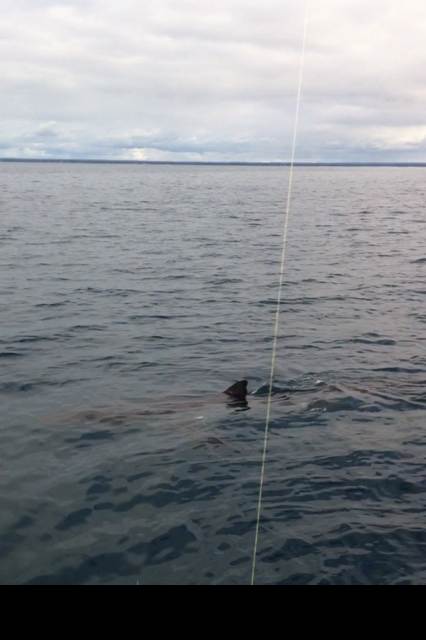
So shark numbers are up. Whale numbers up. Dhufish... well two out of three isn't too bad.
The optimist in me wants to look at this another way - the
GWS was protected a while back because they were seriously low in numbers. Now they appear to be doing a bit better, so great work marine conservationists!
If the highly endangered sumatran tiger suddenly started to recover and grow in population, we'd probably all think that was a good thing. Perhaps the local Sumatran villagers wouldn't all agree though.
We, the ocean loving residents of WA, are just Sumatran villagers in this case. Except unlike the villagers we have the option of exposing ourselves to the risks that sharks pose to us. We chose to play in the ocean, and we chose the consequences of that. Perhaps now the risk is a little higher, but it is still a risk we have the option of accepting.
Accept it, go for surf. Have fun.