

VHF Radio on the Water: Channels and Calls

Quick summary
A VHF marine radio is required safety equipment for any vessel going beyond sheltered waters - and operating one in Australian waters requires a qualification under ACMA rules.
Channel 16 is the single most important habit: it is the international distress, safety and calling channel and should be monitored at all times when underway.
The how-to
After reading this, you can set up your radio correctly, use the right channel for each situation, make a Mayday call under pressure, and register your MMSI for automatic distress response.
A VHF marine radio is the most direct link between you and help when something goes wrong offshore.
A 406 MHz EPIRB will locate you - eventually.
A flare might be spotted - if conditions allow.
A VHF radio on Channel 16 connects you instantly to Marine Rescue, other vessels in your area, and every commercial ship within range.
The licence requirement you need to know first
Operating a VHF marine radio within 12 nautical miles of the Australian coast requires the Australian Waters Qualification (AWQ), or to be supervised by someone who holds it.
The AWQ - formally the MARC059 unit - is available from registered training organisations around Australia.
The radio itself does not need to be licensed with ACMA (the Australian Communications and Media Authority).
The operator does.
If you operate a VHF radio without the AWQ, you may be breaching the Radiocommunications Act 1992.
Courses typically run a few hours and can be completed online through providers accredited by ACMA.
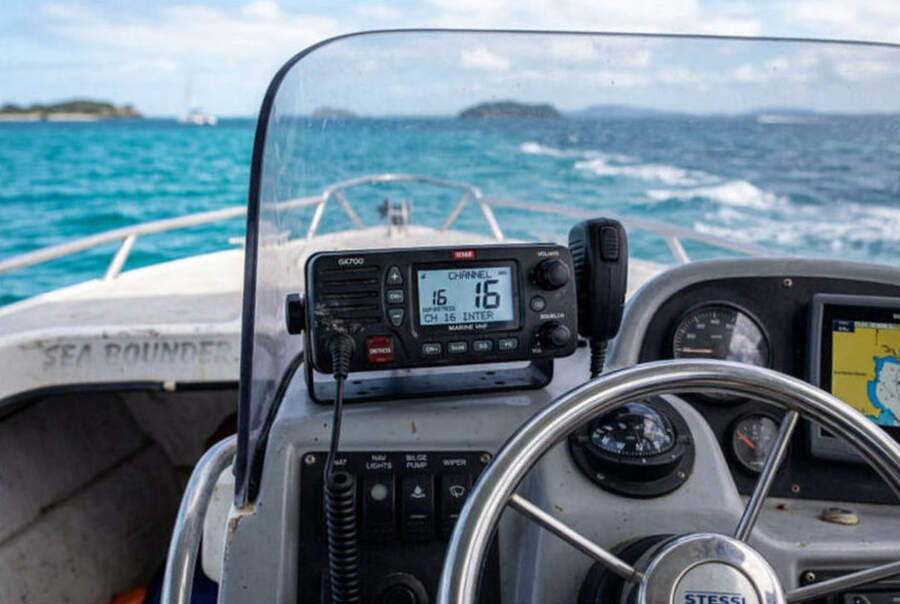
Channel 16 is the single channel that all vessels, commercial and recreational, are required to monitor. It is also the channel every rescue authority is listening to right now.
The channels and what they're for
Channel 16 - distress, safety and calling: this is the one channel you must always monitor when underway.
It is the international distress channel.
Make your initial call to any vessel or shore station on Ch16, then agree on a working channel and switch.
Never block Ch16 with non-emergency conversation.
Channel 67 - recreational working channel: after making contact on Ch16, Australian recreational boaters typically switch to Ch67 for skipper-to-skipper communication.
This is the channel to use for marina berth inquiries, vessel-to-vessel coordination, or checking local conditions with a nearby skipper.
Channel 70 - DSC digital only: Channel 70 carries no voice at all.
It is dedicated exclusively to Digital Selective Calling (DSC) distress and calling functions.
Transmitting voice on Channel 70 is an international maritime offence.
Channel 73 - Marine Rescue shore stations: when logging on or logging off in NSW, use Ch73 to contact a Marine Rescue shore station.
Marine Rescue NSW monitors Ch73 along the NSW coast around the clock.
Channels 72 and 77 - ship-to-ship working: these are used for vessel-to-vessel communications in Australian waters where Ch67 is already busy.
27 MHz Channel 88 - legacy distress only: if your vessel still runs a 27 MHz set, Ch88 remains the distress channel.
27 MHz equipment will not be compliant from 1 September 2028.
If you are still running 27 MHz, start budgeting for VHF.
Making a Mayday call
When life is at risk - vessel sinking, fire aboard, medical emergency - the Mayday call on Ch16 is your fastest path to organised rescue.
The procedure is standard across all Australian state and territory authorities and will be recognised by any rescue service or passing vessel.
Step 1: switch to Channel 16 and press transmit.
Step 2: say "Mayday, Mayday, Mayday".
Step 3: say "This is [vessel name], [vessel name], [vessel name]".
Step 4: say "Mayday, [vessel name]".
Step 5: give your position - GPS coordinates if available, or your best description (bearing and distance from a known landmark, or the last known waypoint).
Step 6: describe the emergency: sinking, fire, medical, person overboard.
Step 7: state the number of persons on board.
Step 8: activate your EPIRB.
Speak slowly and clearly.
If you get no response after three attempts, repeat the call.
The pressure of an emergency makes people rush.
Practise the call sequence out loud before you need it.
DSC - the digital game changer
Most current VHF radios include DSC (Digital Selective Calling) on Channel 70.
A DSC-equipped radio paired with your GPS lets you press a single button to send an automated distress signal that includes your vessel's MMSI number, your GPS position, and a time stamp.
Rescue authorities receive this data instantly, without you speaking a single word.
The catch: you must register your MMSI with AMSA's emergency database for the system to work as intended.
Registering takes under ten minutes and is free.
Without registration, a DSC distress call reaches rescue authorities as an anonymous alert - no vessel name, no home port, no emergency contact.
With registration, it delivers your full vessel profile automatically.
Register at the AMSA website under the MMSI registration service.
Logging on: the habit that saves lives
Logging on when you depart and logging off when you return is the single most underused VHF function among recreational boaters.
Marine Rescue NSW monitors log-on departures and will initiate a search if a vessel fails to log off or check in by its planned return time.
The process is straightforward: contact the nearest Marine Rescue shore station on Ch73, give your vessel name, departure point, destination, expected return time, and number of persons on board.
That single radio call means there is someone on shore who knows where you are and will act if you do not return.
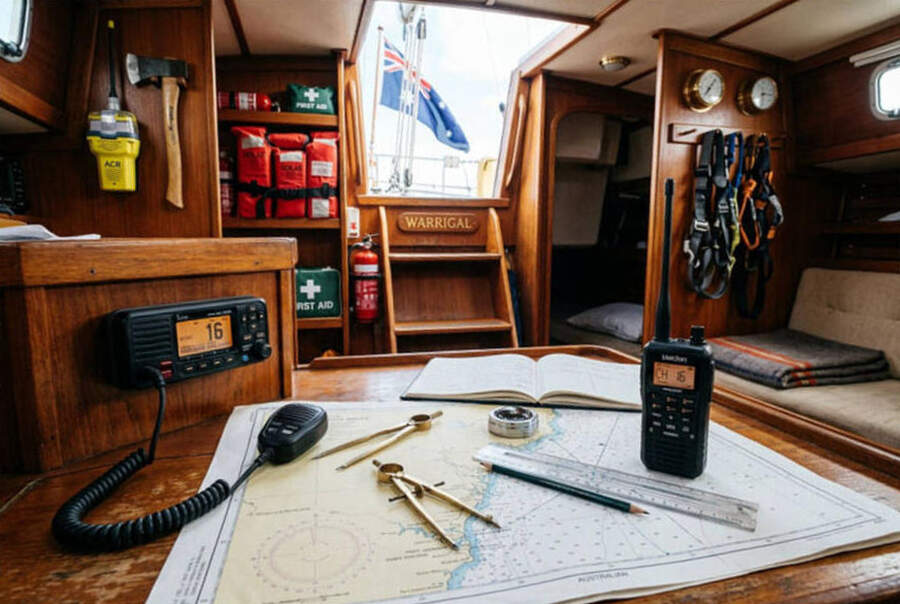
Common mistakes to fix before your next trip
Squelch set too high: if your squelch is cranked right up, you may be blocking out weak but genuine distress calls from nearby vessels.
Set squelch to just above the static threshold, not at maximum.
Only turning on the radio in an emergency: a radio not in receive mode hears nothing.
Turn it on, switch to Ch16, and leave it on for the entire trip.
No MMSI registration: the DSC button on your radio is only as good as the MMSI number linked behind it.
Register the number and check it is correct in your radio's settings.
Using 27 MHz as primary: VHF has longer range, clearer audio, and the DSC capability that 27 MHz cannot provide.
If you have both, use VHF as primary and 27 MHz as backup only.
Questions to answer before your next trip
Does every person aboard know where the radio is and how to make a Mayday call? The skipper is often first to be incapacitated in a serious incident. Your crew needs to know this without being prompted.
Do you have your AWQ? If not, check ACMA-registered RTOs for an online course. Most complete in a half-day and are recognised nationally.
Is your MMSI registered? Check at the AMSA maritime communications page before your next departure.
Does your radio's GPS feed work? A DSC distress call with no GPS fix is still far better than no call at all - but a linked GPS is the full picture. Test the connection before you leave the marina.
Check your VHF setup and log on via Seabreeze warnings before every departure - conditions can change faster than a forecast suggests.




 Mermaid Waters, QLD


 Windsurfing